ClinicaPublication

Home › Books › DrNB Neurosurgery › Previous-year questions

Previous-year questions · June 2020 to April 2026

DrNB Neurosurgery previous-year questions (2020–2026)

The complete DrNB Neurosurgery solved question set part by part, with 44 previous-year questions in their exact exam wording and full solved answers you can read free.

Most-asked DrNB Neurosurgery questions

  1. Epilepsy surgery and drug-resistant epilepsy 16×Asked 16 times across the 12 sessions
  2. Intracranial aneurysm — surgery and endovascular treatment 11×Asked 11 times across the 12 sessions
  3. Newer antiepileptic drugs, phenytoin and valproate 10×Asked 10 times across the 12 sessions
  4. Ventriculoperitoneal shunt and shunt complications 10×Asked 10 times across the 12 sessions
  5. Arteriovenous malformation, cerebral and spinal 9×Asked 9 times across the 12 sessions
  6. Carpal tunnel and entrapment neuropathies 9×Asked 9 times across the 12 sessions
  7. Hydrocephalus — classification and management 9×Asked 9 times across the 12 sessions
  8. Skull base approaches (Kawase, petrous apex, keyhole) 9×Asked 9 times across the 12 sessions
  9. Craniosynostosis, syndromic and non-syndromic 8×Asked 8 times across the 12 sessions
  10. Craniovertebral junction anomaly and basilar invagination 8×Asked 8 times across the 12 sessions
  11. Internuclear ophthalmoplegia and brainstem syndromes 8×Asked 8 times across the 12 sessions
  12. Optic nerve, chiasma and visual field defects 8×Asked 8 times across the 12 sessions

The DrNB Neurosurgery question set, part by part

Every previous-year question is answered in one of these 21 parts. Parts marked “free answers” have solved answers in the free sample.

Volume I — Anatomy, Physiology, Trauma, Tumours, Hydrocephalus and Aneurysms173 answers
  • Part 1 · Neuroanatomy & Applied Anatomy free answers
  • Part 2 · Neurophysiology, ICP & Cerebral Blood Flow
  • Part 3 · Head Injury & Neurotrauma free answers
  • Part 4 · Craniovertebral Junction & Spinal Trauma
  • Part 5 · Neuro-Oncology: Gliomas, Intra-axial Tumours & Neuropathology
  • Part 6 · Skull Base, Meningioma & Orbital Lesions
  • Part 7 · Sellar, Suprasellar & Pituitary Region
  • Part 8 · Ventricular, Pineal & Posterior Fossa Lesions
  • Part 9 · Hydrocephalus, Shunts & CSF Disorders
  • Part 10 · Cerebrovascular I: Aneurysms & Subarachnoid Haemorrhage
Volume II — Vascular, Paediatric, Spine, Infection, Functional, Peripheral Nerve, Technology and Critical Care177 answers
  • Part 11 · Cerebrovascular II: AVM, Fistulae, Stroke & Venous Disease free answers
  • Part 12 · Paediatric Neurosurgery & Craniofacial Anomalies
  • Part 13 · Spinal Dysraphism & Congenital Anomalies
  • Part 14 · Spine: Degenerative Disease, Spinal Tumours & Spinal Surgery
  • Part 15 · Neuro-Infections
  • Part 16 · Functional Neurosurgery, Epilepsy, Pain & Movement Disorders free answers
  • Part 17 · Peripheral Nerve & Brachial Plexus
  • Part 18 · Neuroimaging, Neuromonitoring, Instruments & Technology
  • Part 19 · Radiosurgery & Radiation in Neurosurgery
  • Part 20 · Neuro-Critical Care, Neuro-Anaesthesia & Pharmacology
  • Part 21 · Brain Death, Ethics, Research Methodology & History of Neurosurgery
DrNB Neurosurgery previous-year questions with free solved answers

Each question shows the exam wording, the session, paper and question number, and how often it was asked. The full answers are in the free sample.

Volume I · Part 1 · Neuroanatomy & Applied Anatomy13 questions
  1. Internuclear Ophthalmoplegia & Brainstem Syndromes 1×Apr 2023 · Paper III · Q2

    “Draw a labelled diagram of transverse section of the upper midbrain.”

    “Parinaud's syndrome and its clinical correlates.”

    “Aqueductoplasty.”

  2. Internuclear Ophthalmoplegia & Brainstem Syndromes 1×Oct 2023 · Paper I · Q4

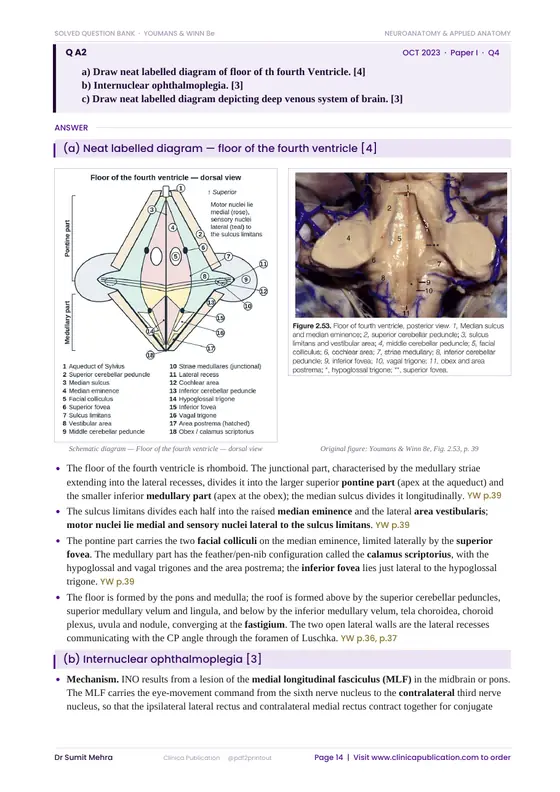
    “Draw neat labelled diagram of floor of th fourth Ventricle.”

    “Internuclear ophthalmoplegia.”

    “Draw neat labelled diagram depicting deep venous system of brain.”

  3. Internuclear Ophthalmoplegia & Brainstem Syndromes 1×Oct 2023 · Paper II · Q3

    “Draw neat labelled diagrams of safe entry zones of brainstem.”

    “Brain stem auditory evoked potential monitoring.”

  4. Internuclear Ophthalmoplegia & Brainstem Syndromes 1×May 2024 · Paper I · Q4

    “Internuclear ophthalmoplegia.”

    “Draw axial section of midbrain at level of tectum.”

    “Clinical features of intrinsic brain stem lesions.”

  5. Internuclear Ophthalmoplegia & Brainstem Syndromes 1×Oct 2025 · Paper I · Q2

    “Internuclear ophthalmoplegia:”

    “Provide anatomical localization with diagram.”

    “Clinical examination technique.”

    “Discuss associated syndromes.”

  6. Internuclear Ophthalmoplegia & Brainstem Syndromes 1×Apr 2026 · Paper I · Q3

    “Surgical anatomy of MLF.”

    “Draw coronal section of midbrain at superior colliculus level.”

  7. Horner's Syndrome & Sympathetic Pathway 1×Jun 2020 · Paper II · Q5 (10 marks)

    “Elaborate Horner’s syndrome:”

    “Clinical features.”

    “Causes.”

    “Pathway of sympathetic system.”

  8. Horner's Syndrome & Sympathetic Pathway 1×Dec 2021 · Paper II · Q5

    “Horner’s syndrome.”

    “Complications of endoscopic third ventriculostomy (ETV).”

  9. Horner's Syndrome & Sympathetic Pathway 1×Dec 2022 · Paper II · Q4

    “Various autonomic Nuclei of the Cranial nerves.”

    “Sympathetic outflow - Anatomy and its supply.”

  10. Horner's Syndrome & Sympathetic Pathway 1×Jan 2025 · Paper II · Q2

    “Horner syndrome.”

    “Craniosacral outflow.”

  11. Spinal Cord Blood Supply / Artery of Adamkiewicz 1×Jun 2020 · Paper I · Q7 (10 marks)

    “Ligamentum denticulatum.”

    “Blood supply of spinal cord.”

    “Conus medullaris.”

  12. Spinal Cord Blood Supply / Artery of Adamkiewicz 1×Dec 2021 · Paper I · Q3

    “Blood supply of spinal cord.”

    “Visual evoked potential (VEP).”

  13. Spinal Cord Blood Supply / Artery of Adamkiewicz 1×Jun 2022 · Paper II · Q1

    “Branches of internal carotid artery.”

    “Parts of internal carotid artery.”

    “Parts and branches of posterior cerebral artery.”

    “Artery of Adamkiewicz and its surgical importance.”

Volume I · Part 3 · Head Injury & Neurotrauma8 questions
  1. Chronic & Acute Subdural Haematoma 1×Jun 2021 · Paper II · Q10

    “Management of:”

    “Chronic subdural hematoma.”

    “Normal pressure hydrocephalus.”

    “Cerebral metastasis.”

  2. Chronic & Acute Subdural Haematoma 1×Dec 2021 · Paper I · Q5

    “Chronic subdural hematoma:”

    “Clinical features.”

    “Pathology.”

    “Management.”

  3. Chronic & Acute Subdural Haematoma 1×Apr 2023 · Paper I · Q5

    “Describe the GCS scale and its fallacies.”

    “Pathogenesis and treatment of acute subdural hematoma.”

  4. Chronic & Acute Subdural Haematoma 1×May 2024 · Paper II · Q2

    “Components of Prothrombin citrate complex and treatment dosages for spontaneous intracranial bleed (PCC).”

    “Management of chronic subdural hematoma patient on DAPT (dual antiplatelet drugs).”

    “Hemostatic agents in neurosurgery.”

  5. Chronic & Acute Subdural Haematoma 1×May 2024 · Paper III · Q8

    “Management of an 85 year old male patient with severe traumatic brain injury presenting with GCS score 7/15, Blood pressure 180/60mmHg and Pulse rate 65/min.”

    “Frailty index in elderly.”

    “Role of middle meningeal artery embolisation in chronic subdural hematomas.”

  6. Diffuse Axonal Injury / Traumatic Axonal Injury 1×Jun 2020 · Paper I · Q8 (10 marks)

    “About Traumatic brain injury:”

    “Discuss pathogenesis and pathology of axonal injury.”

    “Classification of diffuse axonal injury.”

  7. Diffuse Axonal Injury / Traumatic Axonal Injury 1×Dec 2020 · Paper I · Q3 (10 marks)

    “Pathogenesis and pathology of traumatic axonal injury.”

    “How DAI is graded?”

  8. Diffuse Axonal Injury / Traumatic Axonal Injury 1×Dec 2021 · Paper I · Q8

    “Traumatic diffuse axonal brain injury:”

    “Pathology.”

    “Radiological features.”

    “Management.”

Volume II · Part 11 · Cerebrovascular II: AVM, Fistulae, Stroke & Venous Disease13 questions
  1. Arteriovenous Malformation (cerebral & spinal) 1×Jun 2020 · Paper II · Q4 (10 marks)

    “Spinal AVM:”

    “Classification.”

    “Clinical presentations.”

    “Angiographic finding.”

  2. Arteriovenous Malformation (cerebral & spinal) 1×Apr 2023 · Paper II · Q6

    “Clinical presentations of cerebral AVMs.”

    “Molecular biology and genetics of AVMs.”

    “Classification of AVM.”

  3. Arteriovenous Malformation (cerebral & spinal) 1×Oct 2023 · Paper II · Q9

    “Clinical manifestations of spinal AVMs.”

    “Spinal AVMs classification.”

    “Spinal arachnoiditis - radiology and treatment.”

  4. Arteriovenous Malformation (cerebral & spinal) 1×May 2024 · Paper III · Q10

    “Please see the imaging study carried out in a 15-year-old female patient presenting to the emergency in an unconscious status after initial headache. Discuss briefly:”

    “Radiological findings.”

    “Role of Gamma knife.”

    “Role of Endovascular therapies.”

    “Surgical nuances.”

    “Postoperative care.”

  5. Arteriovenous Malformation (cerebral & spinal) 1×Apr 2026 · Paper II · Q1 (10 marks)

    “Management of cerebral AVM-various gradings and treatment.”

  6. Moyamoya Disease & Revascularisation 1×Oct 2023 · Paper II · Q2

    “Differential diagnosis of young stroke.”

    “Various stages of Moya-Moya disease.”

    “Indirect Revascularization procedures.”

  7. Moyamoya Disease & Revascularisation 1×Oct 2025 · Paper III · Q8 (10 marks)

    “Moya moya disease: clinical presentation, pathophysiology, diagnostic work up and treatment options.”

  8. Carotico-Cavernous Fistula 1×Apr 2023 · Paper II · Q3

    “Management of:”

    “Carotico Cavernous Fistula (CCF).”

    “Orbital tumours.”

  9. Carotico-Cavernous Fistula 1×May 2024 · Paper II · Q8

    “Cavernous sinus:”

    “Draw a section of cavernous sinus showing cranial nerve and vascular structures passing through it.”

    “Classification and management of caroticocavernous fistula.”

  10. Further Topics in this Chapter 1×Dec 2020 · Paper II · Q10 (10 marks)

    “Spinal AV fistula’s: Classification and management.”

  11. Further Topics in this Chapter 1×Dec 2020 · Paper III · Q7 (10 marks)

    “Pathophysiology and clinical presentation of carotid artery dissection.”

    “Evaluation and management of vertebrobasilar artery dissection.”

  12. Further Topics in this Chapter 1×Jun 2021 · Paper II · Q1

    “Transverse sinus thrombosis:”

    “Aetio-pathogenesis.”

    “Diagnosis.”

    “Management.”

  13. Further Topics in this Chapter 1×Dec 2021 · Paper II · Q9

    “Vein of Galen malformation:”

    “Clinical features.”

    “Radiological features.”

    “Management.”

Volume II · Part 16 · Functional Neurosurgery, Epilepsy, Pain & Movement Disorders10 questions
  1. Epilepsy Surgery & Drug-Resistant Epilepsy 1×Dec 2020 · Paper III · Q3 (10 marks)

    “Pre-surgical evaluation & surgical approaches in Pediatric epilepsy.”

  2. Epilepsy Surgery & Drug-Resistant Epilepsy 1×Dec 2021 · Paper III · Q9

    “Drug resistant epilepsy:”

    “Preoperative evaluation.”

    “Surgical techniques for managing drug resistant epilepsy.”

  3. Epilepsy Surgery & Drug-Resistant Epilepsy 1×Jun 2022 · Paper II · Q7

    “Discuss focal cortical dysplasia classifications.”

    “Discuss diagnostic workup and management of FCDs.”

  4. Epilepsy Surgery & Drug-Resistant Epilepsy 1×Dec 2022 · Paper III · Q9

    “Newer anti epileptic drugs.”

    “Surgical management of epilepsy.”

  5. Epilepsy Surgery & Drug-Resistant Epilepsy 1×Oct 2023 · Paper III · Q3

    “Definition of intractable epilepsy.”

    “Symptomatic zone in epilepsy.”

    “Side effects of Levetiracetam.”

    “Types of hemispherectomy and indications.”

  6. Epilepsy Surgery & Drug-Resistant Epilepsy 1×Oct 2023 · Paper III · Q7

    “Magnetoencephalogram.”

    “Sterio EEG advantages.”

    “Callosotomy indications and its side effects.”

  7. Epilepsy Surgery & Drug-Resistant Epilepsy 1×May 2024 · Paper III · Q1

    “Deep Brain Stimulation in Epilepsy.”

    “Lesioning in neurosurgery.”

  8. Epilepsy Surgery & Drug-Resistant Epilepsy 1×May 2024 · Paper III · Q2

    “Focal cortical dysplasia classifications.”

    “Diagnostic work up of a suspected case of FCD.”

    “Treatment of FCD.”

  9. Epilepsy Surgery & Drug-Resistant Epilepsy 1×May 2024 · Paper III · Q6

    “Standard Temporal lobectomy.”

    “Selective amygdalohippocampectomy.”

    “Surgery for non-temporal epilepsy.”

    “Wada test.”

  10. Epilepsy Surgery & Drug-Resistant Epilepsy 1×Jan 2025 · Paper III · Q6

    “Vagal nerve stimulation.”

    “Types of epilepsy surgery.”

Read these answers free

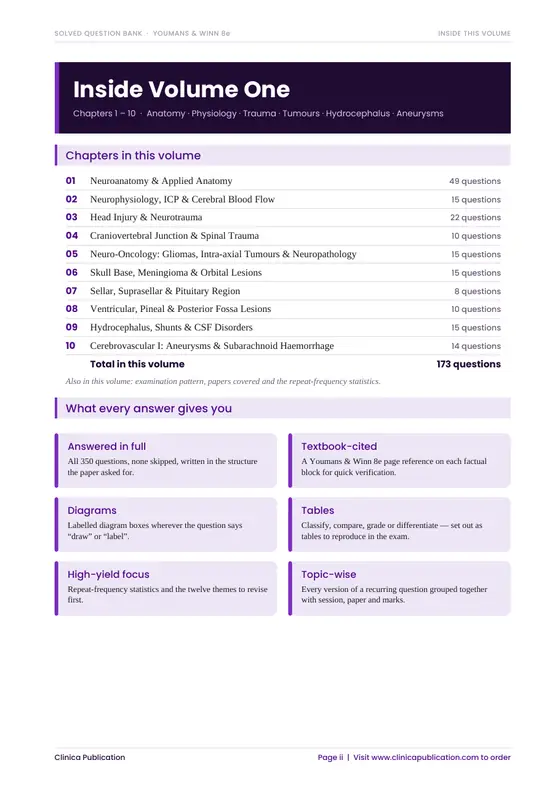
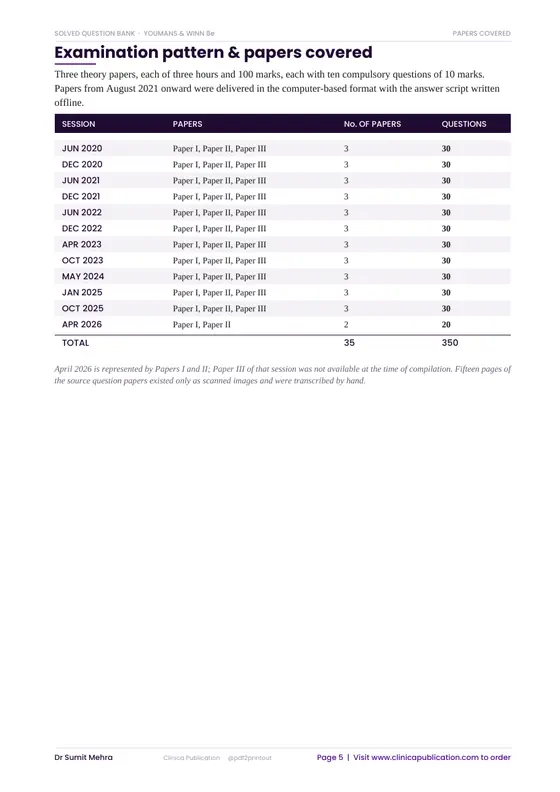
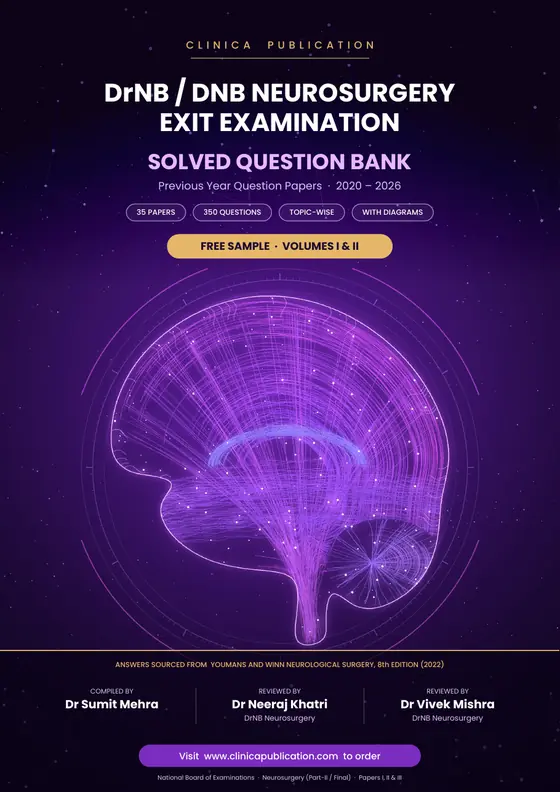
The free 100-page sample is taken straight from the printed DrNB Neurosurgery volumes, with the book's own page numbers. It contains:

  • The opening pages, contents of both volumes and the repeat-frequency statistics, including the twelve themes to revise first
  • Chapter 1 answers: brainstem anatomy, internuclear ophthalmoplegia and brainstem syndromes, with labelled diagrams
  • Chapter 3 answers: head injury and neurotrauma
  • Chapter 11 answers: AVMs, fistulae, stroke and venous disease
  • Chapter 16 answers: epilepsy surgery, drug-resistant epilepsy and functional neurosurgery
DrNB Neurosurgery free sample, page 1DrNB Neurosurgery free sample, page 4DrNB Neurosurgery free sample, page 7DrNB Neurosurgery free sample, page 13

Frequently asked questions

What does the DrNB Neurosurgery solved previous-year question set cover?

All 350 questions answered in two volumes across 21 parts in 2 volumes, from the June 2020 to April 2026 exit examinations. Repeated questions are answered once, with every paper and year in which they were asked.

Which textbooks are the DrNB Neurosurgery answers written from?

Youmans and Winn Neurological Surgery, 8th edition (2022), with the printed page cited on every factual block.

Can I read some answers before buying?

Yes. 44 complete answers are in the free 100-page sample: read the free sample (PDF). The questions they answer are listed on this page with the exact exam wording.

Where can I order the DrNB Neurosurgery book?

Order the printed set from the DrNB Neurosurgery book page. It is printed, bound and delivered anywhere in India.

Get every answer in print

DrNB Neurosurgery: all 350 questions answered in two volumes, printed, bound and delivered anywhere in India.

See the book