ClinicaPublication

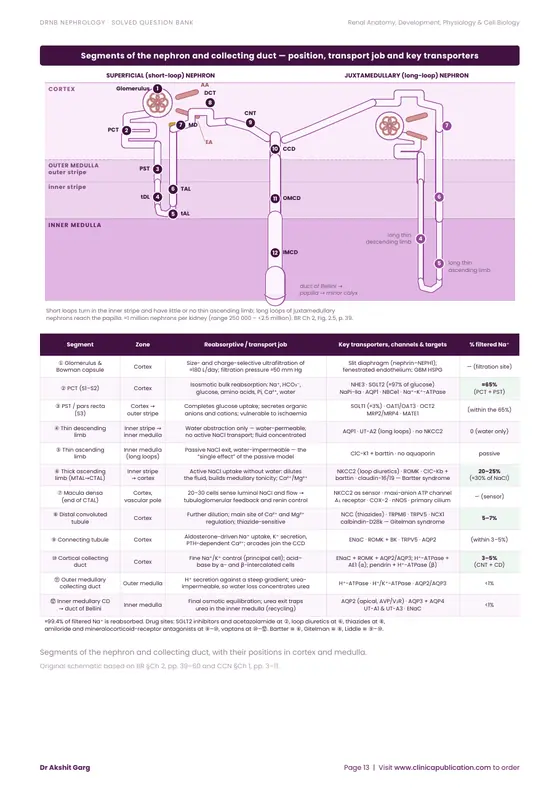
Home › Books › DrNB Nephrology › Previous-year questions

Previous-year questions · 2021 to 2026

DrNB Nephrology previous-year questions (2021–2026)

The complete DrNB Nephrology solved question set chapter by chapter, with 17 previous-year questions in their exact exam wording and full solved answers you can read free.

The DrNB Nephrology question set, chapter by chapter

Every previous-year question is answered in one of these 9 chapters. Chapters marked “free answers” have solved answers in the free sample.

Volume One — Chapters 1–9: physiology, electrolytes, acid–base, diagnostics, AKI, CKD, CKD–MBD, anaemia and glomerular disease66 topics · 137 questions
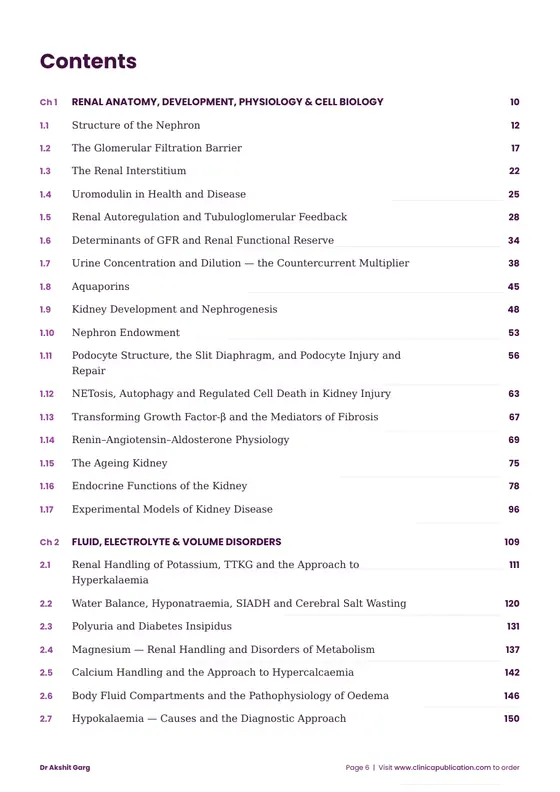
  • Chapter 1 · Renal Anatomy, Development, Physiology & Cell Biology free answers1.1 Structure of the Nephron · 1.2 The Glomerular Filtration Barrier · 1.3 The Renal Interstitium · 1.4 Uromodulin in Health and Disease · 1.5 Renal Autoregulation and Tubuloglomerular Feedback · 1.6 Determinants of GFR and Renal Functional Reserve · 1.7 Urine Concentration and Dilution — the Countercurrent Multiplier · 1.8 Aquaporins · 1.9 Kidney Development and Nephrogenesis · 1.10 Nephron Endowment · 1.11 Podocyte Structure, the Slit Diaphragm, and Podocyte Injury and Repair · 1.12 NETosis, Autophagy and Regulated Cell Death in Kidney Injury · 1.13 Transforming Growth Factor-β and the Mediators of Fibrosis · 1.14 Renin–Angiotensin–Aldosterone Physiology · 1.15 The Ageing Kidney · 1.16 Endocrine Functions of the Kidney · 1.17 Experimental Models of Kidney Disease
  • Chapter 2 · Fluid, Electrolyte & Volume Disorders2.1 Renal Handling of Potassium, TTKG and the Approach to Hyperkalaemia · 2.2 Water Balance, Hyponatraemia, SIADH and Cerebral Salt Wasting · 2.3 Polyuria and Diabetes Insipidus · 2.4 Magnesium — Renal Handling and Disorders of Metabolism · 2.5 Calcium Handling and the Approach to Hypercalcaemia · 2.6 Body Fluid Compartments and the Pathophysiology of Oedema · 2.7 Hypokalaemia — Causes and the Diagnostic Approach · 2.8 The Calcium-Sensing Receptor
  • Chapter 3 · Acid–Base Disorders3.1 Renal Acid Handling, Ammonia Metabolism and Net Acid Excretion · 3.2 Metabolic Acidosis, the Anion Gap and Alkali Therapy in CKD · 3.3 Metabolic Alkalosis and the Saline-Resistant Alkaloses · 3.4 Strong Ion Difference and the Physicochemical Approach to Acid–Base
  • Chapter 4 · Clinical Evaluation, Urinalysis, Biopsy & Diagnostics4.1 Complete Urine Analysis, Sediment Examination and Urinary Indices · 4.2 Estimation of Glomerular Filtration Rate and Assessment of Renal Function · 4.3 Approach to Isolated Haematuria · 4.4 Renal Biopsy — Indications, Procedure, Specimen Handling and Stains · 4.5 Electron Microscopy and Advanced Microscopy in Kidney Disease · 4.6 Biomarkers of Tubular Damage and Point-of-Care Diagnostics including POCUS · 4.7 Non-Invasive Assessment of Interstitial Fibrosis
  • Chapter 5 · Acute Kidney Injury & Critical Care Nephrology5.1 Hepatorenal Syndrome — Pathogenesis, Diagnosis and Management · 5.2 Pathophysiology of Ischaemic and Septic Acute Kidney Injury · 5.3 Sepsis, Septic Shock and the Fluid Resuscitation Debate · 5.4 Kidney Replacement Therapy in AKI — Indications, Timing, Modality and Dose · 5.5 Contrast-Associated Acute Kidney Injury · 5.6 Pigment Nephropathy and Rhabdomyolysis-Induced AKI · 5.7 Acute Kidney Injury in the Tropics and Snakebite Envenomation · 5.8 Atheroembolic Kidney Disease · 5.9 The AKI to CKD Transition, Long-Term Follow-up and Prevention of AKI SYSTEMIC EFFECTS · 6.1 Uraemic Toxins, the Gut Microbiome and Dysbiosis in CKD · 6.2 Cardiovascular Disease in CKD and the Cardiorenal Syndrome · 6.3 Nutrition, Protein-Energy Wasting and Malnutrition in CKD and Dialysis · 6.4 Obesity, Metabolic Factors and Bariatric Surgery in Kidney Disease · 6.5 Mineralocorticoid Receptor Antagonism in CKD · 6.6 Burden, Aetiology and Progression of CKD, and CKD of Unknown Origin · 6.7 Kidney Failure in the Elderly, Conservative Kidney Management and Palliative Nephrology · 6.8 Global Kidney Health — Challenges and Initiatives
  • Chapter 6 · Chronic Kidney Disease — Progression, Complications & Systemic Effects
  • Chapter 7 · CKD–Mineral and Bone Disorder7.1 CKD–MBD — Pathophysiology, Classification, Laboratory Diagnosis and Management · 7.2 FGF-23 and the Klotho Axis · 7.3 Vascular Calcification and Calcific Uraemic Arteriolopathy · 7.4 Secondary Hyperparathyroidism in CKD
  • Chapter 8 · Anaemia of Chronic Kidney Disease8.1 Pathogenesis of Renal Anaemia and the Role of Hepcidin · 8.2 Iron Metabolism and Iron Therapy in CKD · 8.3 Erythropoiesis-Stimulating Agents and HIF Prolyl Hydroxylase Inhibitors
  • Chapter 9 · Glomerular Disease9.1 IgA Nephropathy — Pathogenesis, Prognosis and Management · 9.2 Membranous Nephropathy — Antigens, Biopsy, Risk Stratification and Treatment · 9.3 Complement Biology, C3 Glomerulopathy and Complement Inhibitors · 9.4 FSGS and the Complications of Nephrotic Syndrome · 9.5 Infection-Related Glomerulonephritis · 9.6 Antigens in Glomerular Disease, and the Causes of Rapidly Progressive Renal Failure
DrNB Nephrology previous-year questions with free solved answers

Each question shows the exam wording, the session, paper and question number, and how often it was asked. The full answers are in the free sample.

Volume One · Chapter 1 · Renal Anatomy, Development, Physiology & Cell Biology17 questions
  1. Structure of the Nephron 1×2022·Dec · Paper I · Q4(a) (5 marks)

    “Structure of Nephron.”

  2. The Glomerular Filtration Barrier 2×2022·Dec · Paper I · Q10(a) (3 marks) · 2022·Dec · Paper I · Q10(b) (7 marks)

    “Components of Glomerular filtration barrier.”

    “Physical characteristic of each component.”

  3. The Renal Interstitium 1×2024 · Paper I · Q10 (10 marks)

    “Structure & function of renal interstitium.”

  4. Uromodulin in Health and Disease 2×2021 · Paper I · Q7 (10 marks) · Jan 2025 · Paper III · Q8(b) (4 marks)

    “Uromodulin in health and disease.”

    “Role of uromodulin in health and kidney disease.”

  5. Renal Autoregulation and Tubuloglomerular Feedback 3×2022·Jun · Paper I · Q2(a) (5 marks) · 2022·Jun · Paper I · Q2(b) (5 marks) · 2022·Dec · Paper I · Q2(a) (5 marks)

    “Regulation of Renal Hemodynamics: Describe briefly renal autoregulation.”

    “Regulation of Renal Hemodynamics: Applied aspect of tubuloglomerular feedback.”

    “Renal auto-regulation.”

  6. Determinants of GFR and Renal Functional Reserve 2×2023·Apr · Paper I · Q8(a) (5 marks) · 2022·Dec · Paper III · Q2(a) (5 marks)

    “What are the determinants of glomerular filtration rate?”

    “Renal function reserve.”

  7. Urine Concentration and Dilution — the Countercurrent Multiplier 3×2022·Jun · Paper I · Q3 (10 marks) · 2022·Dec · Paper I · Q4(b) (5 marks) · Jan 2025 · Paper I · Q9(a) (5 marks)

    “Countercurrent multiplier mechanism in the kidney.”

    “Concentration & dilution mechanism of urine.”

    “Water handling by the normal kidney.”

  8. Aquaporins 2×2022·Dec · Paper II · Q10(a) (4 marks) · 2023·Oct · Paper I · Q6(b) (4 marks)

    “Role aquaporins in kidney.”

    “Aquaporins.”

  9. Kidney Development and Nephrogenesis 2×2022·B · Paper I · Q5(a) (5 marks) · 2023·Apr · Paper I · Q10(a) (4 marks)

    “Congenital abnormalities of kidney and urinary tract (CAKUT): Describe kidney development (nephrogenesis).”

    “Elaborate on the key steps in the embryological development of the kidney.”

  10. Nephron Endowment 3×2023·Oct · Paper I · Q6(c) (3 marks) · 2025–26 · Paper I · Q7(a) (3 marks) · 2025–26 · Paper I · Q7(b) (7 marks)

    “Nephron Endowment.”

    “What is nephron endowment?”

    “Discuss factors influencing nephron endowment and effect on kidney health.”

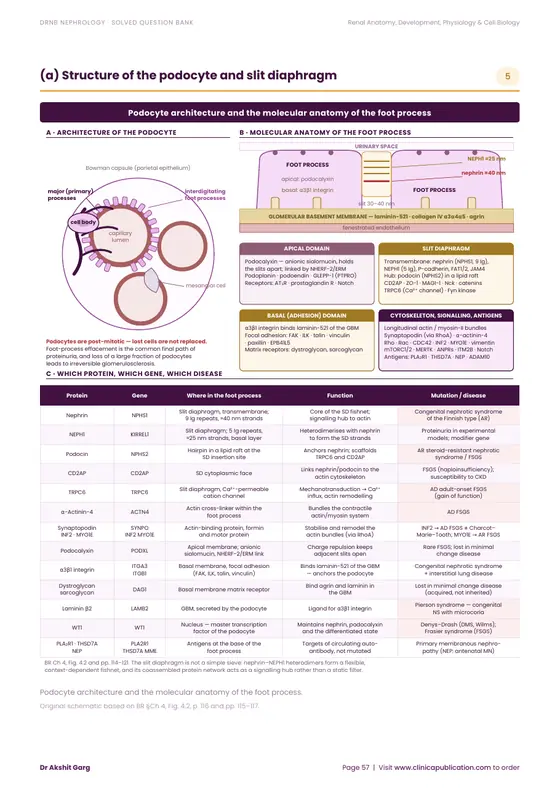
  11. Podocyte Structure, the Slit Diaphragm, and Podocyte Injury and Repair 3×2023·Oct · Paper I · Q4(a) (3 marks) · 2024 · Paper I · Q5(a) (5 marks) · 2024 · Paper I · Q5(b) (5 marks)

    “Role of podocytes in renal diseases.”

    “Draw the structure of renal podocyte & slit diaphragm.”

    “Discuss briefly the podocyte injury & repair mechanism.”

  12. NETosis, Autophagy and Regulated Cell Death in Kidney Injury 1×2021 · Paper I · Q10 (10 marks)

    “Netosis and autophagy.”

  13. Transforming Growth Factor-β and the Mediators of Fibrosis 1×2022·B · Paper I · Q10(a) (3 marks)

    “Transforming Growth factor (TGF-b).”

  14. Renin–Angiotensin–Aldosterone Physiology 2×2022·Jun · Paper I · Q8(a) (5 marks) · 2023·Apr · Paper I · Q3(a) (5 marks)

    “Renin-Angiotensin System: Draw a diagrammatic representation of the Renin-Angiotensin System.”

    “Discuss physiology of Renin Angiotensin Aldosterone axis system.”

  15. The Ageing Kidney 1×2023·Oct · Paper I · Q7(c) (3 marks)

    “Change of GFR with aging.”

  16. Endocrine Functions of the Kidney 2×2025–26 · Paper I · Q6(a) (3 marks) · 2025–26 · Paper I · Q6(b) (7 marks)

    “Mention the endocrine functions of kidneys.”

    “Discuss their role in homeostasis.”

  17. Experimental Models of Kidney Disease 3×Jan 2025 · Paper III · Q3(a) (3 marks) · Jan 2025 · Paper III · Q3(b) (3 marks) · Jan 2025 · Paper III · Q3(c) (4 marks)

    “Heymann nephritis.”

    “Experimental model for minimal change disease.”

    “Experimental model for diabetic kidney disease.”

Read these answers free

The free 100-page sample is taken straight from the printed DrNB Nephrology volumes, with the book's own page numbers. It contains:

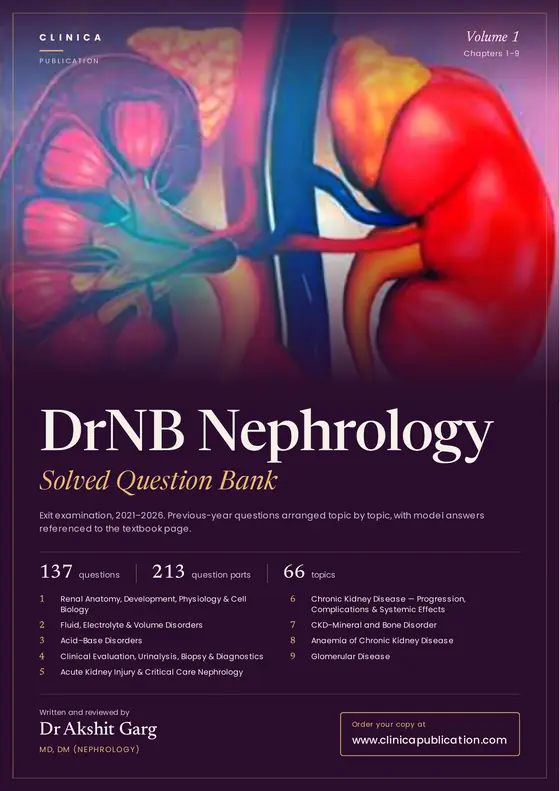
  • The Volume One cover, the KDIGO guideline table and the complete contents of Chapters 1 to 9 (66 topics)
  • Chapter 1 in full: 17 topics on renal anatomy, development, physiology and cell biology, from the nephron and glomerular filtration barrier to the countercurrent multiplier, podocytes and the ageing kidney
  • An examiner’s blueprint with every answer, telling you what to write for the marks
DrNB Nephrology free sample, page 1DrNB Nephrology free sample, page 6DrNB Nephrology free sample, page 13DrNB Nephrology free sample, page 57

Frequently asked questions

What does the DrNB Nephrology solved previous-year question set cover?

The complete three-volume set, 27 chapters across 9 chapters in Volume One, from the 2021 to 2026 exit examinations. Repeated questions are answered once, with every paper and year in which they were asked.

Which textbooks are the DrNB Nephrology answers written from?

Brenner and Rector's The Kidney 12e (2026), Comprehensive Clinical Nephrology 7e (2024) and the current KDIGO guidelines.

Can I read some answers before buying?

Yes. 17 complete answers are in the free 100-page sample: read the free sample (PDF). The questions they answer are listed on this page with the exact exam wording.

Where can I order the DrNB Nephrology book?

Order the printed set from the DrNB Nephrology book page. It is printed, bound and delivered anywhere in India.

Get every answer in print

DrNB Nephrology: the complete three-volume set, 27 chapters, printed, bound and delivered anywhere in India.

See the book