Home › Books › DrNB Critical Care Medicine › Previous-year questions
The complete DrNB Critical Care Medicine solved question set part by part, with 25 previous-year questions in their exact exam wording and full solved answers you can read free.
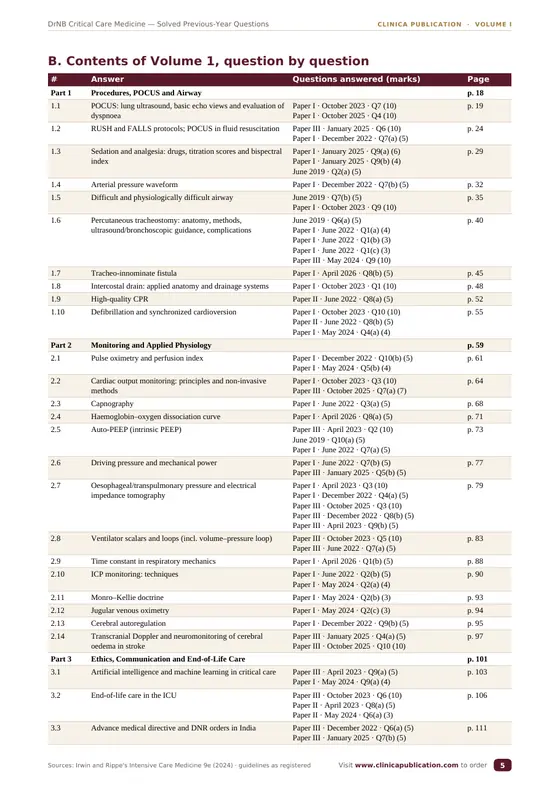
Every previous-year question is answered in one of these 15 parts. Parts marked “free answers” have solved answers in the free sample.
Each question shows the exam wording, the session, paper and question number, and how often it was asked. The full answers are in the free sample.
“Discuss the utility of POCUS in the evaluation of dyspnoea in the emergency department. Write the specific findings that can guide management. Make different diagrams for specific findings.”
“Describe in brief about lung USG and basic views of echocardiography.”
“Describe the "RUSH" (Rapid ultrasound in shock) and the "FALLS" (Fluid administration limited by lung sonography) protocols for the bedside ultrasonographic evaluation of a patient of SHOCK in the ICU.”
“Role of POCUS in fluid resuscitation.”
“Discuss the common drugs used for sedation and analgesia in ICU patients.”
“Describe any two scoring systems used for titration of such agents in critically ill patients.”
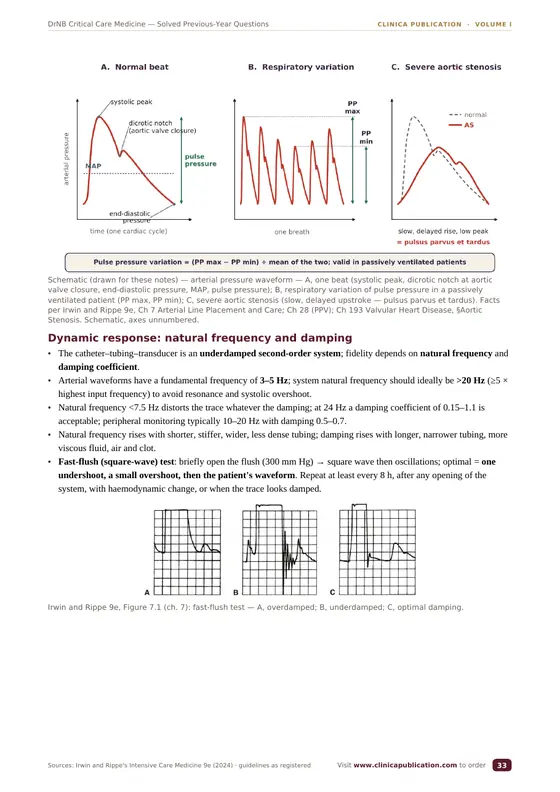
“Explain arterial waveform with diagram.”
“Describe about physiological difficult airway in critically ill patients.”
“Discuss ultrasound-guided percutaneous tracheostomy (PCT). What are the advantages and disadvantages of bronchoscopic guided PCT? [6+(2+2)]”
“Describe about percutaneous tracheostomy: Applied anatomy including arterial and venous supply.”
“Describe about percutaneous tracheostomy: Enumerate various methods.”
“Describe about percutaneous tracheostomy: Complications.”
“Tracheo-innominate fistula.”
“Describe about applied anatomy related to intercostal drain insertion and critical appraisal for drainage system based on number of chambers.”
“Good quality CPR.”
“Describe about defibrillation - devices and indications with doses.”
“Role of synchronized cardioversion.”
“Compare and contrast between defibrillation and cardioversion.”
“Define respiratory failure. Discuss the common non-invasive techniques for monitoring pulmonary function at bedside in an ICU.”
“Outline management of severe ARDS with evidence.”
“Critically analyze Berlin definition of ARDS.”
“Causes of refractory hypoxemia in ARDS.”
“Acute respiratory distress syndrome (ARDS): Its impact on the renal system.”
“Acute respiratory distress syndrome (ARDS): Its impact on the cardiovascular system.”
“Various methods of setting PEEP in ARDS patients.”
“Describe the evidence-based merits and de-merits of proning in ARDS patients in ICU.”
“Discuss the principles of prone position ventilation.”
“Mechanism of hypoxemia.”
“Describe about approach to a patient with hypercarbia.”
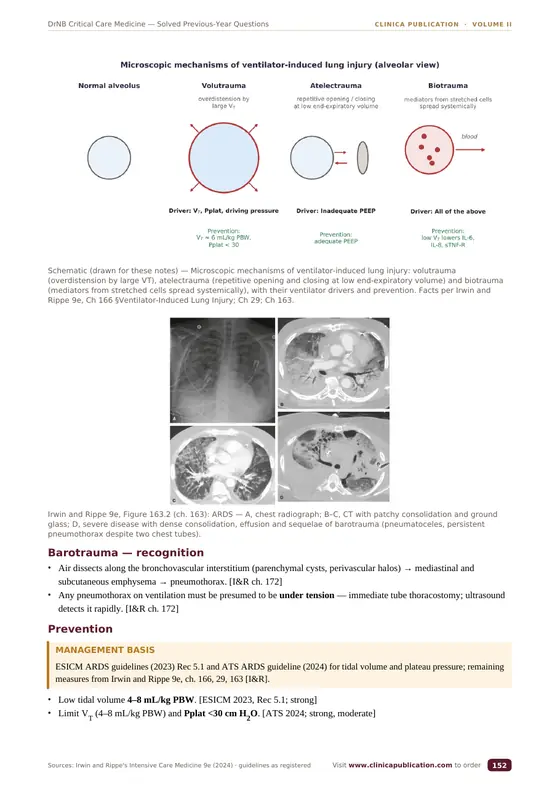
“What are the various types of "ventilator-induced lung injury" (VILI) in patients on prolonged invasive mechanical ventilation?”
“Define the various modes of mechanical ventilation. How are these classified?”
“Basic types of mechanical breath.”
“Role of APRV mode in ARDS.”
“What is the current status of APRV mode in current practice in ICU?”
“Closed loop ventilation.”
“Effect of changes in intra-thoracic pressure during mechanical ventilation on: Right ventricular function.”
“Effect of changes in intra-thoracic pressure during mechanical ventilation on: Left ventricular function.”
“Non cardiac indications of ECMO with supporting evidence.”
“What are the different modalities of ECMO (Extra-Corporeal Membrane Oxygenation) used in critically ill patients?”
“AIR transport of ARDS patient to ECMO centres (Inter hospital).”
“Discuss indications, principles and physiology of gas exchange during high-flow nasal oxygen therapy.”
“Describe the role of HFNC (high-flow nasal cannula) in critical care units, along with utility of "ROX" Index (Respiratory rate Oxygenation Index).”
“Physiological advantages of HFNC.”
The free 100-page sample is taken straight from the printed DrNB Critical Care Medicine volumes, with the book's own page numbers. It contains:
420 questions in 219 answers, two volumes across 15 parts in 2 volumes, from the June 2022 to April 2026 exit examinations. Repeated questions are answered once, with every paper and year in which they were asked.
Irwin and Rippe's Intensive Care Medicine 9e (2024), with current guidelines graded by strength.
Yes. 25 complete answers are in the free 100-page sample: read the free sample (PDF). The questions they answer are listed on this page with the exact exam wording.
Order the printed set from the DrNB Critical Care Medicine book page. It is printed, bound and delivered anywhere in India.
DrNB Critical Care Medicine: 420 questions in 219 answers, two volumes, printed, bound and delivered anywhere in India.