Home › Books › DNB General Surgery › Previous-year questions
The complete DNB General Surgery solved question set part by part, with 40 previous-year questions in their exact exam wording and full solved answers you can read free.
Every previous-year question is answered in one of these 39 parts. Parts marked “free answers” have solved answers in the free sample.
Each question shows the exam wording, the session, paper and question number, and how often it was asked. The full answers are in the free sample.
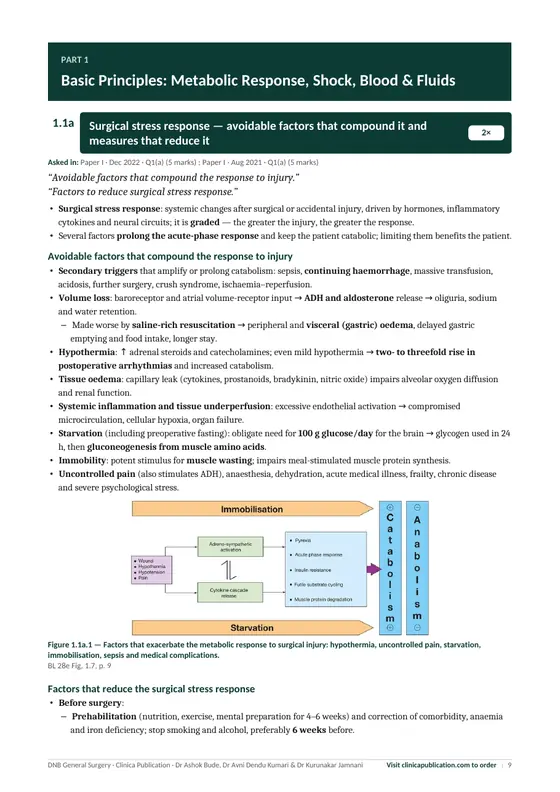
“Avoidable factors that compound the response to injury.”
“Factors to reduce surgical stress response.”
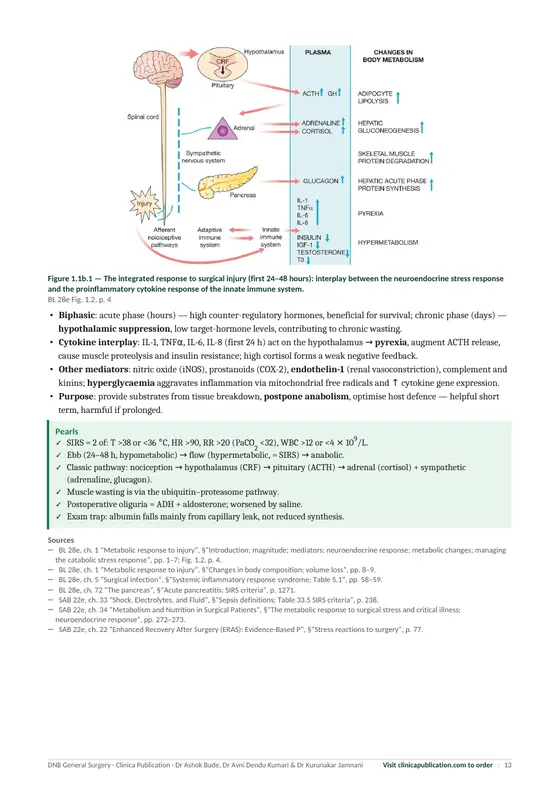
“What is SIRS? Discuss metabolic response to injury and explain neuroendocrine pathway.”
“Neuroendocrine response to injury.”
“Classification of shock.”
“Classification and management of hemorrhagic shock.”
“Classification of hemorrhagic shock.”
“Classify hemorrhage according to time and source.”
“Pathophysiology of hemorrhage.”
“Monitoring of patient in shock.”
“Enumerate different blood products.”
“Discuss in brief complications of blood transfusion. Describe special precautions in event of massive blood transfusion.”
“Complications of blood transfusion.”
“What are the common complications of massive blood transfusion?”
“Discuss different methods and materials available to control intra-operative bleeding.”
“Methods of hemostasis in surgical practice.”
“Advances in topical hemostatic therapy in surgical practice.”
“Discuss the various measures to be taken while operating on a patient with haemophilia A.”
“Fluid and electrolyte distribution in the body.”
“Concept of state of zero fluid balance.”
“Classify the types of body fluid changes. Describe etiology, clinical manifestation and treatment of hyperkalemia.”
“Clinical features and management of hyperkalemia.”
“Describe the types of metabolic acidosis.”
“Define lactic acidemia and discuss its management.”
“What are the various ways to resurface a wound? Discuss how will you raise split thickness skin graft. What are the causes of failure of such a graft?”
“Principles of split thickness skin graft.”
“Differentiate between partial thickness and full thickness skin grafts.”
“Musculocutaneous flaps.”
“Classification of varous types of skin flaps used in plastic surgery reconstructive procedures.”
“Principles of reconstruction in head and neck cancer surgery.”
“Describe the various local flaps used for reconstruction of the lip.”
“Local flaps for reconstruction of lip.”
“Describe commonly used flaps in cases of oral malignancy.”
“Describe various bio-engineered skin substitutes and their current status in patient care.”
“Describe 'LAHSHAL' system of classification. Briefly discuss the principles of surgery for the clinical conditions described by this classification.”
“Enumerate principles of management of cleft lip and palate.”
“Role of microvascular surgery in today's surgical practice.”
“Briefly discuss the premalignant lesions of the skin.”
“Premalignant lesions of skin.”
“Enumerate pre-malignant and malignant tumors of the skin. Discuss the etiopathogenesis, investigations and management of any two.”
“Describe pathophysiology, clinical features, diagnosis & treatment of achalasia cardia.”
“Achalasia cardia.”
“Discuss management of Achalasia Cardia.”
“Discuss the preoperative workup of a patient with achalasia cardia.”
“Outline the physiology of oesophageal motility.”
“High resolution oesophageal manometry.”
“Third space endoscopy.”
“Clinical features, investigations and treatment of gastro-esophageal reflux disease in a 40-year-old male.”
“Briefly discuss the clinical features, investigations and treatment of gastroesophageal reflux Disease (GERD).”
“Management of Barrett's esophagus.”
“Different types of fundoplications.”
“Scoring systems for GERD.”
“Complications of laparoscopic anti-reflux surgery.”
“Briefly discuss the diagnosis and treatment of carcinoma esophagus.”
“Outline the investigations and staging of carcinoma oesophagus.”
“Management options for a 45 year old patient with carcinoma of lower third of oesophagus.”
“Describe management of a patient with corrosive esophageal injury.”
“Differentiate between a gastric and duodenal ulcer.”
“Describe the surgical anatomy of the stomach and discuss the clinical features, evaluation and management of a case of bleeding duodenal ulcer.”
The free 100-page sample is taken straight from the printed DNB General Surgery volumes, with the book's own page numbers. It contains:
768 questions solved in 550 model answers across 39 parts in 3 volumes, from the June 2020 to December 2025 exit examinations. Repeated questions are answered once, with every paper and year in which they were asked.
Bailey & Love 28e and Sabiston 22e, with Schwartz 11e for trauma, burns, endocrine surgery and surgical critical care.
Yes. 40 complete answers are in the free 100-page sample: read the free sample (PDF). The questions they answer are listed on this page with the exact exam wording.
Order the printed set from the DNB General Surgery book page. It is printed, bound and delivered anywhere in India.
DNB General Surgery: 768 questions solved in 550 model answers, printed, bound and delivered anywhere in India.