ClinicaPublication

Home › Books › DNB General Medicine › Previous-year questions

Free question list · June 2020 to December 2025

DNB General Medicine previous-year questions (2020–2025)

All 103 DNB General Medicine Volume I theory questions from June 2020 to December 2025, topic-wise and session-wise, with how often each one has been asked. Use the list to find the high-yield topics, then read the solved answers in our printed book.

Most-asked DNB General Medicine questions

These questions have been set three times or more since June 2020. The number shows how many times each was asked.

  1. Antimicrobial stewardship programme and strategies to prevent resistance 5×Volume I · Part 4 · Infectious Diseases
  2. Iron metabolism, diagnosis of iron deficiency and iron therapy 4×Volume I · Part 3 · Oncology and Hematology
  3. Multiple myeloma and plasma-cell disorders 4×Volume I · Part 3 · Oncology and Hematology
  4. Transfusion reactions and TRALI 4×Volume I · Part 3 · Oncology and Hematology
  5. Palliative care — domains, P-SPIKES, symptoms of the terminally ill and advance care planning 3×Volume I · Part 1 · The Profession of Medicine
  6. Pain pathways, pain modulation and drugs for neuropathic pain 3×Volume I · Part 2 · Cardinal Manifestations and Presentation of Diseases
  7. Headache — pathophysiology, ICHD-3 classification and approach to new-onset headache 3×Volume I · Part 2 · Cardinal Manifestations and Presentation of Diseases
  8. Orthostatic hypotension — causes, diagnosis and management 3×Volume I · Part 2 · Cardinal Manifestations and Presentation of Diseases
  9. Physiology of sleep, hypersomnolence and narcolepsy 3×Volume I · Part 2 · Cardinal Manifestations and Presentation of Diseases
  10. Diarrhoea — types, secretory diarrhoea, stool osmotic gap and approach to chronic diarrhoea 3×Volume I · Part 2 · Cardinal Manifestations and Presentation of Diseases
  11. Upper GI bleeding and haematemesis — causes and management 3×Volume I · Part 2 · Cardinal Manifestations and Presentation of Diseases
  12. Renal tubular acidosis — types, diagnosis and treatment 3×Volume I · Part 2 · Cardinal Manifestations and Presentation of Diseases
  13. Oncological emergencies and tumour lysis syndrome 3×Volume I · Part 3 · Oncology and Hematology
  14. Haemolytic anaemias — classification, pathophysiology and laboratory diagnosis 3×Volume I · Part 3 · Oncology and Hematology
  15. Infective endocarditis — Duke criteria, right-sided IE, surgery, prophylaxis 3×Volume I · Part 4 · Infectious Diseases

Topic-wise DNB General Medicine previous-year questions

Grouped the way the book is organised, 1 volume and 4 parts. Open a part to see its questions, how often each was asked, and the session, paper, question number and marks.

Volume I — Profession of Medicine, Cardinal Manifestations, Oncology & Hematology, Infectious Diseases

Part 1 · The Profession of Medicine7 questions
  1. Statistical analysis in research and Bayes' theorem in diagnosis 2×Jun 2021 · Paper IV · Q3(a) (5 marks) · May 2024 · Paper IV · Q10(a) (5 marks)
  2. Tools for assessing quality of health care 1×May 2024 · Paper IV · Q10(b) (5 marks)
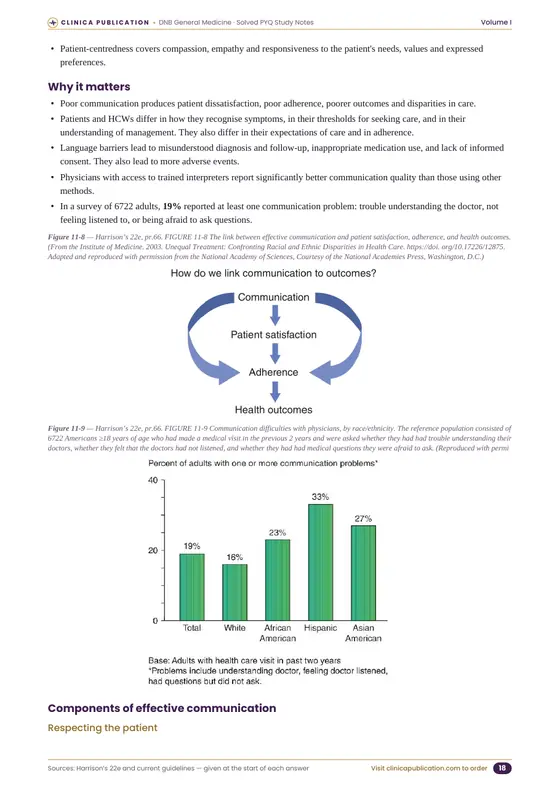
  3. Communication skills in health-care workers 1×Jun 2022 · Paper IV · Q9(b) (5 marks)
  4. Ethical principles and conflicts of interest in the medical profession 1×May 2024 · Paper III · Q3(a) (5 marks) · May 2024 · Paper III · Q3(b) (5 marks)
  5. Informed consent 1×Dec 2022 · Paper IV · Q6(a) (5 marks)
  6. Euthanasia and physician-assisted suicide 2×Dec 2021 · Paper I · Q8(a) (5 marks) · May 2024 · Paper I · Q8(b) (5 marks)
  7. Palliative care — domains, P-SPIKES, symptoms of the terminally ill and advance care planning 3×Jun 2021 · Paper I · Q5 (10 marks) · Jun 2022 · Paper I · Q4(a) (2 marks) · Jun 2022 · Paper I · Q4(b) (3 marks) · Jun 2025 · Paper IV · Q6(a) (4 marks) · Jun 2025 · Paper IV · Q6(b) (3 marks) · Jun 2025 · Paper IV · Q6(c) (3 marks)
Part 2 · Cardinal Manifestations and Presentation of Diseases42 questions
  1. Pain pathways, pain modulation and drugs for neuropathic pain 3×Jun 2021 · Paper I · Q4 (10 marks) · Jun 2022 · Paper I · Q2(a) (2 marks) · Oct 2024 · Paper I · Q2(a) (4 marks) · Oct 2024 · Paper I · Q2(b) (3 marks)
  2. Stroke units — components, types and protocol 1×Apr 2023 · Paper IV · Q8 (10 marks)
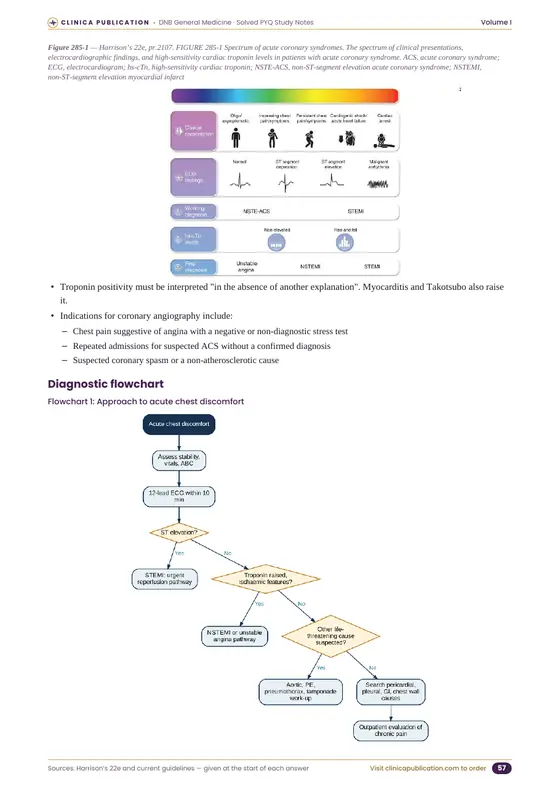
  3. Approach to a patient with chest pain 1×May 2024 · Paper I · Q1 (10 marks)
  4. Abdominal pain — mechanisms and differential diagnosis by location 1×Jun 2022 · Paper I · Q2(b) (4 marks) · Jun 2022 · Paper I · Q2(c) (4 marks)
  5. Headache — pathophysiology, ICHD-3 classification and approach to new-onset headache 3×Jun 2022 · Paper II · Q8(a) (4 marks) · May 2024 · Paper I · Q5(a) (5 marks) · Dec 2025 · Paper III · Q5(a) (2 marks) · Dec 2025 · Paper III · Q5(b) (3 marks) · Dec 2025 · Paper III · Q5(c) (5 marks)
  6. Pathogenesis of fever, fever with rash and approach to FUO 1×Jun 2022 · Paper I · Q3(a) (3 marks) · Jun 2022 · Paper I · Q3(b) (2 marks) · Jun 2022 · Paper I · Q3(c) (5 marks)
  7. Orthostatic hypotension — causes, diagnosis and management 3×Dec 2022 · Paper I · Q5(b) (5 marks) · Oct 2024 · Paper II · Q1(a) (1 marks) · Oct 2024 · Paper II · Q1(b) (3 marks) · Oct 2024 · Paper II · Q1(c) (6 marks) · Jun 2025 · Paper II · Q7(a) (2 marks) · Jun 2025 · Paper II · Q7(b) (3 marks)
  8. Syncope — causes, pathophysiology and evaluation 2×Jun 2021 · Paper I · Q8 (10 marks) · Dec 2025 · Paper II · Q3 (10 marks)
  9. Vertigo — approach, peripheral vs central and treatment 1×Jun 2022 · Paper II · Q10(a) (4 marks) · Jun 2022 · Paper II · Q10(b) (3 marks) · Jun 2022 · Paper II · Q10(c) (3 marks)
  10. Neurological findings that localise a lesion 1×Oct 2024 · Paper I · Q9(a) (5 marks)
  11. Falls in the elderly 1×Dec 2020 · Paper IV · Q8(b) (5 marks)
  12. Delirium — causes and management 1×Jun 2020 · Paper III · Q7 (10 marks)
  13. Coma — approach, aetiopathogenesis and brain death criteria 1×Oct 2023 · Paper II · Q8(a) (4 marks) · Oct 2023 · Paper II · Q8(b) (3 marks) · Oct 2023 · Paper II · Q8(c) (3 marks)
  14. Rapidly progressive dementia 1×Dec 2022 · Paper IV · Q4(b) (5 marks)
  15. Physiology of sleep, hypersomnolence and narcolepsy 3×Jun 2020 · Paper I · Q6 (10 marks) · Dec 2020 · Paper I · Q8 (10 marks) · Jun 2025 · Paper III · Q8(a) (4 marks) · Jun 2025 · Paper III · Q8(b) (6 marks)
  16. Midbrain cross-section and midbrain stroke syndromes 2×Dec 2022 · Paper I · Q3(a) (5 marks) · Dec 2022 · Paper I · Q3(b) (5 marks) · Dec 2025 · Paper I · Q3(a) (5 marks) · Dec 2025 · Paper I · Q3(b) (5 marks)
  17. Physiology of smell and causes of anosmia 1×Apr 2023 · Paper I · Q10(a) (5 marks)
  18. Oral cavity examination in general medicine 1×May 2024 · Paper I · Q4 (10 marks)
  19. Differential cyanosis 1×Apr 2023 · Paper I · Q10(b) (5 marks)
  20. Cardiac cycle and its changes with exercise 1×Oct 2024 · Paper I · Q3(a) (4 marks) · Oct 2024 · Paper I · Q3(b) (6 marks)
  21. Physiology of swallowing and approach to dysphagia 2×Jun 2022 · Paper I · Q7(a) (3 marks) · Jun 2022 · Paper I · Q7(b) (3 marks) · Jun 2025 · Paper I · Q10(a) (5 marks) · Jun 2025 · Paper I · Q10(b) (5 marks)
  22. Diarrhoea — types, secretory diarrhoea, stool osmotic gap and approach to chronic diarrhoea 3×Dec 2020 · Paper IV · Q4(b) (5 marks) · Dec 2021 · Paper I · Q2 (10 marks) · May 2024 · Paper II · Q6(a) (2 marks)
  23. Upper GI bleeding and haematemesis — causes and management 3×Jun 2020 · Paper II · Q10(a) (4 marks) · Apr 2023 · Paper II · Q2 (10 marks) · May 2024 · Paper II · Q8(a) (5 marks)
  24. Innervation of the urinary bladder and types of bladder dysfunction 1×Jun 2022 · Paper I · Q1(a) (5 marks) · Jun 2022 · Paper I · Q1(b) (5 marks)
  25. Azotaemia and renal failure indices 2×Jun 2025 · Paper IV · Q7(a) (5 marks) · Dec 2025 · Paper II · Q2(a) (5 marks)
  26. Estimation of glomerular filtration rate 1×Dec 2022 · Paper I · Q4(a) (5 marks)
  27. Hyperkalaemia — aetiology, ECG features and management 2×Dec 2020 · Paper II · Q9(b) (4 marks) · Apr 2023 · Paper I · Q3 (10 marks)
  28. Hyponatraemia in heart failure and cirrhosis and vasopressin antagonists 1×Dec 2025 · Paper III · Q6(a) (5 marks) · Dec 2025 · Paper III · Q6(b) (5 marks)
  29. Hyponatraemia — types, evaluation by ECF volume and treatment 2×Dec 2020 · Paper I · Q4 (10 marks) · Jun 2022 · Paper II · Q4(b) (7 marks)
  30. Hyporeninaemic hypoaldosteronism and hyperkalaemia 1×Dec 2020 · Paper II · Q9(a) (6 marks)
  31. Lactic acidosis 1×Dec 2020 · Paper IV · Q2(b) (6 marks)
  32. Renal tubular acidosis — types, diagnosis and treatment 3×Jun 2020 · Paper III · Q1(ii) (7 marks) · Dec 2022 · Paper III · Q4(a) (5 marks) · Oct 2024 · Paper III · Q10(a) (5 marks) · Oct 2024 · Paper III · Q10(b) (5 marks)
  33. Infections in pregnancy — immunology and antimicrobial use 1×Dec 2025 · Paper I · Q4(a) (5 marks) · Dec 2025 · Paper I · Q4(b) (5 marks)
  34. Cutaneous manifestations of HIV 1×Jun 2022 · Paper III · Q9(a) (5 marks)
  35. Dermatological complications of diabetes 1×Jun 2021 · Paper II · Q9(ii) (5 marks)
  36. Dermatological manifestations of internal malignancy 1×Oct 2023 · Paper III · Q9(b) (5 marks)
  37. Hypersensitivity reactions — classification and type III immunopathogenesis 1×Dec 2025 · Paper I · Q9(a) (5 marks) · Dec 2025 · Paper I · Q9(b) (5 marks)
  38. Non-immune cutaneous drug reactions 1×Dec 2020 · Paper III · Q6(a) (5 marks)
  39. Chronic granulomatous disease 1×Jun 2025 · Paper III · Q5(a) (5 marks)
  40. Cytokine storm in COVID-19 1×Jun 2021 · Paper I · Q2(a) (5 marks) · Jun 2021 · Paper I · Q2(b) (5 marks)
  41. Haemophagocytic lymphohistiocytosis 1×Dec 2022 · Paper II · Q4(a) (5 marks)
  42. Hypercoagulable state — pathogenesis and diagnostic tests 1×Dec 2022 · Paper I · Q8(b) (5 marks)
Part 3 · Oncology and Hematology38 questions
  1. Case-control study 1×Oct 2023 · Paper IV · Q2(b) (5 marks)
  2. Randomised controlled trials 2×Dec 2022 · Paper IV · Q6(b) (5 marks) · May 2024 · Paper I · Q8(a) (5 marks)
  3. Sample size — calculation for prevalence and errors 1×Apr 2023 · Paper III · Q6 (10 marks)
  4. Carcinogenesis, oncogenes and tumour suppressor genes 2×Dec 2021 · Paper I · Q3(a) (5 marks) · Dec 2025 · Paper I · Q5(a) (5 marks) · Dec 2025 · Paper I · Q5(b) (5 marks)
  5. Signal transduction pathways in cancer cells 1×Dec 2021 · Paper I · Q3(b) (5 marks)
  6. Gompertzian growth of tumours 1×Dec 2020 · Paper IV · Q2(a) (4 marks)
  7. Infections in post-splenectomy patients 1×Dec 2020 · Paper IV · Q1(b) (5 marks)
  8. Oncological emergencies and tumour lysis syndrome 3×Jun 2021 · Paper I · Q7 (10 marks) · Dec 2022 · Paper III · Q8(b) (5 marks) · Dec 2025 · Paper III · Q3(a) (3 marks) · Dec 2025 · Paper III · Q3(b) (7 marks)
  9. Superior vena cava — anatomy and SVC syndrome 2×Jun 2021 · Paper III · Q8 (10 marks) · Dec 2021 · Paper I · Q4(a) (4 marks) · Dec 2021 · Paper I · Q4(b) (6 marks)
  10. Principles of radiation therapy in malignancy 1×Dec 2020 · Paper IV · Q6(a) (5 marks)
  11. Non-respiratory (endocrine and metabolic) functions of the lung 2×Jun 2020 · Paper IV · Q5(a) (5 marks) · Oct 2024 · Paper IV · Q1(a) (5 marks)
  12. Paraneoplastic syndromes — endocrine and neurological, and humoral hypercalcaemia of malignancy 2×Apr 2023 · Paper II · Q7 (10 marks) · Jun 2025 · Paper IV · Q5 (10 marks)
  13. Autoimmune encephalitis — classification, diagnosis and treatment 2×Dec 2022 · Paper IV · Q8(b) (5 marks) · Oct 2024 · Paper IV · Q10(a) (3 marks) · Oct 2024 · Paper IV · Q10(b) (4 marks) · Oct 2024 · Paper IV · Q10(c) (3 marks)
  14. Plasma therapy (convalescent plasma and plasma products) 1×Jun 2020 · Paper III · Q6 (10 marks)
  15. Posterior reversible encephalopathy syndrome 1×Dec 2021 · Paper III · Q1(b) (5 marks)
  16. Iron metabolism, diagnosis of iron deficiency and iron therapy 4×Jun 2020 · Paper I · Q8 (10 marks) · Dec 2021 · Paper I · Q7(a) (5 marks) · Dec 2022 · Paper IV · Q5(a) (5 marks) · Apr 2023 · Paper II · Q1 (10 marks)
  17. Physiology of red cell production and hypoproliferative anaemia 1×Oct 2024 · Paper I · Q6(a) (4 marks) · Oct 2024 · Paper I · Q6(b) (6 marks)
  18. Oxygen dissociation curve and haemoglobins with altered oxygen affinity 2×Dec 2020 · Paper IV · Q5(a) (5 marks) · Dec 2021 · Paper I · Q9(b) (5 marks)
  19. Thalassaemias — -thalassaemia classification and thalassaemia major 2×Dec 2020 · Paper III · Q3(a) (5 marks) · Jun 2025 · Paper IV · Q9(a) (5 marks)
  20. Biochemical basis of megaloblastic anaemia 1×Dec 2021 · Paper I · Q9(a) (5 marks)
  21. Autoimmune haemolytic anaemia 1×May 2024 · Paper II · Q10(b) (5 marks)
  22. Haemolytic anaemias — classification, pathophysiology and laboratory diagnosis 3×Dec 2020 · Paper I · Q7 (10 marks) · Apr 2023 · Paper I · Q9(a) (5 marks) · May 2024 · Paper II · Q10(a) (5 marks)
  23. Paroxysmal nocturnal haemoglobinuria 2×Jun 2021 · Paper III · Q9 (10 marks) · Apr 2023 · Paper I · Q9(b) (5 marks)
  24. Pancytopenia and acquired aplastic anaemia 2×Dec 2021 · Paper IV · Q8 (10 marks) · Oct 2024 · Paper III · Q6(a) (5 marks) · Oct 2024 · Paper III · Q6(b) (5 marks)
  25. Approach to polycythaemia / raised haematocrit 2×Jun 2022 · Paper IV · Q2(b) (5 marks) · May 2024 · Paper II · Q7 (10 marks)
  26. Acute myeloid leukaemia — diagnosis and favourable genetics 1×Dec 2020 · Paper II · Q1(b) (4 marks)
  27. Immune thrombocytopenia 2×Jun 2020 · Paper II · Q7 (10 marks) · Jun 2022 · Paper IV · Q2(a) (5 marks)
  28. Generalised lymphadenopathy, Hodgkin vs non-Hodgkin lymphoma, WHO classification and Ann Arbor staging 2×Dec 2020 · Paper III · Q6(b) (5 marks) · Dec 2025 · Paper II · Q1(a) (4 marks) · Dec 2025 · Paper II · Q1(b) (3 marks) · Dec 2025 · Paper II · Q1(c) (3 marks)
  29. Multiple myeloma and plasma-cell disorders 4×Jun 2020 · Paper III · Q3 (10 marks) · Jun 2021 · Paper II · Q2 (10 marks) · Oct 2023 · Paper II · Q9 (10 marks) · May 2024 · Paper III · Q8(a) (5 marks) · May 2024 · Paper III · Q8(b) (5 marks)
  30. Myeloma kidney 1×Dec 2020 · Paper III · Q2(a) (5 marks)
  31. Blood component therapy and artificial oxygen carriers 1×Oct 2024 · Paper IV · Q3(a) (5 marks) · Oct 2024 · Paper IV · Q3(b) (5 marks)
  32. Transfusion reactions and TRALI 4×Jun 2020 · Paper III · Q5 (10 marks) · Dec 2020 · Paper II · Q1(a) (6 marks) · Jun 2022 · Paper I · Q8(a) (5 marks) · Jun 2022 · Paper I · Q8(b) (5 marks) · Jun 2025 · Paper IV · Q9(b) (5 marks)
  33. Myelodysplastic syndromes and complications of haematopoietic cell transplantation 1×Jun 2025 · Paper I · Q7(a) (4 marks) · Jun 2025 · Paper I · Q7(b) (3 marks) · Jun 2025 · Paper I · Q7(c) (3 marks)
  34. Coagulation cascade, classification and laboratory diagnosis of bleeding disorders 2×Jun 2021 · Paper I · Q9(a) (3 marks) · Jun 2021 · Paper I · Q9(b) (7 marks) · Dec 2021 · Paper III · Q10 (10 marks)
  35. Disseminated intravascular coagulation 1×Dec 2022 · Paper III · Q8(a) (5 marks)
  36. Heparin-induced thrombocytopenia 1×Dec 2021 · Paper III · Q4(a) (5 marks)
  37. Novel (direct) oral anticoagulants 2×Jun 2021 · Paper IV · Q6(a) (5 marks) · May 2024 · Paper IV · Q8(a) (5 marks)
  38. Reversal (remission) of type 2 diabetes 1×Jun 2021 · Paper IV · Q2(b) (5 marks)
Part 4 · Infectious Diseases16 questions
  1. Basic reproduction number (R0) in epidemiology 1×Jun 2020 · Paper I · Q1 (10 marks)
  2. Adult immunisation and novel vaccine approaches 2×Jun 2022 · Paper IV · Q6(b) (5 marks) · Oct 2024 · Paper IV · Q4(a) (5 marks) · Oct 2024 · Paper IV · Q4(b) (5 marks)
  3. Empirical antibiotic treatment of community-acquired pneumonia 1×Dec 2020 · Paper III · Q7(a) (6 marks)
  4. Hospital-acquired pneumonia 1×Jun 2020 · Paper II · Q8 (10 marks)
  5. Infective endocarditis — Duke criteria, right-sided IE, surgery, prophylaxis 3×Dec 2021 · Paper III · Q9 (10 marks) · Dec 2022 · Paper II · Q10(a) (3 marks) · Oct 2024 · Paper II · Q3(a) (4 marks) · Oct 2024 · Paper II · Q3(b) (6 marks)
  6. Traveller's diarrhoea 1×Dec 2022 · Paper III · Q6(a) (4 marks)
  7. Pseudomembranous colitis (C. difficile) 1×Dec 2022 · Paper III · Q3(a) (5 marks)
  8. Asymptomatic bacteriuria and emphysematous pyelonephritis 1×Jun 2022 · Paper II · Q6(a) (5 marks) · Jun 2022 · Paper II · Q6(b) (5 marks)
  9. Catheter-associated urinary tract infection 1×Dec 2022 · Paper III · Q3(b) (5 marks)
  10. Recurrent urinary tract infection — causes, evaluation and treatment 2×Apr 2023 · Paper II · Q3 (10 marks) · May 2024 · Paper II · Q5 (10 marks)
  11. Approach to and management of urethritis in men 1×Jun 2025 · Paper II · Q6 (10 marks)
  12. Laboratory diagnosis of acute viral encephalitis 1×Dec 2021 · Paper I · Q7(b) (5 marks)
  13. CSF findings in acute bacterial meningitis 1×Dec 2020 · Paper II · Q7(b) (3 marks)
  14. Chronic meningitis — non-infectious causes and clinical features 1×Jun 2025 · Paper II · Q9(a) (5 marks) · Jun 2025 · Paper II · Q9(b) (5 marks)
  15. Antimicrobial stewardship programme and strategies to prevent resistance 5×Jun 2020 · Paper I · Q5 (10 marks) · Dec 2020 · Paper I · Q5 (10 marks) · Jun 2022 · Paper III · Q10(b) (5 marks) · Dec 2022 · Paper I · Q2(b) (5 marks) · Oct 2024 · Paper IV · Q7(b) (5 marks)
  16. Mechanisms of antimicrobial resistance 2×Dec 2022 · Paper I · Q2(a) (5 marks) · Oct 2024 · Paper IV · Q7(a) (5 marks)

DNB General Medicine question papers, session by session

The topics set in each exam session, paper by paper and in question order, latest first.

DNB General Medicine December 202520 questions

Paper I

  • Q3(a) — Midbrain cross-section and midbrain stroke syndromes 5 marks
  • Q3(b) — Midbrain cross-section and midbrain stroke syndromes 5 marks
  • Q4(a) — Infections in pregnancy — immunology and antimicrobial use 5 marks
  • Q4(b) — Infections in pregnancy — immunology and antimicrobial use 5 marks
  • Q5(a) — Carcinogenesis, oncogenes and tumour suppressor genes 5 marks
  • Q5(b) — Carcinogenesis, oncogenes and tumour suppressor genes 5 marks
  • Q9(a) — Hypersensitivity reactions — classification and type III immunopathogenesis 5 marks
  • Q9(b) — Hypersensitivity reactions — classification and type III immunopathogenesis 5 marks

Paper II

  • Q1(a) — Generalised lymphadenopathy, Hodgkin vs non-Hodgkin lymphoma, WHO classification and Ann Arbor staging 4 marks
  • Q1(b) — Generalised lymphadenopathy, Hodgkin vs non-Hodgkin lymphoma, WHO classification and Ann Arbor staging 3 marks
  • Q1(c) — Generalised lymphadenopathy, Hodgkin vs non-Hodgkin lymphoma, WHO classification and Ann Arbor staging 3 marks
  • Q2(a) — Azotaemia and renal failure indices 5 marks
  • Q3 — Syncope — causes, pathophysiology and evaluation 10 marks

Paper III

  • Q3(a) — Oncological emergencies and tumour lysis syndrome 3 marks
  • Q3(b) — Oncological emergencies and tumour lysis syndrome 7 marks
  • Q5(a) — Headache — pathophysiology, ICHD-3 classification and approach to new-onset headache 2 marks
  • Q5(b) — Headache — pathophysiology, ICHD-3 classification and approach to new-onset headache 3 marks
  • Q5(c) — Headache — pathophysiology, ICHD-3 classification and approach to new-onset headache 5 marks
  • Q6(a) — Hyponatraemia in heart failure and cirrhosis and vasopressin antagonists 5 marks
  • Q6(b) — Hyponatraemia in heart failure and cirrhosis and vasopressin antagonists 5 marks
DNB General Medicine June 202520 questions

Paper I

  • Q7(a) — Myelodysplastic syndromes and complications of haematopoietic cell transplantation 4 marks
  • Q7(b) — Myelodysplastic syndromes and complications of haematopoietic cell transplantation 3 marks
  • Q7(c) — Myelodysplastic syndromes and complications of haematopoietic cell transplantation 3 marks
  • Q10(a) — Physiology of swallowing and approach to dysphagia 5 marks
  • Q10(b) — Physiology of swallowing and approach to dysphagia 5 marks

Paper II

  • Q6 — Approach to and management of urethritis in men 10 marks
  • Q7(a) — Orthostatic hypotension — causes, diagnosis and management 2 marks
  • Q7(b) — Orthostatic hypotension — causes, diagnosis and management 3 marks
  • Q9(a) — Chronic meningitis — non-infectious causes and clinical features 5 marks
  • Q9(b) — Chronic meningitis — non-infectious causes and clinical features 5 marks

Paper III

  • Q5(a) — Chronic granulomatous disease 5 marks
  • Q8(a) — Physiology of sleep, hypersomnolence and narcolepsy 4 marks
  • Q8(b) — Physiology of sleep, hypersomnolence and narcolepsy 6 marks

Paper IV

  • Q5 — Paraneoplastic syndromes — endocrine and neurological, and humoral hypercalcaemia of malignancy 10 marks
  • Q6(a) — Palliative care — domains, P-SPIKES, symptoms of the terminally ill and advance care planning 4 marks
  • Q6(b) — Palliative care — domains, P-SPIKES, symptoms of the terminally ill and advance care planning 3 marks
  • Q6(c) — Palliative care — domains, P-SPIKES, symptoms of the terminally ill and advance care planning 3 marks
  • Q7(a) — Azotaemia and renal failure indices 5 marks
  • Q9(a) — Thalassaemias — -thalassaemia classification and thalassaemia major 5 marks
  • Q9(b) — Transfusion reactions and TRALI 5 marks
DNB General Medicine October 202426 questions

Paper I

  • Q2(a) — Pain pathways, pain modulation and drugs for neuropathic pain 4 marks
  • Q2(b) — Pain pathways, pain modulation and drugs for neuropathic pain 3 marks
  • Q3(a) — Cardiac cycle and its changes with exercise 4 marks
  • Q3(b) — Cardiac cycle and its changes with exercise 6 marks
  • Q6(a) — Physiology of red cell production and hypoproliferative anaemia 4 marks
  • Q6(b) — Physiology of red cell production and hypoproliferative anaemia 6 marks
  • Q9(a) — Neurological findings that localise a lesion 5 marks

Paper II

  • Q1(a) — Orthostatic hypotension — causes, diagnosis and management 1 marks
  • Q1(b) — Orthostatic hypotension — causes, diagnosis and management 3 marks
  • Q1(c) — Orthostatic hypotension — causes, diagnosis and management 6 marks
  • Q3(a) — Infective endocarditis — Duke criteria, right-sided IE, surgery, prophylaxis 4 marks
  • Q3(b) — Infective endocarditis — Duke criteria, right-sided IE, surgery, prophylaxis 6 marks

Paper III

  • Q6(a) — Pancytopenia and acquired aplastic anaemia 5 marks
  • Q6(b) — Pancytopenia and acquired aplastic anaemia 5 marks
  • Q10(a) — Renal tubular acidosis — types, diagnosis and treatment 5 marks
  • Q10(b) — Renal tubular acidosis — types, diagnosis and treatment 5 marks

Paper IV

  • Q1(a) — Non-respiratory (endocrine and metabolic) functions of the lung 5 marks
  • Q3(a) — Blood component therapy and artificial oxygen carriers 5 marks
  • Q3(b) — Blood component therapy and artificial oxygen carriers 5 marks
  • Q4(a) — Adult immunisation and novel vaccine approaches 5 marks
  • Q4(b) — Adult immunisation and novel vaccine approaches 5 marks
  • Q7(a) — Mechanisms of antimicrobial resistance 5 marks
  • Q7(b) — Antimicrobial stewardship programme and strategies to prevent resistance 5 marks
  • Q10(a) — Autoimmune encephalitis — classification, diagnosis and treatment 3 marks
  • Q10(b) — Autoimmune encephalitis — classification, diagnosis and treatment 4 marks
  • Q10(c) — Autoimmune encephalitis — classification, diagnosis and treatment 3 marks
DNB General Medicine May 202418 questions

Paper I

  • Q1 — Approach to a patient with chest pain 10 marks
  • Q4 — Oral cavity examination in general medicine 10 marks
  • Q5(a) — Headache — pathophysiology, ICHD-3 classification and approach to new-onset headache 5 marks
  • Q8(a) — Randomised controlled trials 5 marks
  • Q8(b) — Euthanasia and physician-assisted suicide 5 marks

Paper II

  • Q5 — Recurrent urinary tract infection — causes, evaluation and treatment 10 marks
  • Q6(a) — Diarrhoea — types, secretory diarrhoea, stool osmotic gap and approach to chronic diarrhoea 2 marks
  • Q7 — Approach to polycythaemia / raised haematocrit 10 marks
  • Q8(a) — Upper GI bleeding and haematemesis — causes and management 5 marks
  • Q10(a) — Haemolytic anaemias — classification, pathophysiology and laboratory diagnosis 5 marks
  • Q10(b) — Autoimmune haemolytic anaemia 5 marks

Paper III

  • Q3(a) — Ethical principles and conflicts of interest in the medical profession 5 marks
  • Q3(b) — Ethical principles and conflicts of interest in the medical profession 5 marks
  • Q8(a) — Multiple myeloma and plasma-cell disorders 5 marks
  • Q8(b) — Multiple myeloma and plasma-cell disorders 5 marks

Paper IV

  • Q8(a) — Novel (direct) oral anticoagulants 5 marks
  • Q10(a) — Statistical analysis in research and Bayes' theorem in diagnosis 5 marks
  • Q10(b) — Tools for assessing quality of health care 5 marks
DNB General Medicine October 20236 questions

Paper II

  • Q8(a) — Coma — approach, aetiopathogenesis and brain death criteria 4 marks
  • Q8(b) — Coma — approach, aetiopathogenesis and brain death criteria 3 marks
  • Q8(c) — Coma — approach, aetiopathogenesis and brain death criteria 3 marks
  • Q9 — Multiple myeloma and plasma-cell disorders 10 marks

Paper III

  • Q9(b) — Dermatological manifestations of internal malignancy 5 marks

Paper IV

  • Q2(b) — Case-control study 5 marks
DNB General Medicine April 202311 questions

Paper I

  • Q3 — Hyperkalaemia — aetiology, ECG features and management 10 marks
  • Q9(a) — Haemolytic anaemias — classification, pathophysiology and laboratory diagnosis 5 marks
  • Q9(b) — Paroxysmal nocturnal haemoglobinuria 5 marks
  • Q10(a) — Physiology of smell and causes of anosmia 5 marks
  • Q10(b) — Differential cyanosis 5 marks

Paper II

  • Q1 — Iron metabolism, diagnosis of iron deficiency and iron therapy 10 marks
  • Q2 — Upper GI bleeding and haematemesis — causes and management 10 marks
  • Q3 — Recurrent urinary tract infection — causes, evaluation and treatment 10 marks
  • Q7 — Paraneoplastic syndromes — endocrine and neurological, and humoral hypercalcaemia of malignancy 10 marks

Paper III

  • Q6 — Sample size — calculation for prevalence and errors 10 marks

Paper IV

  • Q8 — Stroke units — components, types and protocol 10 marks
DNB General Medicine December 202220 questions

Paper I

  • Q2(a) — Mechanisms of antimicrobial resistance 5 marks
  • Q2(b) — Antimicrobial stewardship programme and strategies to prevent resistance 5 marks
  • Q3(a) — Midbrain cross-section and midbrain stroke syndromes 5 marks
  • Q3(b) — Midbrain cross-section and midbrain stroke syndromes 5 marks
  • Q4(a) — Estimation of glomerular filtration rate 5 marks
  • Q5(b) — Orthostatic hypotension — causes, diagnosis and management 5 marks
  • Q8(b) — Hypercoagulable state — pathogenesis and diagnostic tests 5 marks

Paper II

  • Q4(a) — Haemophagocytic lymphohistiocytosis 5 marks
  • Q10(a) — Infective endocarditis — Duke criteria, right-sided IE, surgery, prophylaxis 3 marks

Paper III

  • Q3(a) — Pseudomembranous colitis (C. difficile) 5 marks
  • Q3(b) — Catheter-associated urinary tract infection 5 marks
  • Q4(a) — Renal tubular acidosis — types, diagnosis and treatment 5 marks
  • Q6(a) — Traveller's diarrhoea 4 marks
  • Q8(a) — Disseminated intravascular coagulation 5 marks
  • Q8(b) — Oncological emergencies and tumour lysis syndrome 5 marks

Paper IV

  • Q4(b) — Rapidly progressive dementia 5 marks
  • Q5(a) — Iron metabolism, diagnosis of iron deficiency and iron therapy 5 marks
  • Q6(a) — Informed consent 5 marks
  • Q6(b) — Randomised controlled trials 5 marks
  • Q8(b) — Autoimmune encephalitis — classification, diagnosis and treatment 5 marks
DNB General Medicine June 202227 questions

Paper I

  • Q1(a) — Innervation of the urinary bladder and types of bladder dysfunction 5 marks
  • Q1(b) — Innervation of the urinary bladder and types of bladder dysfunction 5 marks
  • Q2(a) — Pain pathways, pain modulation and drugs for neuropathic pain 2 marks
  • Q2(b) — Abdominal pain — mechanisms and differential diagnosis by location 4 marks
  • Q2(c) — Abdominal pain — mechanisms and differential diagnosis by location 4 marks
  • Q3(a) — Pathogenesis of fever, fever with rash and approach to FUO 3 marks
  • Q3(b) — Pathogenesis of fever, fever with rash and approach to FUO 2 marks
  • Q3(c) — Pathogenesis of fever, fever with rash and approach to FUO 5 marks
  • Q4(a) — Palliative care — domains, P-SPIKES, symptoms of the terminally ill and advance care planning 2 marks
  • Q4(b) — Palliative care — domains, P-SPIKES, symptoms of the terminally ill and advance care planning 3 marks
  • Q7(a) — Physiology of swallowing and approach to dysphagia 3 marks
  • Q7(b) — Physiology of swallowing and approach to dysphagia 3 marks
  • Q8(a) — Transfusion reactions and TRALI 5 marks
  • Q8(b) — Transfusion reactions and TRALI 5 marks

Paper II

  • Q4(b) — Hyponatraemia — types, evaluation by ECF volume and treatment 7 marks
  • Q6(a) — Asymptomatic bacteriuria and emphysematous pyelonephritis 5 marks
  • Q6(b) — Asymptomatic bacteriuria and emphysematous pyelonephritis 5 marks
  • Q8(a) — Headache — pathophysiology, ICHD-3 classification and approach to new-onset headache 4 marks
  • Q10(a) — Vertigo — approach, peripheral vs central and treatment 4 marks
  • Q10(b) — Vertigo — approach, peripheral vs central and treatment 3 marks
  • Q10(c) — Vertigo — approach, peripheral vs central and treatment 3 marks

Paper III

  • Q9(a) — Cutaneous manifestations of HIV 5 marks
  • Q10(b) — Antimicrobial stewardship programme and strategies to prevent resistance 5 marks

Paper IV

  • Q2(a) — Immune thrombocytopenia 5 marks
  • Q2(b) — Approach to polycythaemia / raised haematocrit 5 marks
  • Q6(b) — Adult immunisation and novel vaccine approaches 5 marks
  • Q9(b) — Communication skills in health-care workers 5 marks
DNB General Medicine December 202115 questions

Paper I

  • Q2 — Diarrhoea — types, secretory diarrhoea, stool osmotic gap and approach to chronic diarrhoea 10 marks
  • Q3(a) — Carcinogenesis, oncogenes and tumour suppressor genes 5 marks
  • Q3(b) — Signal transduction pathways in cancer cells 5 marks
  • Q4(a) — Superior vena cava — anatomy and SVC syndrome 4 marks
  • Q4(b) — Superior vena cava — anatomy and SVC syndrome 6 marks
  • Q7(a) — Iron metabolism, diagnosis of iron deficiency and iron therapy 5 marks
  • Q7(b) — Laboratory diagnosis of acute viral encephalitis 5 marks
  • Q8(a) — Euthanasia and physician-assisted suicide 5 marks
  • Q9(a) — Biochemical basis of megaloblastic anaemia 5 marks
  • Q9(b) — Oxygen dissociation curve and haemoglobins with altered oxygen affinity 5 marks

Paper III

  • Q1(b) — Posterior reversible encephalopathy syndrome 5 marks
  • Q4(a) — Heparin-induced thrombocytopenia 5 marks
  • Q9 — Infective endocarditis — Duke criteria, right-sided IE, surgery, prophylaxis 10 marks
  • Q10 — Coagulation cascade, classification and laboratory diagnosis of bleeding disorders 10 marks

Paper IV

  • Q8 — Pancytopenia and acquired aplastic anaemia 10 marks
DNB General Medicine June 202115 questions

Paper I

  • Q2(a) — Cytokine storm in COVID-19 5 marks
  • Q2(b) — Cytokine storm in COVID-19 5 marks
  • Q4 — Pain pathways, pain modulation and drugs for neuropathic pain 10 marks
  • Q5 — Palliative care — domains, P-SPIKES, symptoms of the terminally ill and advance care planning 10 marks
  • Q7 — Oncological emergencies and tumour lysis syndrome 10 marks
  • Q8 — Syncope — causes, pathophysiology and evaluation 10 marks
  • Q9(a) — Coagulation cascade, classification and laboratory diagnosis of bleeding disorders 3 marks
  • Q9(b) — Coagulation cascade, classification and laboratory diagnosis of bleeding disorders 7 marks

Paper II

  • Q2 — Multiple myeloma and plasma-cell disorders 10 marks
  • Q9(ii) — Dermatological complications of diabetes 5 marks

Paper III

  • Q8 — Superior vena cava — anatomy and SVC syndrome 10 marks
  • Q9 — Paroxysmal nocturnal haemoglobinuria 10 marks

Paper IV

  • Q2(b) — Reversal (remission) of type 2 diabetes 5 marks
  • Q3(a) — Statistical analysis in research and Bayes' theorem in diagnosis 5 marks
  • Q6(a) — Novel (direct) oral anticoagulants 5 marks
DNB General Medicine December 202021 questions

Paper I

  • Q4 — Hyponatraemia — types, evaluation by ECF volume and treatment 10 marks
  • Q5 — Antimicrobial stewardship programme and strategies to prevent resistance 10 marks
  • Q7 — Haemolytic anaemias — classification, pathophysiology and laboratory diagnosis 10 marks
  • Q8 — Physiology of sleep, hypersomnolence and narcolepsy 10 marks

Paper II

  • Q1(a) — Transfusion reactions and TRALI 6 marks
  • Q1(b) — Acute myeloid leukaemia — diagnosis and favourable genetics 4 marks
  • Q7(b) — CSF findings in acute bacterial meningitis 3 marks
  • Q9(a) — Hyporeninaemic hypoaldosteronism and hyperkalaemia 6 marks
  • Q9(b) — Hyperkalaemia — aetiology, ECG features and management 4 marks

Paper III

  • Q2(a) — Myeloma kidney 5 marks
  • Q3(a) — Thalassaemias — -thalassaemia classification and thalassaemia major 5 marks
  • Q6(a) — Non-immune cutaneous drug reactions 5 marks
  • Q6(b) — Generalised lymphadenopathy, Hodgkin vs non-Hodgkin lymphoma, WHO classification and Ann Arbor staging 5 marks
  • Q7(a) — Empirical antibiotic treatment of community-acquired pneumonia 6 marks

Paper IV

  • Q1(b) — Infections in post-splenectomy patients 5 marks
  • Q2(a) — Gompertzian growth of tumours 4 marks
  • Q2(b) — Lactic acidosis 6 marks
  • Q4(b) — Diarrhoea — types, secretory diarrhoea, stool osmotic gap and approach to chronic diarrhoea 5 marks
  • Q5(a) — Oxygen dissociation curve and haemoglobins with altered oxygen affinity 5 marks
  • Q6(a) — Principles of radiation therapy in malignancy 5 marks
  • Q8(b) — Falls in the elderly 5 marks
DNB General Medicine June 202013 questions

Paper I

  • Q1 — Basic reproduction number (R0) in epidemiology 10 marks
  • Q5 — Antimicrobial stewardship programme and strategies to prevent resistance 10 marks
  • Q6 — Physiology of sleep, hypersomnolence and narcolepsy 10 marks
  • Q8 — Iron metabolism, diagnosis of iron deficiency and iron therapy 10 marks

Paper II

  • Q7 — Immune thrombocytopenia 10 marks
  • Q8 — Hospital-acquired pneumonia 10 marks
  • Q10(a) — Upper GI bleeding and haematemesis — causes and management 4 marks

Paper III

  • Q1(ii) — Renal tubular acidosis — types, diagnosis and treatment 7 marks
  • Q3 — Multiple myeloma and plasma-cell disorders 10 marks
  • Q5 — Transfusion reactions and TRALI 10 marks
  • Q6 — Plasma therapy (convalescent plasma and plasma products) 10 marks
  • Q7 — Delirium — causes and management 10 marks

Paper IV

  • Q5(a) — Non-respiratory (endocrine and metabolic) functions of the lung 5 marks

Read 17 solved answers free

The free 100-page sample is taken straight from the printed DNB General Medicine volumes, with the book's own page numbers. It contains:

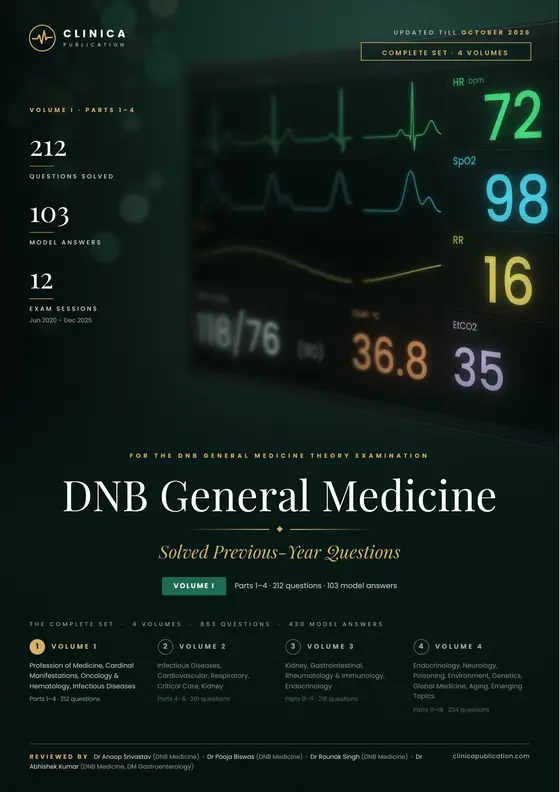
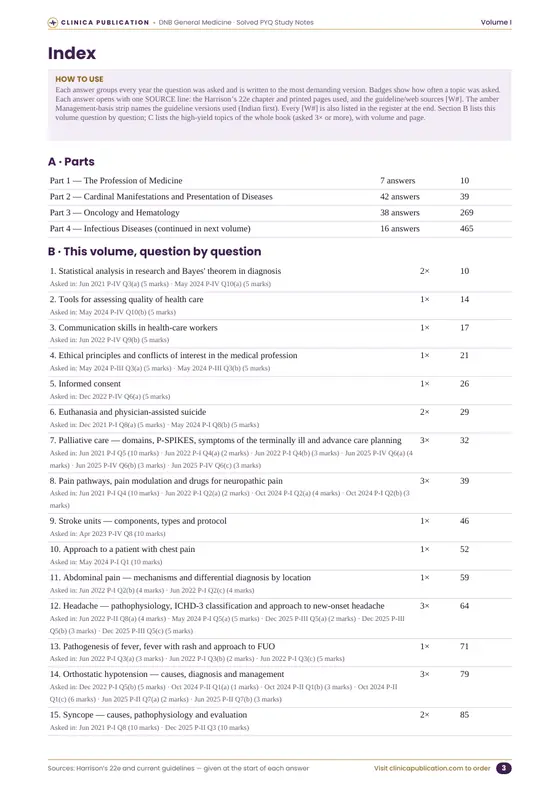
  • The Volume I cover, the complete Volume I index with the papers and years each question was asked, and the whole-book high-yield list
  • Part 1 answers: research statistics and Bayes theorem, quality of care, communication, ethics, consent, euthanasia and palliative care
  • Part 2 answers: pain, stroke units, chest pain, abdominal pain, headache, fever and FUO, orthostatic hypotension, syncope and more
DNB General Medicine free sample, page 1DNB General Medicine free sample, page 3DNB General Medicine free sample, page 18DNB General Medicine free sample, page 57

Solved answers in the free sample

  1. Statistical analysis in research and Bayes' theorem in diagnosisVolume I · Part 1
  2. Tools for assessing quality of health careVolume I · Part 1
  3. Communication skills in health-care workersVolume I · Part 1
  4. Ethical principles and conflicts of interest in the medical professionVolume I · Part 1
  5. Informed consentVolume I · Part 1
  6. Euthanasia and physician-assisted suicideVolume I · Part 1
  7. Palliative care — domains, P-SPIKES, symptoms of the terminally ill and advance care planningVolume I · Part 1
  8. Pain pathways, pain modulation and drugs for neuropathic painVolume I · Part 2
  9. Stroke units — components, types and protocolVolume I · Part 2
  10. Approach to a patient with chest painVolume I · Part 2
  11. Abdominal pain — mechanisms and differential diagnosis by locationVolume I · Part 2
  12. Headache — pathophysiology, ICHD-3 classification and approach to new-onset headacheVolume I · Part 2
  13. Pathogenesis of fever, fever with rash and approach to FUOVolume I · Part 2
  14. Orthostatic hypotension — causes, diagnosis and managementVolume I · Part 2
  15. Syncope — causes, pathophysiology and evaluationVolume I · Part 2
  16. Vertigo — approach, peripheral vs central and treatmentVolume I · Part 2
  17. Neurological findings that localise a lesionVolume I · Part 2

Frequently asked questions

How many DNB General Medicine previous-year questions are there?

This page lists 103 DNB General Medicine Volume I theory questions from 12 exam sessions, June 2020 to December 2025, arranged in 4 parts. Repeated questions are listed once, with every paper and year in which they were asked.

Which DNB General Medicine topics are asked most often?

Antimicrobial stewardship programme and strategies to prevent resistance (5×); Iron metabolism, diagnosis of iron deficiency and iron therapy (4×); Multiple myeloma and plasma-cell disorders (4×); Transfusion reactions and TRALI (4×); Palliative care — domains, P-SPIKES, symptoms of the terminally ill and advance care planning (3×).

Where can I find solved answers to these DNB General Medicine questions?

Every question on this page is answered in full in our printed DNB General Medicine solved previous-year questions, written from Harrison's Principles of Internal Medicine 22e, with current Indian and international guidelines.

Is there a free sample of the answers?

Yes. A free 100-page sample with full answers from the book is available: read the free sample (PDF).

How should I use these questions to prepare for the DNB General Medicine exam?

Start with the most-asked list, since repeated topics come back often. Then work through the topic-wise list part by part, and use the session-wise list to practise complete papers against the clock.
Get every answer in print

DNB General Medicine: the complete four-volume set, 863 questions in 430 model answers, printed, bound and delivered anywhere in India.

See the book