ClinicaPublication

Home › Books › DNB Family Medicine › Previous-year questions

Previous-year questions · June 2020 to December 2025

DNB Family Medicine previous-year questions (2020–2025)

The complete DNB Family Medicine solved question set part by part, with 34 previous-year questions in their exact exam wording and full solved answers you can read free.

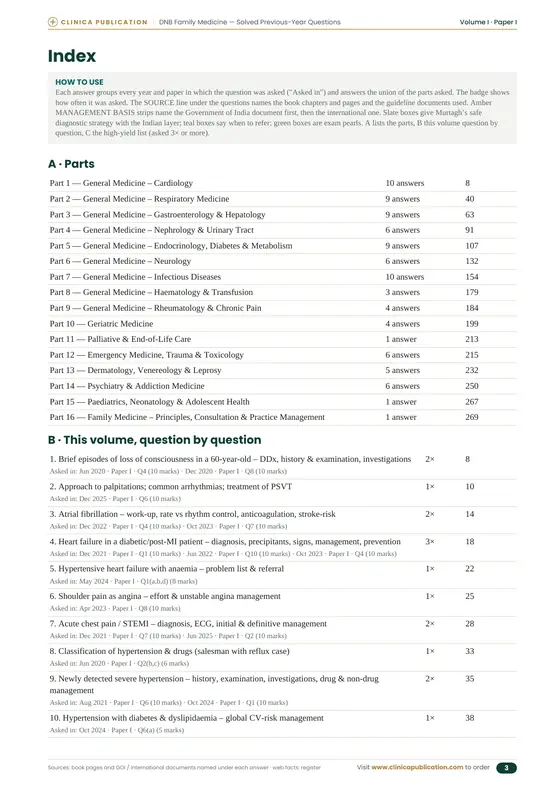
The DNB Family Medicine question set, part by part

Every previous-year question is answered in one of these 52 parts. Parts marked “free answers” have solved answers in the free sample.

Volume I — Paper I · Medicine, Dermatology, STIs and Leprosy90 model answers · 16 parts
  • Part 1 · General Medicine – Cardiology free answers
  • Part 2 · General Medicine – Respiratory Medicine
  • Part 3 · General Medicine – Gastroenterology & Hepatology
  • Part 4 · General Medicine – Nephrology & Urinary Tract
  • Part 5 · General Medicine – Endocrinology, Diabetes & Metabolism
  • Part 6 · General Medicine – Neurology
  • Part 7 · General Medicine – Infectious Diseases
  • Part 8 · General Medicine – Haematology & Transfusion
  • Part 9 · General Medicine – Rheumatology & Chronic Pain
  • Part 10 · Geriatric Medicine
  • Part 11 · Palliative & End-of-Life Care
  • Part 12 · Emergency Medicine, Trauma & Toxicology
  • Part 13 · Dermatology, Venereology & Leprosy
  • Part 14 · Psychiatry & Addiction Medicine
  • Part 15 · Paediatrics, Neonatology & Adolescent Health
  • Part 16 · Family Medicine – Principles, Consultation & Practice Management
Volume II — Paper II · Surgery, Orthopaedics, ENT, Eye, Anaesthesia and Trauma78 model answers · 13 parts
  • Part 17 · General Medicine – Gastroenterology & Hepatology free answers
  • Part 18 · General Medicine – Endocrinology, Diabetes & Metabolism free answers
  • Part 19 · General Medicine – Infectious Diseases free answers
  • Part 20 · General Medicine – Haematology & Transfusion free answers
  • Part 21 · Emergency Medicine, Trauma & Toxicology
  • Part 22 · Dermatology, Venereology & Leprosy
  • Part 23 · General Surgery (incl. Breast, Vascular, Urology, Burns)
  • Part 24 · Orthopaedics
  • Part 25 · ENT (Otorhinolaryngology)
  • Part 26 · Ophthalmology
  • Part 27 · Anaesthesia
  • Part 28 · Gynaecology & Family Planning
  • Part 29 · Community Medicine & National Health Programmes
Volume III — Paper III · Paediatrics, Obstetrics and Gynaecology70 model answers · 9 parts
  • Part 30 · General Medicine – Infectious Diseases free answers
  • Part 31 · General Medicine – Haematology & Transfusion free answers
  • Part 32 · Geriatric Medicine free answers
  • Part 33 · Dermatology, Venereology & Leprosy free answers
  • Part 34 · ENT (Otorhinolaryngology) free answers
  • Part 35 · Obstetrics free answers
  • Part 36 · Gynaecology & Family Planning
  • Part 37 · Paediatrics, Neonatology & Adolescent Health
  • Part 38 · Community Medicine & National Health Programmes
Volume IV — Paper IV · Community Medicine, Programmes, Law and Research88 model answers · 14 parts
  • Part 39 · General Medicine – Cardiology free answers
  • Part 40 · General Medicine – Endocrinology, Diabetes & Metabolism free answers
  • Part 41 · General Medicine – Infectious Diseases free answers
  • Part 42 · General Medicine – Haematology & Transfusion
  • Part 43 · Geriatric Medicine
  • Part 44 · Palliative & End-of-Life Care
  • Part 45 · Dermatology, Venereology & Leprosy
  • Part 46 · Psychiatry & Addiction Medicine
  • Part 47 · Obstetrics
  • Part 48 · Gynaecology & Family Planning
  • Part 49 · Paediatrics, Neonatology & Adolescent Health
  • Part 50 · Community Medicine & National Health Programmes
  • Part 51 · Family Medicine – Principles, Consultation & Practice Management
  • Part 52 · Epidemiology, Research Methodology & Biostatistics

DNB Family Medicine previous-year questions with free solved answers

Each question shows the exam wording, the session, paper and question number, and how often it was asked. The full answers are in the free sample.

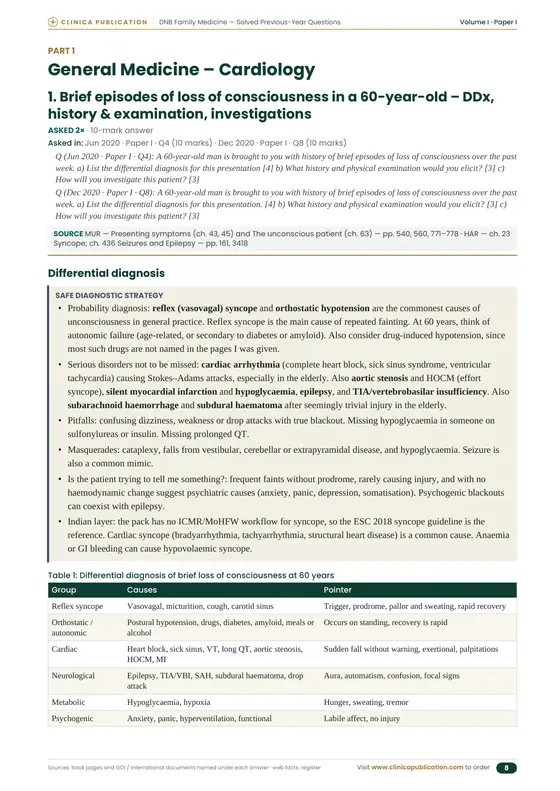
Volume I · Part 1 · General Medicine – Cardiology7 questions
  1. Brief episodes of loss of consciousness in a 60-year-old – DDx, history & examination, investigations 2×Jun 2020 · Paper I · Q4 (10 marks) · Dec 2020 · Paper I · Q8 (10 marks)

    “A 60-year-old man is brought to you with history of brief episodes of loss of consciousness over the past week. a) List the differential diagnosis for this presentation [4] b) What history and physical examination would you elicit? [3] c) How will you investigate this patient? [3]”

    “A 60-year-old man is brought to you with history of brief episodes of loss of consciousness over the past week. a) List the differential diagnosis for this presentation. [4] b) What history and physical examination would you elicit? [3] c) How will you investigate this patient? [3]”

  2. Approach to palpitations; common arrhythmias; treatment of PSVT 1×Dec 2025 · Paper I · Q6 (10 marks)

    “A 45-year-old gentleman complains of unpleasant awareness of his own heartbeat. a) What is your diagnostic approach to a person coming with palpitations? [5] b) What are the common arrhythmias seen in practice? [2] c) How will you treat PSVT? [3]”

  3. Atrial fibrillation – work-up, rate vs rhythm control, anticoagulation, stroke-risk 2×Dec 2022 · Paper I · Q4 (10 marks) · Oct 2023 · Paper I · Q7 (10 marks)

    “A 67-year-old lady was brought to the emergency room with h/o dizziness but no loss of consciousness. She is a known diabetic and hypertensive, occasionally noncompliant with her medications. Her BP is 130/86mmHg, PR- 86/min - irregularly irregular, GRBS- 186mg%. a) What immediate office investigation would you do? [1] b) What may be the most probable diagnosis? [1] c) What other investigations you would want to do? [2] d) What are the complications of this condition? [2] e) How will you assess this patient for stroke risk? [2] f) How will you manage this patient? [2]”

    “A 74-year-old woman presents for her annual physical examination and notes increasing fatigue over the past 3 months. Her history is notable for longstanding systolic hypertension. A physical examination now demonstrates a blood pressure of 120/70 mmHg and an irregular pulse of approximately 120 bpm at rest. The patient’s body mass index is 22. An electrocardiogram confirms atrial fibrillation with a ventricular response of 120 bpm and ECG suggestive of left ventricular hypertrophy. An echocardiogram done a year earlier to evaluate left ventricular hypertrophy was notable only for mild, global left ventricular dysfunction with a left ventricular ejection fraction of 40% and mild mitral regurgitation. The patient’s chronic medical regimen includes lisinopril 20 mg, metoprolol XL 25 mg and 75 mg aspirin daily. A repeat echocardiogram performed in the office demonstrates an ejection fraction of 20% with global hypokinesis. a) What medications should be chosen to control the rate acutely? [2] b) What further work up is required for new onset AF? [2] c) Should one restore sinus rhythm or choose a strategy of rate control? [2] d) What are the anticoagulation requirements for this patient? [2] e) If the decision is made to maintain sinus rhythm after the cardioversion, what are the best medical or procedural options? [2]”

  4. Heart failure in a diabetic/post-MI patient – diagnosis, precipitants, signs, management, prevention 3×Dec 2021 · Paper I · Q1 (10 marks) · Jun 2022 · Paper I · Q10 (10 marks) · Oct 2023 · Paper I · Q4 (10 marks)

    “A 65-year-old man with type 2 diabetes mellitus with past history of acute myocardial infarction 5 years ago, presented to you with dyspnoea on exertion, fatigue, swelling legs and decreased urine output for 5 days duration. He is finding it difficult to sleep at night and wakes up due to breathing difficulty and gets relief after sitting up for sometime. a) What is your probable diagnosis for the presenting symptoms? Explain the clinical features and pathophysiology? [4] b) How will you manage this patient? [4] c) What is the role of family physician in prevention of this condition? [2]”

    “A 50 year old male known to have diabetes and hypertension for 15 years. He had history of acute coronary syndrome a year ago. Now comes to you with fatigue, decreased food intake and dyspnea on exertion. Clinically pedal edema, elevated JVP and on bilateral asculation of the lung bases, he had fine crepitations. What clinical possibilities will you entertain? How do you proceed to evaluate this patient? As a family physician, how will you manage this case? [10]”

    “A 56-year-old male presented to OPD with complaints of swelling of feet and breathing difficulty which has been increasing over the past 8 weeks. He is a diabetic and hypertensive: a) What are the precipitating causes of cardiac failure? [2] b) What are the signs of left and right heart failure? [2] c) What investigations you would want to perform? [2] d) What are the nonpharmacological and pharmacological managements? [4]”

  5. Hypertensive heart failure with anaemia – problem list & referral 1×May 2024 · Paper I · Q1(a,b,d) (8 marks)

    “A 52-year-old male presented to you with complaints of progressive dyspnea on exertion for the past 2 months. He has never consulted a doctor so far in the past two months. He reports bleeding per rectum in the past two months for which he took native treatment from traditional healers. On examination, his face is puffy and significant pallor is present. There is bilateral pitting pedal edema and Jugular Venous Pulse is elevated. His pulse rate is 110 per minute and regular in rhythm. His blood pressure is 210/100 mmHg in the right upper limb. His BMI is 35 Kg/m2. a) Write a problem list and provisional diagnosis for this patient. [2] b) What are the possible etiological factors contributing to the clinical picture? [2] d) As a family doctor, how will you manage this patient in your practice? Mention two indications for referral to the specialist. [4]”

  6. Shoulder pain as angina – effort & unstable angina management 1×Apr 2023 · Paper I · Q8 (10 marks)

    “A 70-year-old lady presents with pain of the left shoulder for the 2 weeks. She is a diabetic and a hypertensive. a) List the differential diagnosis. [2] b) You suspect that she could be having coronary heart disease. How will you investigate to confirm this? [3] c) Outline the management of effort angina and unstable angina. [5]”

  7. Acute chest pain / STEMI – diagnosis, ECG, initial & definitive management 2×Dec 2021 · Paper I · Q7 (10 marks) · Jun 2025 · Paper I · Q2 (10 marks)

    “A 50-year-old male, smoker with type 2 diabetes for past 5 years, presented to the emergency department with sudden onset left sided chest pain for past 1 hour with associated autonomic symptoms. His pulse rate is 120 per minute and blood pressure is 190/110 mmHg. His oxygen saturation is 99%. a) What is your diagnosis and how will you confirm the diagnosis? [3] b) How will you manage this man today in the emergency department? [3] c) What are the causes of chest pain and how will you clinically evaluate any patient with chest pain? [4]”

    “A 52-year-old gentleman was brought to the OPD with chest discomfort since this morning. He has no comorbidities. a) What initial assessment will you perform? [2] b) Write the findings in ECG consistent with ST Elevation Myocardial Infarction (STEMI). [3] c) What is the initial management you provide for STEMI? [2] d) Mention the definitive management in STEMI and Non STEMI. [3]”

Volume II · Part 17 · General Medicine – Gastroenterology & Hepatology3 questions
  1. Dysphagia – causes, red flags, approach 1×Dec 2025 · Paper II · Q8 (10 marks)

    “A 55-year-old lady presents with difficulty in swallowing for the last few weeks. a) What are the causes of dysphagia? [2] b) What are the red flag pointers in dysphagia? [2] c) How will you approach this person with complaints of dysphagia? [6]”

  2. Cholera with shock – approach, diagnosis, treating patient & family, informing authorities 1×Dec 2025 · Paper II · Q6 (10 marks)

    “A 25-year-old gentleman has developed multiple episodes of loose stools for one day. He is brought to the casualty department and is found to be in shock. His brother was diagnosed with cholera and was admitted to the hospital 1 day ago. a) How will you approach this person who is in shock? [4] b) How will you diagnose cholera? [2] c) How will you treat the patient and the family members? [2] d) How and why would you inform the public health authorities? [2]”

  3. Hepatitis B (HBsAg-positive couple in pregnancy) – markers, course, management 1×Oct 2023 · Paper II · Q3 (10 marks)

    “A 28-year-old female came for antenatal checkup, she was found to be Hbs Ag positive. Her husband was also checked and found to be HBsAg positive: a) Who are the groups of people at increased risk for transmission? [2] b) Which are the acute phase and chronic phase serological markers? [2] c) What will be the course of disease? [2] d) Write briefly on management of chronic Hepatitis B. [2] e) If her husband was tested negative, what advice you would have given? [2]”

Volume II · Part 18 · General Medicine – Endocrinology, Diabetes & Metabolism2 questions
  1. Midline neck swelling moving with deglutition ± thyrotoxicosis – DDx, investigations (TI-RADS), treatment 3×Jun 2020 · Paper II · Q1 (10 marks) · Oct 2024 · Paper II · Q4 (10 marks) · Jun 2025 · Paper II · Q10 (10 marks)

    “A 28-year-old female presents with diffuse swelling in the mid line of neck which moves with deglutition. She also has bilateral prominent eyes. a) Discuss the differential diagnosis in such case. [3] b) What investigations will you do and what do you expect in her? [3] c) What are all the various treatment options available to her? [4]”

    “An 18-year-old girl has come with swelling in front of the neck for the past three months. a) List the differential diagnosis. How will you differentiate thyroid swelling from other swellings? [3] b) Mention any four features of thyrotoxicosis you will look for in this patient. [2] c) What are the initial investigations and management in family practice? [4] d) List any two indications for surgical treatment? [1]”

    “A 17-year-old girl presented to you with a swelling in front of her neck, which moves with deglutition. On examination, her pulse rate is 130 per minute and she has fine tremors. a) What relevant history will you elicit and what will you look for in the examination? [3] b) Describe the thyroid Image reporting and data scoring system. [3] c) Describe the management of this 17-year-old girl. [4]”

  2. Functions of thyroid hormones; features of hyper- & hypothyroidism 1×Oct 2023 · Paper II · Q8 (10 marks)

    “A 65-year-old man presents with history of tiredness, frequent stools and decreased sleep for the past 3 months. She is a known diabetic on Metformin 1gm BD. She also reports to have a recent loss weight of 3 Kgs. On examination, extremities are warm to touch, pulse- 110/min, BP- 140/70mmHg, cardiac auscultation S1S2 present and a soft systolic murmur over apex and aortic area, chest is clear. a) What are the functions of thyroid hormones in a normal human? [2] b) What are the common symptoms and signs of hyperthyroidism? [3] c) What are the common symptoms and signs of hypothyroidism? [3] d) What complications do you expect in her if she is left untreated? [2]”

Volume II · Part 19 · General Medicine – Infectious Diseases1 questions
  1. Rational use of antibiotics in sore throat 1×Apr 2023 · Paper II · Q5(b) (5 marks)

    “A 14-year-old old boy presents with fever and sore throat: b) Discuss rational use of antibiotics for treating patients with sore throat. [5]”

Volume II · Part 20 · General Medicine – Haematology & Transfusion2 questions
  1. Anaemia from GI blood loss – history, causes, drugs causing anaemia 1×Oct 2023 · Paper II · Q9(a,b,d) (6 marks)

    “A 65-year-old male presented with recent history, nausea and loss of appetite and dark coloured stools, he was pale and his haemoglobin was 6.5gm%: a) What clinical diagnosis you would offer as the cause of his anemia? [2] b) What all points you will elicit in history to find out the possible causes of anemia? [2] d) What medications can cause anaemia? [2]”

  2. Blood transfusion – indications, risks, donor testing, ward precautions 1×Dec 2022 · Paper II · Q5 (10 marks)

    “Mrs. Satya aged 40 years, presented to outpatient department with history of tiredness and fatigue, she gives history of heavy menstrual bleeding for 5 days, and on examination she is pale. a) What are the indications of blood transfusion? [2] b) What are the risks and complications of blood transfusion? [3] c) What tests will you do on the donor blood before transfusion? [2] d) What measures will you take before, during and after the transfusion in the ward? [3]”

Volume III · Part 30 · General Medicine – Infectious Diseases3 questions
  1. Paediatric TB – diagnosis, treatment, prevention, advice to anganwadi 1×Dec 2022 · Paper III · Q10 (10 marks)

    “A 5-year-old child was brought by his mother with cough, and mild fever for past 2 weeks. His weight is 13 kg (Birth wt-2.9kg). His father was treated for pulmonary TB 3 months back: a) Discuss diagnosis of TB in this child. [2] b) Discuss the treatment of pediatric TB as per National TB elimination program. [4] c) What measures could have prevented the child from being infected by his father? [2] d) What advice will you give to the anganwadi that the child is attendng? [2]”

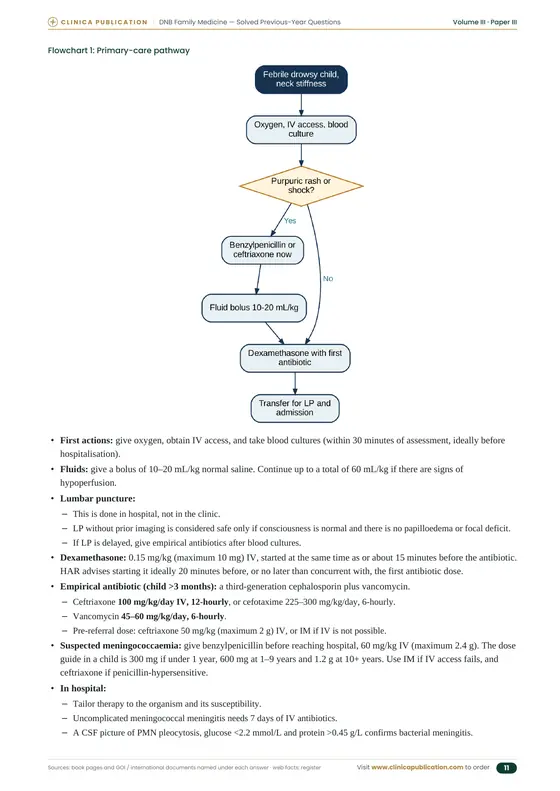
  2. Meningitis in a 2-year-old – organisms, management, referral 1×Jun 2025 · Paper III · Q1 (10 marks)

    “A 2-year-old boy was brought by his mother with complaints of fever, headache associated with vomiting for past 2 days. He is drowsy since this morning. On examination, he is febrile (103°F), conscious, lethargic and there was neck stiffness. There was no weakness in the extremities. a) What are your diagnosis and differential diagnoses? [2] b) What are the common organisms which cause the above condition? How will you manage this child in family practice? [5] c) What are the complications during the treatment that would need referral to the higher center? [3]”

  3. Serodiscordant couple – condom rupture (PEP) & planning conception 1×Apr 2023 · Paper III · Q2 (10 marks)

    “Mr. B, an HIV positive patient, with supressed viral load gets married. The wife knows his condition and the couple is practising safe sex. Mr. B gives a frantic call saying that the condom ruptured during intercourse. a) What advice will you provide to the couple? [5] b) After 2 years of marriage, they decide to conceive a child. What advice and precautions will you give? [5]”

Volume III · Part 31 · General Medicine – Haematology & Transfusion1 questions
  1. Anaemia in adolescent girl – investigations, prevention, treatment 1×Dec 2020 · Paper III · Q7 (10 marks)

    “A 13-year-old girl is brought to you with a history of tiredness. On examination, you find that she is pale and undernourished. a) What are the investigations that you will conduct? [5] b) What are the prevention and treatment modalities for anemia in [5]”

Volume III · Part 32 · Geriatric Medicine1 questions
  1. Elder abuse – warning signs, prevention, legal remedies 1×Dec 2020 · Paper III · Q10 (10 marks)

    “Elder abuse is becoming a common phenomenon: a) What are the warning signs of this problem that you are likely to see in your practice? [5] b) What are the preventive measures to prevent this issue? [3] c) What are the legal remedies that are available to the elderly in such situations? [2]”

Volume III · Part 33 · Dermatology, Venereology & Leprosy1 questions
  1. Management of STIs 2×Jun 2022 · Paper III · Q2(b) (5 marks) · Oct 2023 · Paper III · Q7(d) (3 marks)

    “A 35-year old sexually active lady presents to you with vaginal discharge. b) WHO syndromic approach to sexually acquired infections. [5]”

    “A 28-year-old female presented to you with complaints of vaginal white discharge. Its curdy, yellowish and foul smelling: d) Write briefly on the management of sexually transmitted infections. [3]”

Volume III · Part 34 · ENT (Otorhinolaryngology)1 questions
  1. Acute otitis media / ear pain in a young child – causes, signs, management, delayed antibiotics 2×Aug 2021 · Paper III · Q9 (10 marks) · Apr 2023 · Paper III · Q7 (10 marks)

    “Discuss the clinical features and management of acute otitis media in a 10 month old otherwise healthy child. Outline the role of delayed antibiotic therapy in this condition. [10]”

    “A 4-year-old-girl is brought to you by her parents as she has been crying continuously and rubbing her left ear. a) What are the likely causes? [2] b) What physical signs will be seen in different conditions and how will you manage each one of them? [8]”

Volume III · Part 35 · Obstetrics2 questions
  1. Thyroid disorders in pregnancy & postpartum; neonatal TSH screening 1×Dec 2025 · Paper III · Q3 (10 marks)

    “A P2L2 mother delivered, normal vaginally, 10 months ago. She has gained weight and has irregular periods postpartum. a) Write briefly on thyroid disorders during pregnancy and postpartum. [7] b) What is the role of neonatal TSH screening? [3]”

  2. Antenatal care – investigations, visits, advice, high-risk factors 5×Dec 2022 · Paper III · Q9(a,b) (5 marks) · Apr 2023 · Paper III · Q4(a,b) (5 marks) · Oct 2023 · Paper III · Q1 (10 marks) · Jun 2025 · Paper III · Q4 (10 marks) · Dec 2025 · Paper III · Q2(a) (2 marks)

    “Mrs. Rubina G3P2L1IUD presented at 24 weeks of gestational age for follow up. Her Glucose tolerance test results were as follows: 106, 194 and 176mg% at fasting, 1 hour and 2 hours respectively. She gives history of having gestational diabetes toward the later part in previous pregnancy and was on medical nutrition therapy: a) What is a high risk pregnancy? [2] b) What other relevant history and risk factors you will explore? [3]”

    “A 24-year-old primi gravida comes to you for antenatal check up in the 3rd month. a) What tests will you do? [2] b) What advice will you provide for good pregnancy outcome? [3] At 30th week, she presented with pedal odema and her BP is 140/90 mmHg. [3]”

    “A 35-year-old female high school teacher, who is overweight, consults you at 12 weeks of gestation. Her both parents are diabetic: a) How will you proceed? [2] b) What all investigations you will advise throughout her ANC? [3] c) What are the recommended minimum number of visits for low-risk pregnancy and at what gestation age? [2] d) What all conditions will lead to high-risk pregnancy? [3]”

    “A 23-year-old G3P1L1 SB1 at 36 weeks of gestational age with previous spontaneous preterm birth at 34 weeks with previous small for gestational age has come for ANC follow-up. a) What are the risk factors for preterm birth? [3] b) Which are the factors classify a pregnancy as a high-risk pregnancy? [3] c) What are the routine investigations and recommended visits included in antenatal care in a low-risk and high-risk pregnancy? [4]”

    “A 35-year-old lady G2P1L1 at 14 weeks of gestation comes for her antenatal care. She is worried, since she had PIH (Pregnancy induced hypertension) in her previous pregnancy. a) What are high-risk pregnancies? [2]”

Volume IV · Part 39 · General Medicine – Cardiology2 questions
  1. ACS golden hour; antiplatelet & statin guidelines 1×Dec 2025 · Paper IV · Q3 (10 marks)

    “A 45-year-old gentleman developed recently an ACS. He was on treatment for diabetes mellitus and hypertension. a) What is golden hour in ACS? [2] b) What is the role of the primary care provider in golden hour? [3] c) What are the recent guidelines on the usage of antiplatelets and statins in the prevention and treatment of major cardiovascular events? [5]”

  2. Factors affecting control of primary hypertension 1×Jun 2025 · Paper IV · Q4(a) (4 marks)

    “You are having many patients with hypertension taking treatment in your family practice. Only 50% of them are controlled with medications. Rest of them are uncontrolled even after taking regular medications. You want to study whether drug A or drug B is effective for hypertension in your population. a) What are the factors affecting the control of hypertension in an adult with primary hypertension? [4]”

Volume IV · Part 40 · General Medicine – Endocrinology, Diabetes & Metabolism2 questions
  1. Obesity classification, calorie needs & diet plan 1×Jun 2025 · Paper IV · Q6 (10 marks)

    “A 55-year-old post-menopausal woman, married for 28 years with two children, has come to you for management of uncontrolled diabetes. Her height is 152 cm, and her weight is 88 kg. She is a housewife with sedentary lifestyle. a) How will you classify obesity and what class she fits in? [2] b) What is the daily calories and proteins requirement to maintain her health? [2] c) Write a diet sheet for the patient mentioned above to control her diabetes as well as for weight loss. [3] d) What health promotions and preventions you suggest for her as her personal physician? [3]”

  2. Overweight school children – causes, risks, FP role 1×May 2024 · Paper IV · Q10 (10 marks)

    “You conduct a school health screen for 10th graders and identify 30% of the students are overweight: a) What are the causes for more students being overweight in the past decade? [3] b) What are the future health risks for children with overweight and obesity? [3] c) What is your role in health promotion and prevention as family practitioner for this group of students? [4]”

Volume IV · Part 41 · General Medicine – Infectious Diseases6 questions
  1. Fever, rash, shock with thrombocytopenia – DDx & management 1×Oct 2023 · Paper IV · Q8(a) (5 marks)

    “A 28-year-old man has presented to your health centre with fever and body pain for past four days. There was no obvious focus of infection. Clinical examination reveals an erythematous rash over the chest, trunk and extremities. Pulse rate of 120 / minute. Blood pressure was 78/60 mmHg in right upper limb. There are patients with similar presentation for the past two weeks. His investigations revealed leukopenia and thrombocytopenia; WBC count of 2800/cumm and platelet count of 63,000/cumm. a) What are the possible differential diagnosis? How will you manage him? [5] You heard that there are similar fever patients in the locality from the community workers. [5]”

  2. Integrated vector control in a malaria outbreak 1×May 2024 · Paper IV · Q2(a,c) (6 marks)

    “You have diagnosed 17 cases of malaria in a village of population of 1000 in the last one month. There was only one or two cases diagnosed in the previous months. a) Which are the vectors that transmit Dengue fever, Malarial fever and Chikungunya? [2] c) How will you apply integrated vector control measures in the village? [4]”

  3. NTEP/RNTCP – objectives, recent changes, diagnosis, categorisation, treatment regimens 4×Dec 2021 · Paper IV · Q8 (10 marks) · Jun 2022 · Paper IV · Q7 (10 marks) · Oct 2023 · Paper IV · Q10 (10 marks) · May 2024 · Paper IV · Q7 (10 marks)

    “What are the recent changes in Revised National Tuberculosis programme and what advice will you give to a patient who has been initiated on anti-tuberculous treatment. [10]”

    “What are the aims and objectives of Revised National TB Control Programme of India (elimination program 2020)? How does this programme help to achieve elimination of TB from India? With regard to HIV infection, what are the recommendations by the program? [10]”

    “A 35-year-old, a daily wage labourer presented with weight loss, cough and expectoration for past 3 weeks, with evening rise of fever: a) What are the objectives of Revised National Tuberculosis Control Programme? [2] b) How is the diagnosis, categorization of Tuberculosis done under RNTCP? [4] c) Write about the treatment regimens of Tuberculosis according to RNTCP? [4]”

    “a) Mention the objectives of the recent National Tuberculosis Programme. [2] b) Write briefly about the following as per the National Tuberculosis Programme: [2] i) Diagnosis of Tuberculosis. [2] ii) Categorization. [2] iii) Treatment of Tuberculosis. [2]”

  4. ATT – causes of default, adherence measures, adverse effects 1×Jun 2020 · Paper IV · Q9 (10 marks)

    “A 45-year male had been diagnosed to have TB and started on anti- tubercular treatment (ATT). He returns in two weeks to say that his fever is persisting. What are the common causes of discontinuation of ATT? What measures can you take to ensure compliance? What are the common side effects and adverse effects of the first line ATT? [10]”

  5. Vertical transmission, PPTCT under NACP & PEP 1×Oct 2023 · Paper IV · Q9 (10 marks)

    “A 28-year-old was found to be HIV positive during her ANC: a) Discuss vertical transmission of HIV infection. [3] b) What are the various modalities for prevention of vertical transmission of HIV under National AIDS Control Programme? [3] c) Discuss the post exposure prophylaxis in HIV. [4]”

  6. Treating malaria & implementing malaria elimination framework 1×Jun 2025 · Paper IV · Q10 (10 marks)

    “You have been appointed as a medical officer in-charge of a community health centre in a district with high incidence of malaria (both P. Vivax and P. Falciparum). a) How will you treat an adult with fever and blood smear positive for malaria? [5] b) How will you implement "malaria control" in the community served by your health center according to the national framework for malaria elimination in India? [5]”

Read these answers free

The free 100-page sample is taken straight from the printed DNB Family Medicine volumes, with the book's own page numbers. It contains:

  • The cover of the set and of each volume, the parts of every paper, and the opening of each volume's question-by-question index
  • Volume I (Paper I): seven cardiology answers, from loss of consciousness, palpitations and atrial fibrillation to heart failure, angina and STEMI
  • Volume II (Paper II): dysphagia, cholera with shock, hepatitis B in pregnancy, thyroid swelling and thyroid function, antibiotics in sore throat, anaemia and blood transfusion
  • Volume III (Paper III): paediatric TB, meningitis, PEP and conception in a serodiscordant couple, adolescent anaemia, elder abuse, STIs, otitis media, thyroid disease in pregnancy and antenatal care
  • Volume IV (Paper IV): ACS, hypertension control, obesity and diet plans, school health, fever with shock, malaria control, NTEP and ATT adherence, and PPTCT
  • Management basis strips naming the Government of India document first, Murtagh's safe diagnostic strategy, refer-when boxes and exam pearls
DNB Family Medicine free sample, page 1DNB Family Medicine free sample, page 4DNB Family Medicine free sample, page 6DNB Family Medicine free sample, page 59

Frequently asked questions

What does the DNB Family Medicine solved previous-year question set cover?

480 questions solved in 326 model answers across 52 parts in 4 volumes, from the June 2020 to December 2025 exit examinations. Repeated questions are answered once, with every paper and year in which they were asked.

Which textbooks are the DNB Family Medicine answers written from?

Murtagh's General Practice 9e at the core, with Harrison's 22e, Bailey and Love 28e, Park's Preventive and Social Medicine, DC Dutta, Ghai and Dhingra for their subjects, and current Government of India programme documents, ICMR Standard Treatment Workflows and Acts.

Can I read some answers before buying?

Yes. 34 complete answers are in the free 100-page sample: read the free sample (PDF). The questions they answer are listed on this page with the exact exam wording.

Where can I order the DNB Family Medicine book?

Order the printed set from the DNB Family Medicine book page. It is printed, bound and delivered anywhere in India.

Get every answer in print

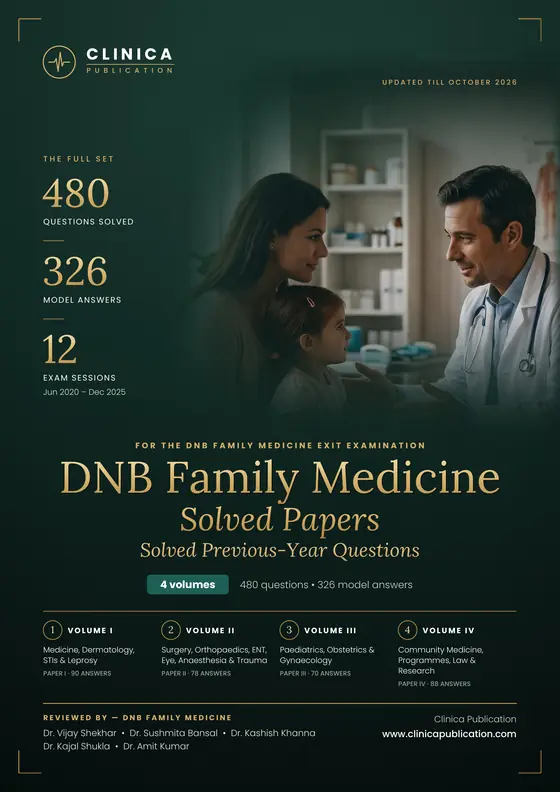
DNB Family Medicine: 480 questions solved in 326 model answers, printed, bound and delivered anywhere in India.

See the book