The DNB ENT question set, part by part
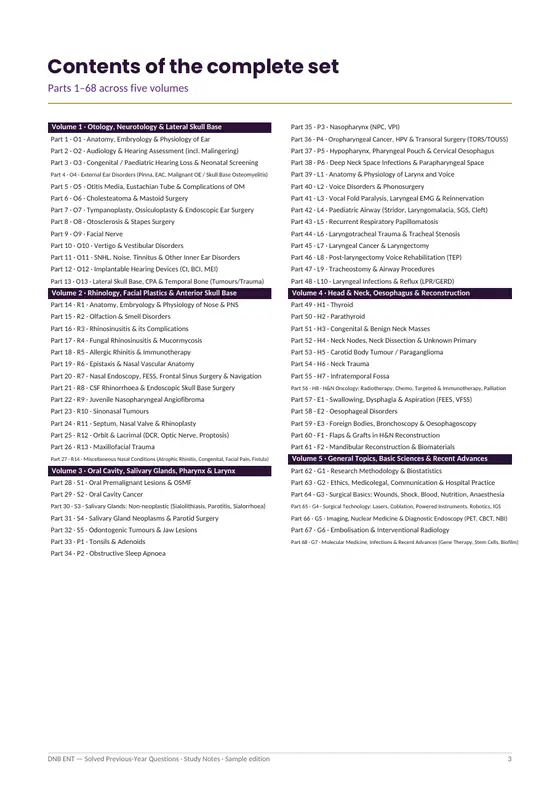
Every previous-year question is answered in one of these 68 parts. Parts marked “free answers” have solved answers in the free sample.
Volume 1 — Otology, Neurotology & Lateral Skull Base136 answers
- Part 1 · Anatomy, Embryology & Physiology of Ear free answers
- Part 2 · Audiology & Hearing Assessment (incl. Malingering)
- Part 3 · Congenital / Paediatric Hearing Loss & Neonatal Screening
- Part 4 · External Ear Disorders (Pinna, EAC, Malignant OE / Skull Base Osteomyelitis)
- Part 5 · Otitis Media, Eustachian Tube & Complications of OM
- Part 6 · Cholesteatoma & Mastoid Surgery
- Part 7 · Tympanoplasty, Ossiculoplasty & Endoscopic Ear Surgery
- Part 8 · Otosclerosis & Stapes Surgery
- Part 9 · Facial Nerve
- Part 10 · Vertigo & Vestibular Disorders
- Part 11 · SNHL, Noise, Tinnitus & Other Inner Ear Disorders
- Part 12 · Implantable Hearing Devices (CI, BCI, MEI)
- Part 13 · Lateral Skull Base, CPA & Temporal Bone (Tumours/Trauma)
Volume 2 — Rhinology, Facial Plastics & Anterior Skull Base110 answers
- Part 14 · Anatomy, Embryology & Physiology of Nose & PNS free answers
- Part 15 · Olfaction & Smell Disorders
- Part 16 · Rhinosinusitis & its Complications
- Part 17 · Fungal Rhinosinusitis & Mucormycosis
- Part 18 · Allergic Rhinitis & Immunotherapy
- Part 19 · Epistaxis & Nasal Vascular Anatomy
- Part 20 · Nasal Endoscopy, FESS, Frontal Sinus Surgery & Navigation
- Part 21 · CSF Rhinorrhoea & Endoscopic Skull Base Surgery
- Part 22 · Juvenile Nasopharyngeal Angiofibroma
- Part 23 · Sinonasal Tumours
- Part 24 · Septum, Nasal Valve & Rhinoplasty
- Part 25 · Orbit & Lacrimal (DCR, Optic Nerve, Proptosis)
- Part 26 · Maxillofacial Trauma
- Part 27 · Miscellaneous Nasal Conditions (Atrophic Rhinitis, Congenital, Facial Pain, Fistula)
Volume 3 — Oral Cavity, Salivary Glands, Pharynx & Larynx130 answers
- Part 28 · Oral Premalignant Lesions & OSMF free answers
- Part 29 · Oral Cavity Cancer free answers
- Part 30 · Salivary Glands: Non-neoplastic (Sialolithiasis, Parotitis, Sialorrhoea)
- Part 31 · Salivary Gland Neoplasms & Parotid Surgery
- Part 32 · Odontogenic Tumours & Jaw Lesions
- Part 33 · Tonsils & Adenoids
- Part 34 · Obstructive Sleep Apnoea
- Part 35 · Nasopharynx (NPC, VPI)
- Part 36 · Oropharyngeal Cancer, HPV & Transoral Surgery (TORS/TOUSS)
- Part 37 · Hypopharynx, Pharyngeal Pouch & Cervical Oesophagus
- Part 38 · Deep Neck Space Infections & Parapharyngeal Space
- Part 39 · Anatomy & Physiology of Larynx and Voice
- Part 40 · Voice Disorders & Phonosurgery
- Part 41 · Vocal Fold Paralysis, Laryngeal EMG & Reinnervation
- Part 42 · Paediatric Airway (Stridor, Laryngomalacia, SGS, Cleft)
- Part 43 · Recurrent Respiratory Papillomatosis
- Part 44 · Laryngotracheal Trauma & Tracheal Stenosis
- Part 45 · Laryngeal Cancer & Laryngectomy
- Part 46 · Post-laryngectomy Voice Rehabilitation (TEP)
- Part 47 · Tracheostomy & Airway Procedures
- Part 48 · Laryngeal Infections & Reflux (LPR/GERD)
Volume 4 — Head & Neck, Oesophagus & Reconstruction114 answers
- Part 49 · Thyroid free answers
- Part 50 · Parathyroid
- Part 51 · Congenital & Benign Neck Masses
- Part 52 · Neck Nodes, Neck Dissection & Unknown Primary
- Part 53 · Carotid Body Tumour / Paraganglioma
- Part 54 · Neck Trauma
- Part 55 · Infratemporal Fossa
- Part 56 · H&N Oncology: Radiotherapy, Chemo, Targeted & Immunotherapy, Palliation
- Part 57 · Swallowing, Dysphagia & Aspiration (FEES, VFSS)
- Part 58 · Oesophageal Disorders
- Part 59 · Foreign Bodies, Bronchoscopy & Oesophagoscopy
- Part 60 · Flaps & Grafts in H&N Reconstruction
- Part 61 · Mandibular Reconstruction & Biomaterials
Volume 5 — General Topics, Basic Sciences & Recent Advances91 answers
- Part 62 · Research Methodology & Biostatistics free answers
- Part 63 · Ethics, Medicolegal, Communication & Hospital Practice
- Part 64 · Surgical Basics: Wounds, Shock, Blood, Nutrition, Anaesthesia
- Part 65 · Surgical Technology: Lasers, Coblation, Powered Instruments, Robotics, IGS
- Part 66 · Imaging, Nuclear Medicine & Diagnostic Endoscopy (PET, CBCT, NBI)
- Part 67 · Embolisation & Interventional Radiology
- Part 68 · Molecular Medicine, Infections & Recent Advances (Gene Therapy, Stem Cells, Biofilm)