ClinicaPublication

Home › Books › DNB Emergency Medicine › Previous-year questions

Free question list · June 2020 to December 2025

DNB Emergency Medicine previous-year questions (2020–2025)

All 627 DNB Emergency Medicine exit-exam theory questions from June 2020 to December 2025, topic-wise and session-wise, with how often each one has been asked. Use the list to find the high-yield topics, then read the solved answers in our printed book.

Most-asked DNB Emergency Medicine questions

These questions have been set three times or more since June 2020. The number shows how many times each was asked.

  1. Tumour lysis syndrome: criteria, investigations and ED management 5×Volume 3 · Part 19 · Haematological & Oncological Emergencies
  2. Spinal cord syndromes; central vs anterior cord syndrome 4×Volume 1 · Part 1 · Applied Anatomy
  3. Cerebral circulation, regulation of CBF and autoregulation 4×Volume 1 · Part 2 · Applied Physiology
  4. Physiology of temperature regulation: the hypothalamic thermostat and responses to heat and cold 4×Volume 1 · Part 2 · Applied Physiology
  5. Diagnostic test accuracy 4×Volume 1 · Part 3 · Biostatistics & Research Methodology
  6. Child abuse: types, signs and injuries that suggest abuse, evaluation and reporting 4×Volume 1 · Part 4 · Medico-legal & Ethics
  7. Risk-stratification scores: HEART, EDACS, ACC/AHA, TIMI, GRACE 4×Volume 1 · Part 8 · Cardiovascular Emergencies
  8. Dehydration in a child with diarrhoea: clinical grading, ED evaluation and fluid therapy (moderate vs severe) 4×Volume 2 · Part 13 · Paediatric & Neonatal Emergencies
  9. Sepsis: Sepsis-3, diagnosis, prehospital antibiotics, vancomycin 4×Volume 2 · Part 14 · Infectious Diseases, Sepsis & COVID-19
  10. Acute vertigo: differential, approach and management algorithm 4×Volume 2 · Part 15 · Neurological Emergencies
  11. Thyroid storm: precipitants, clinical features, Burch-Wartofsky Point Scale and ED management 4×Volume 3 · Part 18 · Endocrine & Metabolic Emergencies
  12. Adrenal insufficiency and acute adrenal crisis: recognition, ED approach, management, hydrocortisone and fluids 4×Volume 3 · Part 18 · Endocrine & Metabolic Emergencies
  13. Acute painful red eye: differential diagnosis and management 4×Volume 3 · Part 20 · Eye, ENT & Dental Emergencies
  14. Periorbital versus orbital cellulitis 4×Volume 3 · Part 20 · Eye, ENT & Dental Emergencies
  15. Acute visual loss: differential diagnosis and management 4×Volume 3 · Part 20 · Eye, ENT & Dental Emergencies
  16. Rotator cuff injuries: risk factors, clinical assessment, imaging and management 4×Volume 3 · Part 22 · Orthopaedic & Musculoskeletal Emergencies
  17. Acute agitation in the ED: approach, assessment, management, rapid tranquillisation and pharmacological restraint 4×Volume 3 · Part 23 · Psychiatric & Behavioural Emergencies
  18. Delirium: definition, causes, assessment (CAM, RASS), evaluation and management in the elderly 4×Volume 3 · Part 23 · Psychiatric & Behavioural Emergencies
  19. Hip dislocation and the dashboard injury 4×Volume 3 · Part 25 · Trauma (ATLS order)
  20. Ocular ultrasound: technique and utility in trauma 4×Volume 3 · Part 26 · Procedures (Roberts & Hedges order)
  21. Paediatric vs adult airway 3×Volume 1 · Part 1 · Applied Anatomy
  22. Brachial plexus: labelled diagram 3×Volume 1 · Part 1 · Applied Anatomy
  23. Buffers, respiratory and renal regulation of acid–base balance 3×Volume 1 · Part 2 · Applied Physiology
  24. Physiology of haemostasis, the coagulation cascade and approach to the bleeding patient on warfarin 3×Volume 1 · Part 2 · Applied Physiology

Topic-wise DNB Emergency Medicine previous-year questions

Grouped the way the book is organised, 3 volumes and 27 parts. Open a part to see its questions, how often each was asked, and the session, paper, question number and marks.

Volume 1 — Basic Sciences, Resuscitation and Cardiovascular

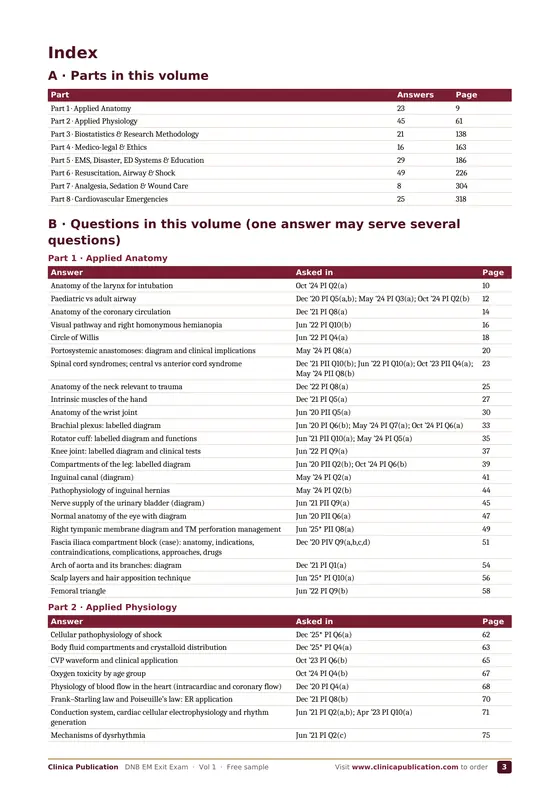
Part 1 · Applied Anatomy23 questions
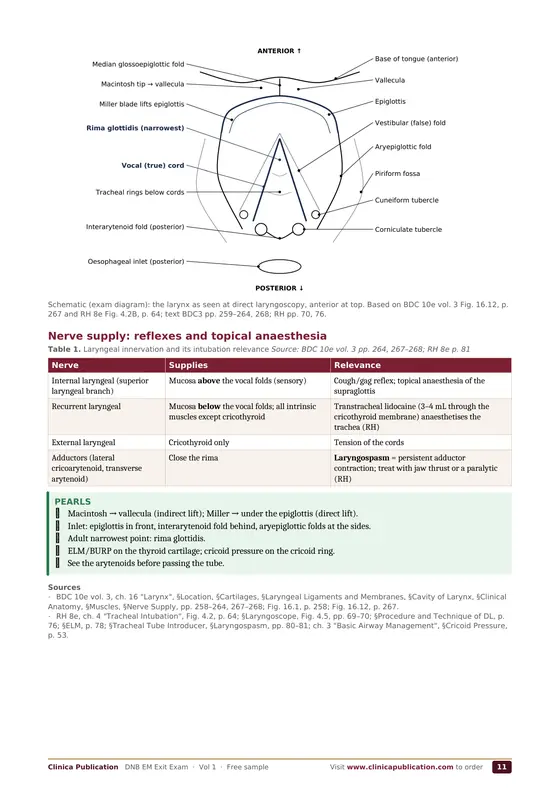
  1. Anatomy of the larynx for intubation 1×Oct 2024 · Paper I · Q2(a)
  2. Paediatric vs adult airway 3×Dec 2020 · Paper I · Q5(a,b) · May 2024 · Paper I · Q3(a) · Oct 2024 · Paper I · Q2(b)
  3. Anatomy of the coronary circulation 1×Dec 2021 · Paper I · Q8(a)
  4. Visual pathway and right homonymous hemianopia 1×Jun 2022 · Paper I · Q10(b)
  5. Circle of Willis 1×Jun 2022 · Paper I · Q4(a)
  6. Portosystemic anastomoses: diagram and clinical implications 1×May 2024 · Paper I · Q8(a)
  7. Spinal cord syndromes; central vs anterior cord syndrome 4×Dec 2021 · Paper II · Q10(b) · Jun 2022 · Paper I · Q10(a) · Oct 2023 · Paper II · Q4(a) · May 2024 · Paper II · Q8(b)
  8. Anatomy of the neck relevant to trauma 1×Dec 2022 · Paper I · Q8(a)
  9. Intrinsic muscles of the hand 1×Dec 2021 · Paper I · Q5(a)
  10. Anatomy of the wrist joint 1×Jun 2020 · Paper II · Q5(a)
  11. Brachial plexus: labelled diagram 3×Jun 2020 · Paper I · Q6(b) · May 2024 · Paper I · Q7(a) · Oct 2024 · Paper I · Q6(a)
  12. Rotator cuff: labelled diagram and functions 2×Jun 2021 · Paper II · Q10(a) · May 2024 · Paper I · Q5(a)
  13. Knee joint: labelled diagram and clinical tests 1×Jun 2022 · Paper I · Q9(a)
  14. Compartments of the leg: labelled diagram 2×Jun 2020 · Paper II · Q2(b) · Oct 2024 · Paper I · Q6(b)
  15. Inguinal canal (diagram) 1×May 2024 · Paper I · Q2(a)
  16. Pathophysiology of inguinal hernias 1×May 2024 · Paper I · Q2(b)
  17. Nerve supply of the urinary bladder (diagram) 1×Jun 2021 · Paper II · Q9(a)
  18. Normal anatomy of the eye with diagram 1×Jun 2020 · Paper II · Q6(a)
  19. Right tympanic membrane diagram and TM perforation management 1×Jun 2025 · Paper II · Q8(a)
  20. Fascia iliaca compartment block (case): anatomy, indications, contraindications, complications, approaches, drugs 1×Dec 2020 · Paper IV · Q9(a,b,c,d)
  21. Arch of aorta and its branches: diagram 1×Dec 2021 · Paper I · Q1(a)
  22. Scalp layers and hair apposition technique 1×Jun 2025 · Paper I · Q10(a)
  23. Femoral triangle 1×Jun 2022 · Paper I · Q9(b)
Part 2 · Applied Physiology45 questions
  1. Cellular pathophysiology of shock 1×Dec 2025 · Paper I · Q6(a)
  2. Body fluid compartments and crystalloid distribution 1×Dec 2025 · Paper I · Q4(a)
  3. CVP waveform and clinical application 1×Oct 2023 · Paper I · Q6(b)
  4. Oxygen toxicity by age group 1×Oct 2024 · Paper I · Q4(b)
  5. Physiology of blood flow in the heart (intracardiac and coronary flow) 1×Dec 2020 · Paper I · Q4(a)
  6. Frank–Starling law and Poiseuille’s law: ER application 1×Dec 2021 · Paper I · Q8(b)
  7. Conduction system, cardiac cellular electrophysiology and rhythm generation 2×Jun 2021 · Paper I · Q2(a,b) · Apr 2023 · Paper I · Q10(a)
  8. Mechanisms of dysrhythmia 1×Jun 2021 · Paper I · Q2(c)
  9. Pathophysiology of heart failure and acute heart failure 2×Jun 2020 · Paper I · Q10(a) · May 2024 · Paper I · Q6(c)
  10. Lung volumes and capacities: diagram and physiology 2×Jun 2020 · Paper I · Q4(a) · Jun 2022 · Paper I · Q3(a)
  11. Physiological principles of respiration 1×Dec 2021 · Paper I · Q2(a)
  12. Alveolar–arterial oxygen gradient 1×Apr 2023 · Paper I · Q6(a)
  13. Hypoxic pulmonary vasoconstriction 1×Dec 2025 · Paper I · Q1(b)
  14. Bohr and Haldane effects 1×Dec 2025 · Paper I · Q10(b)
  15. Pathophysiology of bronchial asthma 1×Jun 2021 · Paper I · Q3(a)
  16. CSF: production, flow and normal findings 1×Jun 2021 · Paper I · Q1(a)
  17. Cerebral circulation, regulation of CBF and autoregulation 4×Dec 2021 · Paper I · Q4(a) · Apr 2023 · Paper I · Q4(a) · Oct 2023 · Paper II · Q1(a) · Jun 2025 · Paper II · Q2(a)
  18. Physiology of regulation of intracranial pressure 1×Dec 2021 · Paper I · Q6(a)
  19. Measurement of intracranial pressure 1×Apr 2023 · Paper I · Q4(b)
  20. Neuromuscular junction: anatomy and physiology 2×Jun 2020 · Paper I · Q3(a) · Jun 2022 · Paper I · Q2(a)
  21. The nephron — functional unit of the kidney 1×Jun 2021 · Paper I · Q4(a)
  22. Physiology of urine formation 1×Dec 2020 · Paper I · Q9(a)
  23. Countercurrent mechanism and urine acidification 2×Jun 2020 · Paper I · Q1(a) · Jun 2022 · Paper I · Q5(a)
  24. Evaluation of renal function 1×Jun 2021 · Paper I · Q4(b)
  25. Diuretics: mechanisms and complications 1×Dec 2020 · Paper I · Q9(b,c)
  26. Buffers, respiratory and renal regulation of acid–base balance 3×Dec 2020 · Paper I · Q6(a) · Dec 2021 · Paper I · Q10(a) · Jun 2022 · Paper I · Q6(a)
  27. Strong ion difference 1×Jun 2021 · Paper I · Q10(c)
  28. Sodium homeostasis: physiology and pathophysiology 2×Dec 2021 · Paper I · Q9(a) · Dec 2025 · Paper I · Q4(b)
  29. Potassium homeostasis 2×Dec 2022 · Paper I · Q4(a) · Apr 2023 · Paper I · Q7(a)
  30. Calcium homeostasis 1×Jun 2020 · Paper I · Q9(a)
  31. Physiology of thyroid hormone production 1×Jun 2021 · Paper III · Q8(a)
  32. Physiology of adrenal hormone secretion 1×Dec 2020 · Paper I · Q7(a)
  33. Pathophysiology of acute liver failure 1×May 2024 · Paper I · Q8(b)
  34. Generation and metabolism of bilirubin 1×Oct 2024 · Paper I · Q9(a)
  35. Pathogenesis of ascites in chronic liver disease 1×Oct 2024 · Paper I · Q9(c)
  36. COVID-19: pathophysiology and immune response 2×Jun 2020 · Paper I · Q5(a) · Dec 2021 · Paper I · Q7(a)
  37. COVID-19 vaccines 1×Dec 2021 · Paper IV · Q6(a)
  38. Physiology of haemostasis, the coagulation cascade and approach to the bleeding patient on warfarin 3×Dec 2020 · Paper I · Q8(a) · Jun 2022 · Paper III · Q7(a) · Oct 2024 · Paper I · Q10(a)
  39. Endocrine changes in sepsis 1×Dec 2021 · Paper I · Q3(a)
  40. Physiology of temperature regulation: the hypothalamic thermostat and responses to heat and cold 4×Jun 2020 · Paper I · Q7(a) · Dec 2020 · Paper I · Q2(a) · Jun 2021 · Paper I · Q6(a) · Apr 2023 · Paper I · Q2(a)
  41. Pathophysiology of acclimatisation to high altitude 1×Dec 2020 · Paper I · Q3(a)
  42. Anatomical and physiological changes of pregnancy 3×Jun 2022 · Paper I · Q7(a) · Oct 2023 · Paper I · Q9(b) · May 2024 · Paper I · Q9(a)
  43. Eclampsia: pathophysiology and clinical features 1×May 2024 · Paper I · Q9(b)
  44. Physiology of pain perception: pathways and mechanism of transmission 3×Dec 2020 · Paper I · Q1(a) · Jun 2022 · Paper I · Q8(a) · Apr 2023 · Paper I · Q1(a)
  45. Oxygen-haemoglobin dissociation curve 3×Jun 2021 · Paper I · Q7(a) · Oct 2023 · Paper I · Q3(a) · Dec 2025 · Paper I · Q10(a)
Part 3 · Biostatistics & Research Methodology21 questions
  1. Case–control versus cohort studies 1×Apr 2023 · Paper IV · Q8(b)
  2. Randomisation techniques 2×May 2024 · Paper IV · Q1(b) · Oct 2024 · Paper IV · Q7(b)
  3. Randomised controlled trial: conduct and reporting (CONSORT) 2×Jun 2021 · Paper IV · Q8(a) · Jun 2022 · Paper IV · Q9(a)
  4. Phases of clinical trials of a new drug 1×Dec 2022 · Paper IV · Q3(a)
  5. Case reports: conduct and reporting 1×Jun 2022 · Paper IV · Q9(b)
  6. Sample size calculation for a research study in the ED 1×Jun 2020 · Paper IV · Q2(a)
  7. Significance of the P-value 1×Dec 2021 · Paper IV · Q4(b)
  8. Type II error, with an example 1×Jun 2021 · Paper IV · Q8(c)
  9. Confidence interval 1×Dec 2022 · Paper IV · Q4(c)
  10. Odds ratio 1×Dec 2022 · Paper IV · Q4(d)
  11. Linear (Pearson) correlation coefficient 1×Dec 2020 · Paper IV · Q5(b)
  12. Parametric versus non-parametric tests 2×Jun 2021 · Paper IV · Q8(b) · Apr 2023 · Paper IV · Q8(a)
  13. Cox (proportional hazards) regression model 1×Jun 2020 · Paper IV · Q2(b)
  14. Evaluating the diagnostic accuracy of a test 1×May 2024 · Paper IV · Q1(a)
  15. Levels of evidence and the pyramid of evidence-based medicine 2×Dec 2020 · Paper IV · Q5(a) · Dec 2021 · Paper IV · Q4(a)
  16. Class of recommendation and level of evidence table 1×Apr 2023 · Paper IV · Q10(b)
  17. PICO concept for a systematic review 1×Apr 2023 · Paper IV · Q9(a)
  18. Forest plot: salient features 3×Jun 2020 · Paper IV · Q2(c) · Jun 2022 · Paper IV · Q5(a) · Oct 2024 · Paper IV · Q7(a)
  19. Critical appraisal of a research article 1×Jun 2022 · Paper IV · Q5(b)
  20. Opportunities and challenges of emergency care research 1×Jun 2022 · Paper IV · Q6(a)
  21. Diagnostic test accuracy 4×Jun 2021 · Paper IV · Q8(d) · Dec 2022 · Paper IV · Q4(a,b,e) · Oct 2024 · Paper IV · Q7(c) · Dec 2025 · Paper IV · Q8(a,b)
Part 4 · Medico-legal & Ethics16 questions
  1. Brain (brain-stem) death: definition, prerequisites, clinical tests, ancillary studies and certification 3×Jun 2020 · Paper IV · Q5(a,b) · Dec 2022 · Paper I · Q1(a,b) · Oct 2023 · Paper IV · Q6(a)
  2. Care and stabilisation of the brain-dead potential organ donor 2×Jun 2020 · Paper IV · Q5(c) · Apr 2023 · Paper IV · Q6(a)
  3. ‘Do not attempt resuscitation’ (DNAR) decisions — the ICMR guideline question 2×Jun 2020 · Paper IV · Q3(a) · Dec 2022 · Paper IV · Q10(a)
  4. Euthanasia 1×Jun 2020 · Paper IV · Q3(b)
  5. Estimating the age of a lacerated wound 1×Jun 2021 · Paper IV · Q6(b)
  6. Child abuse: types, signs and injuries that suggest abuse, evaluation and reporting 4×Jun 2021 · Paper IV · Q1(c) · Oct 2023 · Paper IV · Q6(b) · May 2024 · Paper IV · Q2(b) · Oct 2024 · Paper IV · Q4(a)
  7. Forensic evaluation of bullet wounds 1×Jun 2021 · Paper IV · Q6(a)
  8. Emergency contraception after rape: role and regimens 2×Jun 2020 · Paper II · Q4(b) · Apr 2023 · Paper II · Q5(b)
  9. POCSO Act 2012: key provisions and the emergency physician’s duties 1×Jun 2021 · Paper IV · Q6(c)
  10. Health consequences of intimate partner violence 1×Oct 2024 · Paper III · Q6(b)
  11. Elder abuse: categories, recognition and ED management 2×May 2024 · Paper III · Q10(b) · Oct 2024 · Paper III · Q6(a)
  12. Elderly woman assaulted: ED examination and preparing the injury report 1×Dec 2021 · Paper II · Q7(a,b)
  13. How to declare a patient ‘brought dead’ 1×Jun 2020 · Paper IV · Q4(c)
  14. Discharge against medical advice (DAMA) from the ED 1×Jun 2020 · Paper IV · Q4(a)
  15. Medico-legal implications of a prisoner absconding from the ED 1×Jun 2020 · Paper IV · Q4(b)
  16. Sexual assault victim: examination and assessment 2×Jun 2020 · Paper II · Q4(a) · Apr 2023 · Paper II · Q5(a)
Part 5 · EMS, Disaster, ED Systems & Education29 questions
  1. ED triage preparation for a pandemic 1×Jun 2020 · Paper I · Q5(d)
  2. Disaster definition; hospital disaster (emergency operations) plan 2×Jun 2021 · Paper I · Q5(a) · Oct 2024 · Paper I · Q7(a,b)
  3. ED disaster response including triage 1×Oct 2024 · Paper I · Q7(c)
  4. Incident Command System for an external disaster 2×Dec 2022 · Paper I · Q7(a) · Jun 2025 · Paper I · Q2(a)
  5. Mass-casualty field triage: START, SALT, JumpSTART, colour categories 3×Jun 2022 · Paper IV · Q7(a) · Dec 2022 · Paper I · Q5 · Jun 2025 · Paper I · Q2(b)
  6. Ultrasound-guided triage during disaster 1×Jun 2022 · Paper IV · Q7(b)
  7. Field Triage Decision Scheme 1×Oct 2023 · Paper II · Q10(a)
  8. Pathophysiology of blast injuries 2×Jun 2021 · Paper I · Q5(b) · Oct 2023 · Paper I · Q1(b)
  9. Control zones in a chemical release 1×Dec 2022 · Paper IV · Q9(b)
  10. Level A, B and C personal protective equipment 1×Oct 2023 · Paper I · Q1(a)
  11. High-risk chemicals compromising oxygen delivery 1×Jun 2025 · Paper I · Q3(a)
  12. Physics of radiation, types and monitoring equipment 2×Dec 2022 · Paper I · Q7(b) · Jun 2025 · Paper I · Q3(b)
  13. Acute radiation syndrome 2×Dec 2022 · Paper IV · Q9(a) · Oct 2023 · Paper I · Q2(a)
  14. Tactical Combat Casualty Care 2×Oct 2023 · Paper IV · Q1(b) · Oct 2024 · Paper IV · Q5(c)
  15. Developing an emergency care system for a state 1×May 2024 · Paper IV · Q10(a)
  16. ED crowding: causes and measures 1×Dec 2020 · Paper IV · Q1(a,b)
  17. Fishbone analysis for quality improvement in the ED 1×Jun 2020 · Paper IV · Q8(a)
  18. QI methodology to reduce door-to-needle time in AMI 1×May 2024 · Paper IV · Q2(a)
  19. Key performance indicators for time-sensitive emergencies 1×May 2024 · Paper IV · Q10(b)
  20. Shift handover in the ED 1×Jun 2021 · Paper IV · Q7(a)
  21. Duty roster for ED residents 1×Jun 2021 · Paper IV · Q7(b)
  22. Common medical errors in the ED 1×Jun 2021 · Paper IV · Q7(c)
  23. Communication skills during resuscitation 1×Jun 2021 · Paper IV · Q7(d)
  24. Factors leading to difficult patient–physician interaction 1×Dec 2020 · Paper IV · Q7(a)
  25. ED preparedness and prevention of violence 1×Dec 2020 · Paper IV · Q7(b)
  26. Simulation as a teaching tool, incl. resource-constrained settings 2×Jun 2021 · Paper IV · Q9(a) · Oct 2023 · Paper IV · Q9(b)
  27. Role of telemedicine in emergency care 2×Jun 2021 · Paper IV · Q9(b) · Oct 2023 · Paper IV · Q9(a)
  28. Artificial intelligence in EM, triage and decision support 2×May 2024 · Paper IV · Q9(b) · Dec 2025 · Paper IV · Q7(a)
  29. Flipped classroom 1×Jun 2021 · Paper IV · Q9(c)
Part 6 · Resuscitation, Airway & Shock49 questions
  1. Shock: classification and types 1×Jun 2025 · Paper II · Q1(a)
  2. Distributive shock: ED management 1×Apr 2023 · Paper III · Q5(a)
  3. Vasopressor-resistant shock 1×Jun 2022 · Paper III · Q10(a)
  4. Colloids vs crystalloids in hypovolaemic shock 1×Jun 2021 · Paper I · Q10(a)
  5. Thromboelastography: normal thromboelastogram and interpretation of waveform components 3×Jun 2021 · Paper I · Q9(b) · May 2024 · Paper I · Q4(b) · Oct 2024 · Paper IV · Q10(a)
  6. Anaphylaxis: criteria and clinical picture 2×Dec 2022 · Paper I · Q3(b) · Oct 2024 · Paper I · Q1(a,b)
  7. Anaphylaxis: pathophysiology 1×Dec 2022 · Paper I · Q3(a)
  8. Anaphylaxis: ED treatment incl. vaccine-induced 3×Dec 2021 · Paper I · Q7(b) · Oct 2024 · Paper I · Q1(c) · Jun 2025 · Paper III · Q2(a)
  9. Metabolic acidosis 1×Jun 2025 · Paper I · Q4(a)
  10. Lactic acidosis: classification and pathophysiology 1×Jun 2022 · Paper I · Q1(b)
  11. Metabolic alkalosis 3×Jun 2021 · Paper I · Q10(b) · Dec 2021 · Paper III · Q4(b) · Dec 2025 · Paper I · Q3(b)
  12. Arterial versus venous blood gas 1×Dec 2020 · Paper I · Q6(b)
  13. Hyponatraemia: causes (elderly) and management of hyponatraemic seizures 2×Dec 2021 · Paper I · Q9(b) · Jun 2025 · Paper III · Q4(a)
  14. SIADH: causes and diagnostic criteria 1×Oct 2023 · Paper I · Q4(a)
  15. Hyperkalaemia: aetiology, features, ECG, emergency treatment 2×Dec 2022 · Paper I · Q4(b) · Dec 2025 · Paper III · Q3(a,b)
  16. Hypokalaemia: causes, identification, evaluation, treatment 2×Apr 2023 · Paper I · Q7(b) · Jun 2025 · Paper I · Q9(b)
  17. Hypocalcaemia: causes, features, treatment 1×Jun 2020 · Paper I · Q9(b,c,d)
  18. Hypercalcaemia: approach; malignancy ECG and treatment 2×Jun 2022 · Paper III · Q10(b) · Oct 2023 · Paper I · Q4(b)
  19. ER management of VT and VF 1×Jun 2025 · Paper I · Q5(b)
  20. ECG features of AF and atrial flutter 1×Jun 2025 · Paper I · Q5(a)
  21. Supraventricular tachyarrhythmias incl. PSVT: ED management 2×Dec 2021 · Paper III · Q10(a) · Oct 2023 · Paper IV · Q4(a)
  22. AF: stabilisation of paroxysmal AF; unstable AF in RHD (case) 2×Jun 2021 · Paper III · Q5(a) · Apr 2023 · Paper III · Q7(a)
  23. CHA2DS2-VASc score 1×Jun 2025 · Paper IV · Q10(a)
  24. Approach to wide-complex tachycardia 1×Jun 2020 · Paper III · Q4(a)
  25. Brugada and early repolarisation syndromes: ECG and treatment 1×Oct 2023 · Paper III · Q7(a)
  26. Assessment and management of adult bradycardia 1×Dec 2022 · Paper IV · Q6(b)
  27. VF arrest management; newer defibrillation techniques 2×May 2024 · Paper IV · Q6(b) · Jun 2025 · Paper IV · Q5(a)
  28. Antiarrhythmic drugs: classification and mechanisms of action 3×Dec 2020 · Paper I · Q10(b) · Dec 2022 · Paper I · Q10(a) · Apr 2023 · Paper I · Q10(b)
  29. Class IV antiarrhythmics: pharmacology and clinical use 1×Oct 2023 · Paper I · Q5(a)
  30. Amiodarone: pharmacodynamics, pharmacokinetics, IV indications, adverse effects 2×Oct 2023 · Paper I · Q5(b) · Dec 2025 · Paper I · Q8(a)
  31. Classification of vasopressors and inotropes 1×Dec 2022 · Paper I · Q10(b)
  32. Push-dose pressors 1×Jun 2022 · Paper IV · Q1(b)
  33. Hyperbaric oxygen therapy: definition, delivery, indications and clinical utility 2×Jun 2020 · Paper III · Q2(b) · Oct 2023 · Paper IV · Q5(a,b)
  34. High-quality CPR and physiological monitoring 1×Dec 2022 · Paper IV · Q6(a,b)
  35. Peri-shock pause: causes and reduction 2×May 2024 · Paper IV · Q8(a) · Oct 2024 · Paper IV · Q8(b)
  36. Double sequential external defibrillation 1×Oct 2024 · Paper IV · Q8(a)
  37. PEA arrest management 2×Oct 2023 · Paper IV · Q4(b) · Jun 2025 · Paper I · Q7(a)
  38. ECPR: principles, indications, contraindications 2×May 2024 · Paper IV · Q6(c) · Dec 2025 · Paper IV · Q2(a,b)
  39. ECMO in the ED: types, roles, ED ECMO unit 2×Dec 2021 · Paper IV · Q1(b) · Oct 2024 · Paper IV · Q2(a,b)
  40. Electrical storm: recent advances 1×May 2024 · Paper IV · Q9(a)
  41. Recent updates in adult ACLS 1×Dec 2025 · Paper IV · Q7(b)
  42. Post-cardiac arrest syndrome 1×May 2024 · Paper IV · Q3(a)
  43. Targeted temperature management in the ED 1×Jun 2021 · Paper I · Q6(c)
  44. Neuroprognostication after cardiac arrest 1×Dec 2020 · Paper IV · Q8(b)
  45. Awake proning 1×Jun 2020 · Paper I · Q5(b)
  46. ARDS: Berlin definition, ED diagnosis and ventilator strategy 2×Dec 2021 · Paper I · Q2(b) · Oct 2023 · Paper III · Q9(b)
  47. POCUS in estimating fluid volume (volume status) in shock 1×Dec 2020 · Paper I · Q4(b)
  48. Permanent pacemakers: indications, code, malfunction, pacemaker syndrome, ACLS, complications 2×Dec 2020 · Paper III · Q3(a,b,c,d,e) · Dec 2025 · Paper I · Q9(b)
  49. Implantable cardioverter-defibrillators 2×Oct 2023 · Paper I · Q2(b) · Jun 2025 · Paper IV · Q7(b)
Part 7 · Analgesia, Sedation & Wound Care8 questions
  1. Non-conventional analgesics in the ED 1×Dec 2025 · Paper I · Q2(a)
  2. Pain relief plan: elderly hypertensive post-PTCA woman with hip fracture 1×Dec 2021 · Paper II · Q1(b)
  3. Local anaesthetics: classification, mechanism, indications, contraindications, adverse effects 3×Dec 2020 · Paper I · Q1(b) · May 2024 · Paper I · Q7(b) · Dec 2025 · Paper I · Q2(b)
  4. Bupivacaine pharmacology and local anaesthetic systemic toxicity 2×Dec 2022 · Paper IV · Q2(a) · Oct 2023 · Paper I · Q8(a)
  5. ASA physical status classification 1×Dec 2022 · Paper I · Q2(a)
  6. Imaging for soft-tissue foreign bodies 1×Dec 2022 · Paper I · Q9(a)
  7. Dog bite: ED management and rabies post-exposure prophylaxis 2×Jun 2020 · Paper III · Q6(c) · Jun 2025 · Paper I · Q8(b)
  8. Approach to a patient with monkey bite in the ED 1×Dec 2021 · Paper III · Q8(a)
Part 8 · Cardiovascular Emergencies25 questions
  1. Young adult with acute chest pain and normal ECG: assessment and management 1×Jun 2022 · Paper III · Q1(a)
  2. Cardiac biomarkers and high-sensitivity troponin 3×Dec 2021 · Paper III · Q3(b) · Dec 2025 · Paper I · Q5(a) · Dec 2025 · Paper IV · Q1(a)
  3. Chest pain one week after PCI: possibilities, evaluation, ED treatment of AMI 1×Apr 2023 · Paper III · Q2(a,b,c)
  4. Contraindications to fibrinolysis in STEMI 1×Jun 2025 · Paper III · Q9(b)
  5. Role of 2D echocardiography in MI 1×Jun 2025 · Paper III · Q10(a)
  6. Cardiogenic shock: pathogenesis, evaluation, management 3×Dec 2022 · Paper III · Q7(a) · Apr 2023 · Paper III · Q5(b) · Jun 2025 · Paper IV · Q10(b)
  7. Role of POCUS: rheumatic heart disease, AF 180/min, diarrhoea and hypotension 1×Jun 2021 · Paper III · Q5(b)
  8. Radiology (imaging) in acute coronary syndrome 1×Dec 2021 · Paper IV · Q9(b)
  9. Risk-stratification scores: HEART, EDACS, ACC/AHA, TIMI, GRACE 4×Dec 2021 · Paper IV · Q10(b) · Jun 2022 · Paper III · Q1(b) · Dec 2025 · Paper I · Q5(b) · Dec 2025 · Paper IV · Q1(b)
  10. Syncope: causes, examination, diagnostic approach, disposition 2×Jun 2021 · Paper III · Q1(a,b,c) · Oct 2024 · Paper III · Q2(a,b)
  11. Heart failure: definition, classification, presentation 2×Apr 2023 · Paper III · Q7(b) · May 2024 · Paper I · Q6(a,b)
  12. Biomarkers in diagnosis of heart failure 1×Jun 2020 · Paper I · Q10(b)
  13. Hypertensive AHF and SCAPE 3×Jun 2020 · Paper I · Q10(c) · Jun 2022 · Paper III · Q9(a) · Oct 2023 · Paper III · Q7(b)
  14. Ultrasound in acute dyspnoea: role, BLUE-type diagram and bedside identification of acute heart failure 3×Dec 2022 · Paper IV · Q5(b) · Oct 2024 · Paper I · Q8(b) · Jun 2025 · Paper IV · Q8(a)
  15. Acute pericarditis 2×Dec 2022 · Paper III · Q7(b) · Jun 2025 · Paper III · Q9(a)
  16. Wells and PERC scoring in suspected pulmonary embolism 1×May 2024 · Paper III · Q2(a)
  17. Suspected PE in a young woman on oral contraceptives: assessment and investigations 1×Oct 2023 · Paper III · Q2(a)
  18. Pulmonary thromboembolism: stabilisation and treatment 2×Oct 2023 · Paper III · Q2(b) · May 2024 · Paper III · Q2(b)
  19. Unstable suspected PE: approach and echocardiography 1×Dec 2020 · Paper III · Q1(b,c)
  20. Hypertensive emergency case: definitions and goals in AIS, dissection, ICH, eclampsia 1×Dec 2020 · Paper III · Q5(a,b,c,d,e)
  21. Treating malignant hypertension in the ED 1×Dec 2021 · Paper III · Q7(b)
  22. Drugs in hypertensive emergencies: indications, advantages, disadvantages 1×Oct 2024 · Paper I · Q3(a,b)
  23. Acute aortic dissection: features, ADD-RS, medical management 1×Oct 2024 · Paper III · Q5(a,b,c)
  24. Abdominal aortic aneurysm 1×Jun 2020 · Paper II · Q10(c)
  25. Acute limb ischaemia 2×Dec 2020 · Paper II · Q7(a,b,c,d) · Apr 2023 · Paper II · Q9(a)

Volume 2 — Respiratory, GI, Renal, Obstetrics, Paediatrics, Infections, Neurology, Toxicology and Environmental

Part 9 · Respiratory Emergencies13 questions
  1. Hypercapnia in the ED: causes and evaluation 1×Apr 2023 · Paper I · Q6(b)
  2. Type I respiratory failure: ED management 1×Apr 2023 · Paper III · Q6(b)
  3. POCUS in COVID-19 1×Jun 2020 · Paper IV · Q1(a)
  4. Haemoptysis: differential diagnosis and approach in the ED 2×Jun 2021 · Paper III · Q4(a) · Dec 2025 · Paper III · Q9(a)
  5. Massive haemoptysis: management, bronchoscopy and embolisation 2×Jun 2021 · Paper III · Q4(b) · Dec 2025 · Paper III · Q9(b)
  6. CAP: aetiology, pathogens by age and CURB-65 2×Jun 2020 · Paper III · Q7(a,c) · Dec 2022 · Paper III · Q1(a)
  7. Pneumonia: clinical and radiological features 1×Jun 2020 · Paper III · Q7(b)
  8. CAP: ED investigations and management; outpatient antibiotics 3×Jun 2020 · Paper III · Q7(d) · Dec 2022 · Paper III · Q1(b) · Jun 2025 · Paper III · Q2(c)
  9. Pathophysiology of pulmonary tuberculosis 1×Dec 2025 · Paper I · Q1(a)
  10. Acute asthma: definition of exacerbation, severity classification and parameters of severe asthma 2×Jun 2021 · Paper I · Q3(b) · May 2024 · Paper III · Q6(a,b)
  11. Acute severe asthma: initial assessment and ED management 2×Oct 2023 · Paper III · Q9(a) · May 2024 · Paper III · Q6(c)
  12. Teaching metered-dose inhaler use 1×Jun 2021 · Paper I · Q3(c)
  13. Acute exacerbation of COPD: definition, differentials, treatment and NIV 2×Oct 2024 · Paper III · Q1(a,b,c,d) · Jun 2025 · Paper III · Q4(b)
Part 10 · Gastrointestinal & Hepatobiliary Emergencies28 questions
  1. Acute abdomen: X-ray and US features 1×Jun 2021 · Paper II · Q7(a)
  2. Upper abdominal pain to the back with shock (case) 1×Dec 2022 · Paper II · Q2(a,b,c)
  3. Differential diagnosis of RLQ pain 2×May 2024 · Paper II · Q2(a) · Dec 2025 · Paper II · Q10(b)
  4. POCUS findings in the ED: cardiovascular, respiratory, abdominal (including non-traumatic abdominal pain) and obstetric 2×Oct 2023 · Paper IV · Q10(a,b) · Jun 2025 · Paper IV · Q8(b)
  5. Sonographic signs of pneumoperitoneum 1×May 2024 · Paper II · Q4(a)
  6. Approach to acute dysentery in an adult 1×Dec 2021 · Paper III · Q3(a)
  7. C. difficile diarrhoea: clinical features and management 1×Dec 2022 · Paper IV · Q2(c)
  8. Upper GI bleeding: causes, investigations, management of massive haematemesis with shock 3×Jun 2022 · Paper III · Q7(b) · Apr 2023 · Paper III · Q4(a,b) · Oct 2023 · Paper II · Q5(a)
  9. Haematochezia and lower GI bleeding: evaluation and management 3×Dec 2021 · Paper II · Q6(b) · Apr 2023 · Paper II · Q9(b) · May 2024 · Paper III · Q5(b)
  10. Meckel's diverticulum 1×Jun 2021 · Paper II · Q7(b)
  11. Acute mesenteric ischaemia 2×Jun 2020 · Paper II · Q10(a) · Dec 2022 · Paper III · Q6(b)
  12. Swallowed foreign body in an adult: emergency management 1×Dec 2025 · Paper II · Q10(a)
  13. Acute pancreatitis: causes, diagnosis, grading, scoring, treatment, complications 3×Jun 2020 · Paper II · Q10(b) · Apr 2023 · Paper I · Q9(a,b) · Jun 2025 · Paper II · Q9(a)
  14. Jaundice, fever and RUQ pain (acute cholangitis): differential diagnosis and ED management 1×Dec 2020 · Paper III · Q7(a,b)
  15. Laboratory and imaging tests in hepatobiliary disease; biochemical changes in chronic liver disease 2×Apr 2023 · Paper I · Q8(a) · Jun 2025 · Paper I · Q8(a)
  16. Hepatic encephalopathy: pathogenesis, recognition, treatment 2×Oct 2024 · Paper I · Q9(b) · Jun 2025 · Paper III · Q8(b)
  17. Appendicitis scoring systems (modified Alvarado) 2×Jun 2021 · Paper II · Q7(d) · Apr 2023 · Paper I · Q8(b)
  18. Appendicitis: conservative vs surgical 1×Dec 2021 · Paper II · Q2(b)
  19. Acute diverticulitis 1×May 2024 · Paper II · Q4(b)
  20. Bowel obstruction: causes; ileus vs mechanical 2×Dec 2020 · Paper II · Q8(a,b) · Oct 2023 · Paper II · Q9(b)
  21. Approach to and ED management of bowel obstruction 3×Jun 2020 · Paper II · Q3(c) · Dec 2020 · Paper II · Q8(c) · Jun 2025 · Paper II · Q9(b)
  22. Uncomplicated hernias: anatomical and clinical features 1×Jun 2020 · Paper II · Q3(a)
  23. Obstructed hernia: evaluation and management 1×Jun 2020 · Paper II · Q3(b)
  24. Acute painful right inguinal swelling in a young male 1×Dec 2021 · Paper II · Q2(a)
  25. Anal fissure 1×Oct 2023 · Paper II · Q5(b)
  26. ED management of fistula-in-ano 1×Dec 2025 · Paper II · Q8(b)
  27. CPR in suspected COVID-19 1×Dec 2021 · Paper IV · Q5(b)
  28. Management of long COVID 1×Dec 2021 · Paper IV · Q9(a)
Part 11 · Renal, Genitourinary, Electrolyte & Acid–Base Disorders12 questions
  1. Causes of acute kidney injury 1×May 2024 · Paper III · Q4(b)
  2. AKI criteria, KDIGO and scoring systems 3×Dec 2021 · Paper I · Q10(b) · Oct 2023 · Paper III · Q4(a) · May 2024 · Paper III · Q4(a)
  3. Urinalysis in AKI and urinary findings of ATN 2×Jun 2021 · Paper I · Q4(c) · May 2024 · Paper III · Q4(c)
  4. Indications for emergent RRT 1×Oct 2023 · Paper III · Q4(b)
  5. Pathophysiology of rhabdomyolysis-induced AKI 1×Jun 2022 · Paper I · Q5(b)
  6. McMahon score 1×Jun 2022 · Paper II · Q5(b)
  7. Methods of renal replacement therapy 1×Jun 2020 · Paper I · Q1(b)
  8. The haemodialysis patient in the ED 2×Dec 2020 · Paper III · Q8(a,b,c) · Jun 2025 · Paper III · Q8(a)
  9. Approach to haematuria 1×Jun 2021 · Paper II · Q9(c)
  10. Approach to acute urinary retention 1×Jun 2021 · Paper II · Q9(b)
  11. Acute scrotal pain: causes and clinical differentiation 2×Dec 2022 · Paper II · Q5(b) · Oct 2024 · Paper II · Q1(a,b)
  12. Testicular torsion in children: ER management 3×Dec 2021 · Paper IV · Q7(a) · Oct 2024 · Paper II · Q1(c) · Jun 2025 · Paper IV · Q3(b)
Part 12 · Obstetric & Gynaecological Emergencies12 questions
  1. Vaginal bleeding in a non-pregnant woman: approach, adolescent DDx, AUB at 30 3×Jun 2021 · Paper II · Q5(b) · May 2024 · Paper II · Q3(b) · Oct 2024 · Paper II · Q8(a)
  2. Approach to acute pelvic pain in a woman 1×Jun 2021 · Paper II · Q5(a)
  3. Diagnostic algorithm: vaginal bleeding <20 weeks 1×Jun 2021 · Paper II · Q5(c)
  4. Ectopic pregnancy: diagnostic algorithm, treatment, methotrexate 2×Dec 2022 · Paper II · Q7(a) · Jun 2025 · Paper II · Q5(a)
  5. Spontaneous abortion 1×Oct 2024 · Paper II · Q8(b)
  6. Hyperemesis gravidarum: physiology and ED management 3×Jun 2020 · Paper II · Q1(a) · Dec 2021 · Paper II · Q4(a) · Oct 2024 · Paper II · Q8(c)
  7. Thromboembolism in pregnancy: diagnosis and treatment 1×Jun 2020 · Paper II · Q1(b,c)
  8. Acute dyspnoea at 40 weeks: DDx and management 1×Dec 2022 · Paper II · Q7(b)
  9. Hypertension at 26 weeks: definitions, DDx, laboratory evaluation, treatment 2×Oct 2024 · Paper II · Q9(a,b) · Jun 2025 · Paper II · Q5(b)
  10. Massive uterine bleeding in pregnancy: DDx and management 1×Jun 2022 · Paper II · Q5(a)
  11. Premature rupture of membranes 1×May 2024 · Paper II · Q3(a)
  12. Postpartum haemorrhage: causes, risk factors, investigations, management, complications 2×Dec 2020 · Paper II · Q5(a,b,c,d) · Dec 2021 · Paper II · Q4(b)
Part 13 · Paediatric & Neonatal Emergencies47 questions
  1. Neonatal resuscitation 1×Jun 2025 · Paper IV · Q1(a)
  2. Tracheoesophageal fistula in the newborn: diagnostic evaluation and ED treatment 1×Jun 2025 · Paper IV · Q9(a)
  3. AHA pediatric BLS/ALS 2020 and 2025 updates 1×Dec 2020 · Paper IV · Q8(a)
  4. Broselow tape (length-based weight and equipment estimation) 1×Jun 2020 · Paper IV · Q6(b)
  5. Treating a child with sepsis in the ER 1×Dec 2020 · Paper IV · Q6(c)
  6. Pain scales for non-verbal patients, infants and toddlers 2×Jun 2022 · Paper I · Q8(b) · Jun 2025 · Paper IV · Q4(b)
  7. The inconsolable crying child: approach, differential diagnosis and management (incl. crush injury to foot) 2×Jun 2022 · Paper IV · Q3(b) · Oct 2024 · Paper IV · Q3(b)
  8. Differential diagnosis of jaundice in a neonate 1×May 2024 · Paper IV · Q7(a)
  9. ALTE/BRUE in a neonate: differential diagnosis and management 1×Apr 2023 · Paper IV · Q5(b)
  10. Fever in a neonate (0–28 days): evaluation and management 2×Jun 2020 · Paper IV · Q10(a) · May 2024 · Paper IV · Q7(b)
  11. Febrile infant 1–12 months: evaluation and management 1×Jun 2020 · Paper IV · Q10(b)
  12. Role of procalcitonin and lactate in paediatric sepsis 1×Dec 2025 · Paper IV · Q10(b)
  13. Acute bacterial meningitis in children: aetiology, investigations and treatment 1×Dec 2022 · Paper IV · Q5(a)
  14. Fever, drooling and respiratory distress in a child: differential diagnosis and management of each; the persistently drooling child in the ED 3×Jun 2021 · Paper IV · Q2(a,b) · Dec 2021 · Paper IV · Q3(b) · Oct 2023 · Paper IV · Q8(a)
  15. Approach to acute stridor in a child 1×Jun 2022 · Paper IV · Q2(a)
  16. Severe croup in a 1-year-old: differential diagnosis and treatment 1×Jun 2025 · Paper IV · Q2(b)
  17. Foreign body inhalation: emergency management 1×Apr 2023 · Paper II · Q4(a)
  18. Pediatric assessment triangle (PAT) 1×Oct 2024 · Paper IV · Q4(b)
  19. Acute severe asthma in a child: clinical possibilities, stabilisation with doses, approach to status asthmaticus, role of magnesium sulphate and ketamine 2×Apr 2023 · Paper IV · Q2(a,b) · Dec 2025 · Paper IV · Q5(a,b)
  20. PRAM — Pediatric Respiratory Assessment Measure 1×Dec 2025 · Paper IV · Q9(a)
  21. ED algorithm for managing a child with bronchiolitis 1×Dec 2025 · Paper IV · Q9(b)
  22. Approach to the cyanotic baby: evaluation and treatment of neonatal cyanosis 2×Jun 2022 · Paper IV · Q3(a) · Apr 2023 · Paper IV · Q5(a)
  23. Cyanotic (tet) spells: pathophysiology and management 1×Jun 2020 · Paper III · Q8(b,c)
  24. Diagnostic criteria of Kawasaki disease 1×May 2024 · Paper IV · Q3(b)
  25. Multisystem inflammatory syndrome in children (MIS-C) after COVID-19 1×Dec 2021 · Paper IV · Q8(a)
  26. Bloody diarrhoea in a 1-year-old with fever, abdominal pain and vomiting: differential diagnosis and investigations 1×Dec 2020 · Paper IV · Q6(a,b)
  27. Composition of oral rehydration solution (ORS) 1×Jun 2021 · Paper IV · Q5(a)
  28. Infantile hypertrophic pyloric stenosis: rapid assessment, stabilisation, diagnosis and confirmation 2×Jun 2021 · Paper IV · Q4(a,b) · Oct 2024 · Paper IV · Q3(a)
  29. Recurrent vomiting: differential diagnosis by age and approach in the young infant 3×Jun 2021 · Paper IV · Q4(c) · Apr 2023 · Paper IV · Q4(a) · May 2024 · Paper IV · Q4(b)
  30. Dehydration in a child with diarrhoea: clinical grading, ED evaluation and fluid therapy (moderate vs severe) 4×Jun 2021 · Paper IV · Q5(b,c) · Dec 2021 · Paper IV · Q3(a) · Oct 2023 · Paper IV · Q8(b) · Dec 2025 · Paper IV · Q6(a,b)
  31. Severe dehydration from diarrhoea in a 40-kg child: initial fluid resuscitation and maintenance fluid therapy 1×Jun 2025 · Paper IV · Q2(a)
  32. Paediatric abdominal surgical emergencies and the infant with acute abdominal distension 2×Dec 2021 · Paper IV · Q10(a) · Apr 2023 · Paper IV · Q4(b)
  33. Appendicitis in a 5-year-old: clinical features, investigations and treatment 1×Jun 2025 · Paper IV · Q4(a)
  34. Nephrotic syndrome in a child: diagnostic criteria, laboratory evaluation and treatment 1×Oct 2023 · Paper IV · Q2(a)
  35. Haemolytic uraemic syndrome in a 9-year-old: pathophysiology, clinical features and management 1×Oct 2023 · Paper IV · Q2(b)
  36. Neonatal seizures: algorithmic approach 2×Jun 2022 · Paper IV · Q2(b) · Oct 2024 · Paper IV · Q1(b)
  37. New-onset seizures in children: evaluation, status epilepticus algorithm, and status epilepticus in the neonate and infant 2×May 2024 · Paper IV · Q5(b) · Jun 2025 · Paper IV · Q6(a)
  38. Febrile seizures in children: ED management; role of antipyretics and benzodiazepines 1×Dec 2025 · Paper IV · Q4(a,b)
  39. Unconscious febrile 2-year-old after a seizure: expected findings, investigations and ED stabilisation 1×Apr 2023 · Paper IV · Q1(a,b,c)
  40. Acute rheumatic fever: Jones criteria, pathophysiology, management 1×Jun 2021 · Paper IV · Q3(a,b,c)
  41. Salter-Harris classification 2×Jun 2021 · Paper II · Q6(d) · May 2024 · Paper IV · Q4(a)
  42. Supracondylar fracture of the humerus in children 3×Jun 2021 · Paper II · Q6(a,b) · Dec 2022 · Paper IV · Q1(b) · Oct 2023 · Paper IV · Q3(b)
  43. Fall on the outstretched hand: injuries and ED management in the child 3×Jun 2021 · Paper II · Q6(c) · Dec 2021 · Paper IV · Q8(b) · Jun 2022 · Paper IV · Q4(b)
  44. Febrile 2-year-old refusing to bear weight: differential diagnosis, Kocher criteria, investigations and ER treatment 1×Dec 2020 · Paper IV · Q4(a,b,c,d)
  45. Slipped capital femoral epiphysis 1×Jun 2025 · Paper IV · Q9(b)
  46. Approach to a febrile child with skin rash 1×Oct 2024 · Paper IV · Q1(a)
  47. Paediatric DKA (12-year-old, 49 kg): fluids, insulin, bicarbonate, investigations, monitoring and complications 1×Dec 2020 · Paper IV · Q3(a,b,c,d,e)
Part 14 · Infectious Diseases, Sepsis & COVID-1927 questions
  1. Inotropic support in septic shock 1×Dec 2021 · Paper III · Q1(b)
  2. MEWS (Modified Early Warning Score) 1×Jun 2020 · Paper IV · Q9(a)
  3. “PIRO” concept for staging of sepsis 1×Apr 2023 · Paper IV · Q9(b)
  4. Recent advances in sepsis biomarkers 1×Dec 2025 · Paper IV · Q10(a)
  5. Non-infectious causes of fever (case) 1×Dec 2020 · Paper III · Q1(a)
  6. Sepsis: Sepsis-3, diagnosis, prehospital antibiotics, vancomycin 4×Jun 2020 · Paper IV · Q9(b,c) · Dec 2021 · Paper I · Q3(b) · Jun 2022 · Paper III · Q3(b) · Jun 2025 · Paper I · Q7(b)
  7. COVID-19: the hypoxic patient and drug therapy (HCQ, dexamethasone) 3×Jun 2020 · Paper IV · Q1(b,c) · Dec 2021 · Paper III · Q10(b) · Dec 2022 · Paper IV · Q3(b)
  8. Gas gangrene (clostridial myonecrosis): pathophysiology, clinical features and management 2×May 2024 · Paper II · Q9(b) · Oct 2024 · Paper III · Q7(a)
  9. Genital ulcers: differential diagnosis and management 2×Dec 2022 · Paper III · Q8(b) · Oct 2024 · Paper III · Q7(b)
  10. Newer COVID-19 variants 1×Dec 2021 · Paper IV · Q6(b)
  11. Herpes simplex virus infection: clinical features, diagnosis and treatment 1×Oct 2023 · Paper III · Q10(a)
  12. Herpes zoster: clinical features and management 1×May 2024 · Paper III · Q3(b)
  13. Clinical features of monkeypox (mpox) 1×Dec 2022 · Paper III · Q8(a)
  14. Acute diarrhoea in the immunocompromised: differential diagnosis 1×May 2024 · Paper III · Q5(a)
  15. Infective endocarditis: features, Duke criteria, initial management 2×Apr 2023 · Paper IV · Q3(a) · May 2024 · Paper III · Q3(a)
  16. Infective endocarditis in an IV drug user 1×Apr 2023 · Paper IV · Q3(b)
  17. Endocarditis prophylaxis in the ED 1×Jun 2020 · Paper III · Q4(b)
  18. Tetanus in adults: pathogenesis, clinical features, differential diagnosis and treatment 2×Dec 2022 · Paper III · Q10 · Apr 2023 · Paper III · Q10(b)
  19. Post-injury tetanus prophylaxis 1×Jun 2025 · Paper I · Q10(b)
  20. Rabies: pathogenesis and clinical features 1×Jun 2020 · Paper III · Q6(a,b)
  21. Life cycle of Plasmodium vivax (with diagram) 1×Dec 2022 · Paper I · Q6(a)
  22. Laboratory diagnosis of malaria; diagnosing P. vivax and P. falciparum 2×Dec 2022 · Paper I · Q6(b) · Apr 2023 · Paper III · Q3(b)
  23. Food poisoning: definition 1×Dec 2022 · Paper IV · Q2(b)
  24. Home isolation of a COVID-19 patient 1×Jun 2020 · Paper IV · Q7(b)
  25. Dengue (case): phases, severe dengue, laboratory investigations and ER management 1×Dec 2020 · Paper III · Q4(a,b,c,d)
  26. Acute febrile illness in the ED: aetiology and management 1×Dec 2021 · Paper III · Q1(a)
  27. Needle-stick injury in a healthcare worker: recognition and management 2×Dec 2021 · Paper III · Q8(b) · Apr 2023 · Paper III · Q10(a)
Part 15 · Neurological Emergencies22 questions
  1. Acute headache: ED evaluation, red flags and neuroimaging 1×Dec 2025 · Paper III · Q10(a,b)
  2. Migraine: clinical features and ED treatment 1×Dec 2022 · Paper III · Q2(b)
  3. Diagnosing cerebral venous thrombosis in the ED 1×Dec 2021 · Paper I · Q4(b)
  4. Non-traumatic SAH: causes, imaging, LP findings, management 2×Jun 2022 · Paper III · Q2(a) · Jun 2025 · Paper III · Q6(a)
  5. Pathophysiology of acute ischaemic stroke 1×Jun 2022 · Paper I · Q4(b)
  6. ASPECTS: utility and method 1×Jun 2022 · Paper III · Q2(b)
  7. Radiology in stroke; imaging protocol in wake-up stroke 2×Oct 2023 · Paper III · Q1(a) · May 2024 · Paper III · Q9(c)
  8. Thrombolysis in AIS: methods, ED protocol, eligibility 3×Jun 2022 · Paper III · Q8(b) · Oct 2023 · Paper III · Q1(b) · Jun 2025 · Paper III · Q5(b)
  9. NIH Stroke Scale 1×Oct 2023 · Paper I · Q7(a)
  10. Transient ischaemic attack 1×May 2024 · Paper III · Q9(a,b)
  11. Stroke mimics 1×Jun 2025 · Paper III · Q5(a)
  12. ED evaluation of locked-in syndrome 1×Dec 2025 · Paper III · Q5(a)
  13. Acute vertigo: differential, approach and management algorithm 4×Jun 2020 · Paper II · Q9(b) · Jun 2021 · Paper III · Q3(a,c) · Jun 2022 · Paper II · Q6(a) · Dec 2025 · Paper III · Q6(a)
  14. Peripheral vs central vertigo 2×Jun 2021 · Paper III · Q3(b) · Dec 2025 · Paper III · Q6(b)
  15. Generalised convulsive status epilepticus 1×Jun 2021 · Paper III · Q2(a,b,c)
  16. Acute non-traumatic quadriparesis 3×Jun 2020 · Paper I · Q3(b) · Jun 2022 · Paper I · Q2(b) · Apr 2023 · Paper III · Q6(a)
  17. Acute lower-limb weakness: emergent causes and assessment 1×Dec 2020 · Paper III · Q6(a,b,c)
  18. Single breath count 1×Jun 2020 · Paper I · Q5(c)
  19. Management of myasthenic crisis 1×Jun 2020 · Paper I · Q3(c)
  20. CSF findings in bacterial, viral and tubercular meningitis 2×Jun 2021 · Paper I · Q1(b) · Dec 2025 · Paper I · Q7(b)
  21. Encephalitis versus meningitis 1×Jun 2021 · Paper I · Q1(c)
  22. Fever with altered sensorium in a young adult: aetiology and assessment 1×Jun 2020 · Paper III · Q8(a)
Part 16 · Toxicology18 questions
  1. Toxidromes presenting to the ED 1×Dec 2021 · Paper III · Q9(a)
  2. Serotonin syndrome: pathophysiology and management; differentiation from neuroleptic malignant syndrome 2×May 2024 · Paper III · Q8(b) · Dec 2025 · Paper III · Q4(a,b)
  3. Lithium toxicity: precipitating factors, clinical features and management 2×May 2024 · Paper III · Q1(a) · Oct 2024 · Paper III · Q3(a,b,c)
  4. Methanol poisoning: pathogenesis, clinical features, differential diagnosis and management 2×Jun 2020 · Paper III · Q1(a,b,c) · Oct 2023 · Paper III · Q6(b)
  5. Pharmacologic management of alcohol use disorder 1×Oct 2024 · Paper III · Q6(c)
  6. Cannabinoid hyperemesis syndrome: management 1×Dec 2021 · Paper III · Q9(b)
  7. Salicylate poisoning: acid–base changes, clinical severity, diagnosis and treatment in adults 2×Oct 2023 · Paper III · Q8(b) · Dec 2025 · Paper I · Q3(a)
  8. Paracetamol (acetaminophen) poisoning: toxic dose, pathophysiology, features, risk assessment and ED management (with case) 2×Dec 2020 · Paper III · Q2(a,b,c,d,e) · Dec 2022 · Paper III · Q3(a,b,c)
  9. Oleander poisoning: clinical features and treatment 1×Jun 2025 · Paper III · Q1(b)
  10. Beta-blocker overdose; calcium channel blocker versus beta-blocker toxicity 2×Jun 2022 · Paper III · Q4(b) · Oct 2024 · Paper III · Q9(a)
  11. High-dose insulin (hyperinsulinaemia–euglycaemia) therapy in acute poisoning 1×Jun 2020 · Paper I · Q8(b)
  12. Intravenous lipid emulsion (ILE) therapy 1×Jun 2020 · Paper I · Q8(c)
  13. Anticonvulsants 1×Dec 2020 · Paper I · Q10(a)
  14. Kerosene (hydrocarbon) poisoning: management 1×Jun 2025 · Paper III · Q3(a)
  15. Acid (caustic) ingestion: clinical features, diagnostic evaluation and treatment 1×Jun 2025 · Paper III · Q3(b)
  16. Organophosphorus insecticide poisoning: management 1×Jun 2025 · Paper III · Q10(b)
  17. Paraquat poisoning: pathophysiology and treatment modalities 2×Dec 2021 · Paper III · Q2(a) · Dec 2025 · Paper III · Q5(b)
  18. Cyanide poisoning: clinical features, treatment and the role of hydroxocobalamin 1×Dec 2025 · Paper III · Q7(a,b)
Part 17 · Environmental Emergencies, Bites & Stings16 questions
  1. Local injuries due to cold exposure: non-freezing cold injuries and frostbite 1×Dec 2022 · Paper III · Q9(a)
  2. Accidental hypothermia: pathophysiology and management 2×Jun 2021 · Paper I · Q6(b) · Dec 2022 · Paper III · Q9(b)
  3. Heat stroke: features, differential diagnosis and ED treatment 3×Jun 2020 · Paper I · Q7(b) · Dec 2020 · Paper I · Q2(c) · Jun 2025 · Paper III · Q1(a)
  4. Types and management of heat-related illness in adults 1×Jun 2022 · Paper III · Q9(b)
  5. Models of heat injury 1×Apr 2023 · Paper I · Q2(b)
  6. Unconscious young woman after hours in a hot desert, on oral contraceptives: assessment, investigations, stabilisation and disposition 1×Apr 2023 · Paper III · Q1(a,b)
  7. Wasp and bee stings: clinical presentation and management 2×Apr 2023 · Paper III · Q8(a) · Jun 2025 · Paper III · Q2(b)
  8. Scorpion sting: scorpions of medical importance, venom, pathophysiology, clinical features and management 3×Jun 2021 · Paper III · Q7(a,b,c) · Jun 2022 · Paper III · Q4(a) · Oct 2024 · Paper III · Q9(b)
  9. Viper bite: clinical features and management 1×May 2024 · Paper III · Q8(a)
  10. Snakebite management and ASV 2×Apr 2023 · Paper I · Q3(b) · Oct 2023 · Paper III · Q10(b)
  11. Decompression (caisson) sickness in divers 2×Dec 2020 · Paper I · Q3(c) · Apr 2023 · Paper I · Q3(a)
  12. Drowning event algorithm 1×Apr 2023 · Paper III · Q8(b)
  13. Acute mountain sickness: features and management 2×Jun 2020 · Paper III · Q3(a) · Dec 2020 · Paper I · Q3(b)
  14. High-altitude pulmonary oedema (HAPE): clinical features, diagnosis and management 2×Jun 2020 · Paper III · Q3(b) · Oct 2023 · Paper III · Q6(a)
  15. High-altitude cerebral oedema (HACE): clinical presentation, investigations and treatment 2×Jun 2020 · Paper III · Q3(c) · Dec 2021 · Paper I · Q6(b)
  16. Electrical injury in a lineman with abdominal-wall burns: clinical features and ED management 1×Dec 2020 · Paper III · Q9(a,b)

Volume 3 — Endocrine, Haematology, EENT, Skin, Orthopaedics, Psychiatry, Trauma, Procedures and Trials

Part 18 · Endocrine & Metabolic Emergencies9 questions
  1. Insulin pumps (continuous SC insulin infusion): the device and ED problems 1×Oct 2024 · Paper III · Q4(c)
  2. Hypoglycaemia in the ED: clinical features, evaluation and treatment 2×Dec 2021 · Paper III · Q5(a) · Jun 2025 · Paper III · Q7(a)
  3. Sulphonylurea-induced hypoglycaemia: management 1×May 2024 · Paper III · Q1(b)
  4. Pathophysiology of DKA and how it differs from HHS 2×Jun 2020 · Paper I · Q2(a) · Jun 2022 · Paper I · Q1(a)
  5. Diabetic ketoacidosis: diagnostic criteria, diagnosis and complications 2×Jun 2020 · Paper I · Q2(b,c) · Oct 2023 · Paper III · Q3(a)
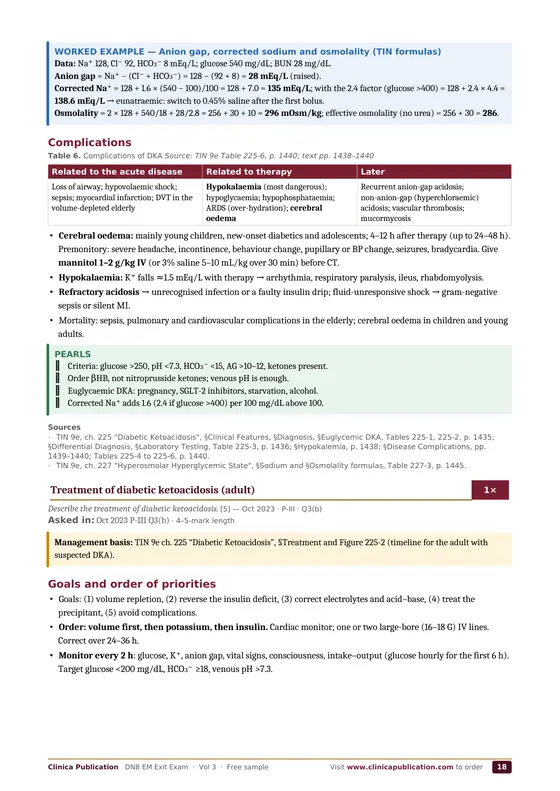
  6. Treatment of diabetic ketoacidosis (adult) 1×Oct 2023 · Paper III · Q3(b)
  7. Myxoedema coma: precipitants, recognition and management 2×Dec 2022 · Paper III · Q4(a) · Apr 2023 · Paper III · Q9(b)
  8. Thyroid storm: precipitants, clinical features, Burch-Wartofsky Point Scale and ED management 4×Jun 2021 · Paper III · Q8(b,c) · Jun 2022 · Paper III · Q5(b) · Oct 2023 · Paper IV · Q7(a) · Oct 2024 · Paper III · Q4(a,b)
  9. Adrenal insufficiency and acute adrenal crisis: recognition, ED approach, management, hydrocortisone and fluids 4×Dec 2020 · Paper I · Q7(b) · Dec 2022 · Paper III · Q4(b) · Apr 2023 · Paper III · Q9(a) · Dec 2025 · Paper III · Q2(a,b)
Part 19 · Haematological & Oncological Emergencies16 questions
  1. Peripheral blood smear examination 1×Jun 2020 · Paper III · Q5(a)
  2. Tests of haemostasis (primary and secondary) and their clinical correlation 2×Dec 2020 · Paper I · Q8(b) · Oct 2023 · Paper I · Q10(a)
  3. Disseminated intravascular coagulation: aetiopathogenesis, diagnosis and ED management 3×Dec 2021 · Paper III · Q6(a) · May 2024 · Paper I · Q4(a) · Oct 2024 · Paper III · Q10(a,b,c)
  4. von Willebrand disease 1×Dec 2020 · Paper I · Q8(c)
  5. Acute vaso-occlusive crisis in sickle cell disease 1×Dec 2022 · Paper III · Q6(a)
  6. Priapism in sickle cell disease: pathophysiology and management 1×May 2024 · Paper II · Q2(b)
  7. Autoimmune haemolytic anaemia 1×Jun 2020 · Paper III · Q5(b)
  8. Differential diagnosis of acute intravascular haemolysis 1×Dec 2022 · Paper III · Q2(a)
  9. Blood transfusion reactions: pathophysiology, evaluation and management 2×Dec 2021 · Paper III · Q7(a) · Dec 2022 · Paper I · Q1(c)
  10. Antiplatelet drugs 1×Jun 2020 · Paper I · Q8(a)
  11. Heparin: mechanism of action and complications 1×May 2024 · Paper I · Q10(b)
  12. Oral anticoagulants, newer anticoagulants and their antidotes; role in acute DVT 2×Dec 2021 · Paper III · Q6(b) · Oct 2024 · Paper I · Q10(b,c)
  13. Tranexamic acid: mechanism, indications, contraindications and complications 1×May 2024 · Paper I · Q10(a)
  14. Tumour lysis syndrome: criteria, investigations and ED management 5×Jun 2021 · Paper III · Q6(a,b) · Jun 2022 · Paper III · Q5(a) · May 2024 · Paper III · Q7(b) · Jun 2025 · Paper IV · Q3(a) · Dec 2025 · Paper III · Q1(a)
  15. Management of hypercalcaemia and hyperuricaemia in malignancy 1×Dec 2025 · Paper III · Q1(b)
  16. Management of sepsis in febrile neutropenia in the ED 1×Jun 2022 · Paper III · Q3(a)
Part 20 · Eye, ENT & Dental Emergencies15 questions
  1. Topical ophthalmic medications in the ED 1×Jun 2021 · Paper II · Q3(b)
  2. Acute painful red eye: differential diagnosis and management 4×Dec 2020 · Paper II · Q2(a) · Dec 2022 · Paper II · Q9(c) · Apr 2023 · Paper II · Q3(b) · Jun 2025 · Paper II · Q7(b)
  3. Periorbital versus orbital cellulitis 4×Jun 2020 · Paper II · Q6(b) · Jun 2022 · Paper II · Q7(b) · Oct 2024 · Paper II · Q10(b) · Jun 2025 · Paper II · Q7(a)
  4. Acute visual loss: differential diagnosis and management 4×Jun 2021 · Paper II · Q3(a) · Jun 2022 · Paper II · Q7(a) · Apr 2023 · Paper II · Q3(a) · Oct 2023 · Paper II · Q7(b)
  5. Acute diplopia: causes and management 1×Dec 2021 · Paper II · Q6(a)
  6. Approach to acute pain in the ear 1×Jun 2020 · Paper II · Q9(a)
  7. Malignant otitis externa 2×Jun 2020 · Paper II · Q9(c) · May 2024 · Paper II · Q5(c)
  8. Otitis media in adults: pathophysiology, microbiology, treatment, complications 2×Dec 2022 · Paper II · Q9(d) · Oct 2024 · Paper II · Q3(a,b,c)
  9. Facial cellulitis and erysipelas 1×May 2024 · Paper II · Q5(b)
  10. Periodontal abscess: management 1×Dec 2021 · Paper II · Q5(b)
  11. Acute necrotising ulcerative gingivitis 1×May 2024 · Paper IV · Q5(a)
  12. Fractured tooth: ED management 1×Jun 2022 · Paper II · Q8(a)
  13. Acute sore throat: causes, red flags, risk stratification, investigations, empirical management 1×Dec 2020 · Paper II · Q3(a,b,c,d)
  14. Retropharyngeal and peritonsillar abscess 1×Dec 2022 · Paper II · Q8(b)
  15. Ludwig's angina: assessment and management 1×Jun 2022 · Paper II · Q6(b)
Part 21 · Dermatological Emergencies6 questions
  1. Modified Lynch algorithm: approach to the erythematous, life-threatening and undifferentiated rash 3×Jun 2021 · Paper III · Q9(a,b) · Jun 2022 · Paper III · Q6(b) · Oct 2024 · Paper III · Q8(a)
  2. Stevens-Johnson syndrome and toxic epidermal necrolysis: causes, clinical features and treatment 3×Jun 2020 · Paper III · Q10(a) · Oct 2023 · Paper III · Q5(a,b) · Jun 2025 · Paper III · Q7(b)
  3. Staphylococcal scalded skin syndrome 1×Jun 2021 · Paper III · Q9(c)
  4. Toxic shock syndromes: features, differential diagnosis and management 2×Jun 2020 · Paper III · Q10(b) · Apr 2023 · Paper III · Q3(a)
  5. Acute-onset vesiculobullous lesions: differential diagnosis and management 1×Jun 2022 · Paper III · Q6(a)
  6. Scabies 1×Oct 2024 · Paper III · Q8(b)
Part 22 · Orthopaedic & Musculoskeletal Emergencies26 questions
  1. Complications of fracture-dislocation and their ED management 1×Jun 2020 · Paper II · Q7(b)
  2. High-pressure injection injuries of the hand 1×Jun 2020 · Paper II · Q2(c)
  3. Flexor and extensor tendon injuries of the hand 1×Dec 2022 · Paper II · Q10(b)
  4. Jersey finger 1×Jun 2025 · Paper II · Q10(b)
  5. Ulnar nerve injuries: clinical presentation 1×Dec 2021 · Paper I · Q5(b)
  6. Radiological features of the normal wrist 1×Jun 2020 · Paper II · Q5(b)
  7. Perilunate dislocation 1×Jun 2020 · Paper II · Q5(c)
  8. Sensory and motor testing of radial, median and ulnar nerves in elbow injury 1×Oct 2023 · Paper II · Q6(a)
  9. Galeazzi and Monteggia fracture-dislocations 1×Jun 2025 · Paper II · Q6(a)
  10. Anterior versus posterior shoulder dislocation 1×Dec 2022 · Paper II · Q1(a)
  11. Proximal humerus fractures: classification and management 1×Dec 2022 · Paper II · Q1(b)
  12. Brachial plexus injuries: aetiology and clinical features 2×Jun 2020 · Paper I · Q6(c) · Dec 2022 · Paper II · Q5(a)
  13. Fractures of the hip 3×Dec 2021 · Paper II · Q1(a) · May 2024 · Paper II · Q7(a) · Oct 2024 · Paper II · Q2(a)
  14. Anterior and posterior cruciate ligament injuries 1×Oct 2024 · Paper II · Q2(b)
  15. Ottawa and Pittsburgh rules for knee and ankle injuries 3×Jun 2020 · Paper II · Q8(c,d) · Jun 2022 · Paper II · Q9(b) · Apr 2023 · Paper II · Q10(b)
  16. Evaluation of an acutely painful swollen ankle 1×Apr 2023 · Paper II · Q10(a)
  17. Lisfranc injury 1×Jun 2022 · Paper II · Q9(a)
  18. Compartment syndrome after crush injury: pathophysiology, investigations, treatment 2×Dec 2020 · Paper II · Q9(a,b,c) · Dec 2025 · Paper II · Q3(a)
  19. Acute low back pain: causes, red flags, differential diagnosis 2×Dec 2020 · Paper II · Q6(a,b) · Jun 2025 · Paper II · Q10(a)
  20. Cauda equina syndrome 2×Dec 2020 · Paper II · Q6(c) · Oct 2024 · Paper II · Q4(b)
  21. Rotator cuff injuries: risk factors, clinical assessment, imaging and management 4×Jun 2020 · Paper I · Q6(a) · Jun 2021 · Paper II · Q10(b,c,d) · Dec 2022 · Paper II · Q10(a) · May 2024 · Paper I · Q5(b)
  22. Bursal syndromes of the hip and knee 1×May 2024 · Paper II · Q6(a)
  23. Acute joint pain and monoarthritis: differential, synovial fluid, approach 1×Jun 2021 · Paper II · Q8(a,b,c)
  24. Septic arthritis of the knee: ED management 1×Jun 2020 · Paper II · Q2(a)
  25. Acute gout: clinical features and ED management 2×May 2024 · Paper III · Q7(a) · Dec 2025 · Paper III · Q8(a)
  26. Colchicine and corticosteroids in acute gout 1×Dec 2025 · Paper III · Q8(b)
Part 23 · Psychiatric & Behavioural Emergencies4 questions
  1. Acute agitation in the ED: approach, assessment, management, rapid tranquillisation and pharmacological restraint 4×Jun 2020 · Paper III · Q9(d) · Dec 2020 · Paper III · Q10(a) · Jun 2022 · Paper III · Q8(a) · Jun 2025 · Paper III · Q6(b)
  2. Delirium: definition, causes, assessment (CAM, RASS), evaluation and management in the elderly 4×Jun 2020 · Paper III · Q9(a,b,c) · Dec 2021 · Paper III · Q4(a) · Dec 2022 · Paper III · Q5(a,b,c) · Oct 2023 · Paper III · Q8(a)
  3. Anxiety disorders (case with Chvostek and Trousseau signs): classification, ED assessment and management, organic vs primary 1×Jun 2021 · Paper III · Q10(a,b,c)
  4. Anorexia nervosa 1×Oct 2024 · Paper IV · Q5(a)
Part 24 · Abuse, Geriatric & Special Situations5 questions
  1. Emergencies in an injection drug user 1×May 2024 · Paper III · Q10(a)
  2. Renal transplant recipient emergencies and stabilisation 2×Jun 2020 · Paper I · Q1(c) · Apr 2023 · Paper IV · Q6(b)
  3. Role of palliative care in the emergency department 1×Dec 2022 · Paper IV · Q10(b)
  4. Symptom management in terminal cancer 1×Oct 2024 · Paper IV · Q5(b)
  5. Grief counselling in the ED and its methods 2×Jun 2020 · Paper IV · Q7(a) · Jun 2022 · Paper IV · Q6(b)
Part 25 · Trauma (ATLS order)72 questions
  1. Polytrauma with airway bleeding, shock and coma: stepwise initial management 2×Jun 2022 · Paper II · Q1(a) · Apr 2023 · Paper II · Q2(a)
  2. Classification of shock in trauma 1×Dec 2021 · Paper II · Q8(b)
  3. Management of haemorrhagic shock in trauma 2×Jun 2021 · Paper II · Q1(a) · Jun 2022 · Paper II · Q1(b)
  4. ED treatment of TBI: targets, pearls and pitfalls 3×Jun 2021 · Paper II · Q2(a) · Oct 2023 · Paper II · Q1(b) · May 2024 · Paper I · Q1(b)
  5. Neurogenic shock vs spinal shock 3×Dec 2020 · Paper II · Q1(a) · Oct 2023 · Paper I · Q9(a) · Jun 2025 · Paper II · Q1(b)
  6. Shifting a patient with cervical spine injury 1×Jun 2025 · Paper II · Q3(b)
  7. Hip dislocation and the dashboard injury 4×Jun 2020 · Paper II · Q7(c) · Dec 2021 · Paper II · Q3(b) · May 2024 · Paper II · Q7(b) · Dec 2025 · Paper II · Q7(a)
  8. Point-of-care ultrasound in paediatric trauma and the FAST protocol in children 1×Dec 2025 · Paper IV · Q3(a,b)
  9. Role of ultrasound and POCUS signs in chest trauma 2×Dec 2020 · Paper II · Q4(c) · Jun 2022 · Paper II · Q4(a)
  10. Complications of prolonged tourniquet application 1×Dec 2025 · Paper II · Q7(b)
  11. REBOA: indications, technique, complications 2×Jun 2022 · Paper II · Q3(b) · Oct 2024 · Paper IV · Q10(b)
  12. Airway challenges in facial trauma 1×Dec 2025 · Paper II · Q9(b)
  13. Significant clinical features in facial trauma 1×Oct 2024 · Paper II · Q7(b)
  14. Le Fort fractures 3×Dec 2022 · Paper II · Q6(a) · Oct 2024 · Paper II · Q7(c) · Jun 2025 · Paper II · Q4(a)
  15. Open pneumothorax 1×Dec 2020 · Paper II · Q4(a)
  16. Tension pneumothorax: identification and treatment 1×Oct 2023 · Paper II · Q3(a)
  17. Flail chest 2×Oct 2024 · Paper II · Q7(a) · Jun 2025 · Paper II · Q1(c)
  18. Rib fractures and acute rib-fracture pain 2×Dec 2020 · Paper II · Q4(b) · Jun 2022 · Paper II · Q8(b)
  19. Traumatic diaphragmatic injury 1×Dec 2025 · Paper II · Q6(a)
  20. Decision rule for chest imaging (CT) in blunt chest trauma 1×May 2024 · Paper II · Q10(a)
  21. Haemorrhagic shock classification and pathophysiology 2×Dec 2022 · Paper I · Q8(b) · May 2024 · Paper II · Q1(b)
  22. Pathophysiology of traumatic shock 1×Jun 2021 · Paper I · Q9(a)
  23. Acid–base disorders and coagulopathy in trauma 2×Dec 2020 · Paper I · Q6(c) · Jun 2022 · Paper I · Q6(b)
  24. Massive transfusion protocol: indications, steps and chart 2×Apr 2023 · Paper II · Q7(b) · Oct 2023 · Paper IV · Q1(a)
  25. Emergency management of severe soft-tissue injuries 1×Apr 2023 · Paper II · Q8(b)
  26. Resuscitative thoracotomy 2×Oct 2024 · Paper IV · Q8(c) · Dec 2025 · Paper II · Q6(b)
  27. Pelvic fractures: classification, emergency management, binders and embolisation 3×Jun 2022 · Paper II · Q10(b) · Apr 2023 · Paper II · Q7(a) · Dec 2025 · Paper II · Q1(a,b)
  28. Fluid and blood transfusion therapy; choice of fluid from recent trials 2×Dec 2021 · Paper IV · Q1(a) · Oct 2023 · Paper II · Q3(b)
  29. Abdominal compartment syndrome 1×Jun 2022 · Paper II · Q4(b)
  30. Balanced and haemostatic–hypotensive resuscitation 2×Oct 2024 · Paper I · Q5(b) · Dec 2025 · Paper I · Q6(b)
  31. Haemorrhagic shock in children, older adults and pregnancy 1×Jun 2021 · Paper II · Q1(b)
  32. Anticoagulant/antiplatelet reversal in TBI 1×Jun 2025 · Paper II · Q2(b)
  33. Management of life-threatening cervical spine injury 1×Dec 2021 · Paper II · Q10(a)
  34. Pathophysiology of TBI; primary and secondary injury; reducing secondary injury 3×Dec 2022 · Paper II · Q4(a) · May 2024 · Paper I · Q1(a) · Oct 2024 · Paper II · Q5(a)
  35. Raised ICP features and herniation syndromes 2×Jun 2021 · Paper II · Q2(b) · Oct 2024 · Paper II · Q5(b)
  36. Mechanism and classification of spinal cord injuries 1×Dec 2025 · Paper II · Q4(a)
  37. Cervical spine clearance in the field 1×Jun 2025 · Paper I · Q1(b)
  38. Unstable cervical spine fractures and pure flexion injuries 2×Oct 2024 · Paper II · Q4(a) · Jun 2025 · Paper II · Q3(a)
  39. Paediatric differences in spinal cord injury 1×Dec 2020 · Paper II · Q1(b)
  40. Paediatric GCS versus adult GCS: key differences 1×Jun 2022 · Paper IV · Q4(a)
  41. Mild TBI: symptoms, signs and ED management 2×Dec 2020 · Paper II · Q1(c) · Oct 2024 · Paper II · Q5(c)
  42. Canadian CT Head Rule vs New Orleans Criteria 2×Jun 2021 · Paper II · Q2(c) · May 2024 · Paper II · Q10(b)
  43. NEXUS and Canadian C-spine rules 3×Jun 2020 · Paper II · Q8(a,b) · Jun 2022 · Paper II · Q2(a) · Oct 2023 · Paper II · Q2(a)
  44. Management of suicidal hanging 1×Jun 2022 · Paper II · Q2(b)
  45. Mannitol and hypertonic saline 1×May 2024 · Paper IV · Q6(a)
  46. Methylprednisolone in spinal trauma 1×Dec 2025 · Paper II · Q4(b)
  47. Damage control surgery 1×Oct 2024 · Paper I · Q5(c)
  48. Thermal burns: assessment, classification and ED management 2×Dec 2022 · Paper II · Q3(a) · Oct 2024 · Paper II · Q6(a,b)
  49. Smoke inhalation / inhalational injury 2×Jun 2020 · Paper III · Q2(a) · Dec 2021 · Paper II · Q9(a)
  50. Hydrofluoric acid burns 1×Oct 2023 · Paper II · Q10(b)
  51. Gustilo classification of open tibial shaft fractures 1×Jun 2025 · Paper II · Q6(b)
  52. Brachial artery injury: causes and clinical presentation 1×Dec 2021 · Paper II · Q3(a)
  53. Paediatric vs adult trauma: anatomical and physiological differences 2×Jun 2021 · Paper IV · Q1(a) · May 2024 · Paper II · Q1(a)
  54. PECARN vs CHALICE 1×Jun 2021 · Paper IV · Q1(b)
  55. Physiological changes in the elderly relevant to emergencies 1×Dec 2022 · Paper I · Q3(c)
  56. Trauma in pregnancy: injuries and ED management 1×Apr 2023 · Paper II · Q1(a)
  57. Placental abruption and membrane rupture after trauma 1×Oct 2023 · Paper II · Q4(b)
  58. Nasal fracture and septal haematoma 1×May 2024 · Paper II · Q5(a)
  59. Indications for laparotomy in abdominal trauma 2×Oct 2023 · Paper II · Q2(b) · Dec 2025 · Paper II · Q2(b)
  60. Classification of liver and kidney injury 1×Jun 2022 · Paper II · Q10(a)
  61. Splenic injury: classification and management 1×Dec 2022 · Paper II · Q4(b)
  62. Approach to penetrating abdominal trauma 1×Dec 2025 · Paper II · Q2(a)
  63. Traumatic urethral injury in the male 2×Dec 2022 · Paper II · Q6(b) · Dec 2025 · Paper II · Q8(a)
  64. Isolated renal trauma 1×May 2024 · Paper II · Q9(a)
  65. Urinary bladder injury 1×Oct 2023 · Paper II · Q9(a)
  66. Hard/soft signs of neck injury and penetrating neck trauma protocol 3×Dec 2022 · Paper II · Q3(b) · Apr 2023 · Paper II · Q2(b) · Jun 2025 · Paper II · Q4(b)
  67. Uses of Foley catheter balloon tamponade 1×Jun 2022 · Paper II · Q3(a)
  68. Treatment of blunt eye trauma 1×Jun 2020 · Paper II · Q6(c)
  69. Chemical ocular injury: evaluation and alkali treatment 2×Dec 2020 · Paper II · Q2(d) · Oct 2023 · Paper II · Q7(a)
  70. Traumatic globe rupture 2×Oct 2024 · Paper II · Q10(a) · Dec 2025 · Paper II · Q5(a)
  71. Zygomatic fractures: classification and treatment 1×Dec 2025 · Paper II · Q5(b)
  72. Corneal abrasion and suspected corneal injury 2×Dec 2020 · Paper II · Q2(c) · Dec 2021 · Paper II · Q9(b)
Part 26 · Procedures (Roberts & Hedges order)50 questions
  1. Point-of-care ultrasound: basic physics, clinical applications, M-mode and lung artefacts 2×Jun 2021 · Paper I · Q8(a,b,c) · Oct 2024 · Paper I · Q8(a,c,d)
  2. Methods of measuring body temperature 1×Dec 2020 · Paper I · Q2(b)
  3. End-tidal CO2 and capnography 3×Dec 2022 · Paper I · Q4(c) · Oct 2023 · Paper I · Q3(b) · Oct 2024 · Paper IV · Q6(a,b,c,d)
  4. Oxygen delivery devices 2×Jun 2021 · Paper I · Q7(b) · Oct 2024 · Paper I · Q4(a)
  5. High-flow nasal oxygen 1×Dec 2021 · Paper III · Q2(b)
  6. Supraglottic airway devices 1×May 2024 · Paper I · Q3(b)
  7. Difficult airway assessment and LEMON 3×Dec 2022 · Paper I · Q2(b) · Apr 2023 · Paper I · Q5(a) · Oct 2023 · Paper I · Q6(a)
  8. Difficult and failed paediatric airway 2×Dec 2020 · Paper I · Q5(c) · Jun 2025 · Paper I · Q9(a)
  9. Rapid sequence intubation and modifications 2×Dec 2022 · Paper IV · Q8(a) · Oct 2023 · Paper I · Q7(b)
  10. Physiologically difficult airway 3×Dec 2020 · Paper IV · Q10(a) · Dec 2021 · Paper IV · Q2(a) · Dec 2022 · Paper IV · Q8(c)
  11. Intubation steps and failed intubation 1×Apr 2023 · Paper I · Q5(b)
  12. Delayed sequence intubation 2×Dec 2022 · Paper IV · Q8(b) · Oct 2024 · Paper I · Q5(a)
  13. Newer airway aids 1×Dec 2021 · Paper IV · Q2(b)
  14. Airway ultrasound 2×Jun 2020 · Paper IV · Q6(a) · Jun 2022 · Paper IV · Q1(a)
  15. Etomidate; ketamine vs etomidate 2×Dec 2020 · Paper IV · Q10(b) · Dec 2025 · Paper I · Q8(b)
  16. Succinylcholine 1×Jun 2025 · Paper I · Q4(b)
  17. Surgical cricothyroidotomy 2×Apr 2023 · Paper II · Q6(b) · Jun 2025 · Paper I · Q6(b)
  18. Needle cricothyrotomy and jet ventilation 1×Oct 2023 · Paper IV · Q7(b)
  19. Airway management in COVID-19 1×Dec 2020 · Paper IV · Q2(b)
  20. Ventilator waveforms 1×Jun 2025 · Paper IV · Q6(b)
  21. Initial ventilator settings in acidosis 2×Jun 2020 · Paper I · Q4(b,c) · Jun 2022 · Paper I · Q3(b)
  22. Noninvasive ventilation 1×Dec 2025 · Paper I · Q9(a)
  23. Transcutaneous pacing: equipment, technique, outcomes 1×Jun 2025 · Paper IV · Q7(a)
  24. TEE during CPR 1×May 2024 · Paper IV · Q8(b)
  25. Mechanical chest compression devices in the ED 1×Dec 2021 · Paper IV · Q5(a)
  26. Selective aortic arch perfusion 1×Jun 2025 · Paper IV · Q5(b)
  27. Right subclavian vein cannulation: steps 1×Dec 2021 · Paper I · Q1(b)
  28. Intraosseous access: indications, contraindications, technique 1×Jun 2025 · Paper IV · Q1(b)
  29. Haematoma block 1×Dec 2020 · Paper I · Q1(c)
  30. Types of nerve blocks in the ED; nerve blocks in trauma 2×Jun 2020 · Paper IV · Q6(c) · Apr 2023 · Paper I · Q1(b)
  31. Block on arrival; PENG versus fascia iliaca block 1×Jun 2022 · Paper IV · Q10(a,b)
  32. Recurrent anterior shoulder dislocation in a wrestler: assessment, investigations and management 2×Dec 2020 · Paper II · Q10(a,b,c) · Oct 2023 · Paper II · Q6(b)
  33. Procedural sedation: ketamine regimens; PSA for proximal humerus fracture 2×Oct 2023 · Paper I · Q8(b) · Jun 2025 · Paper I · Q6(a)
  34. Auricular laceration management 1×Dec 2025 · Paper II · Q9(a)
  35. Wound closure techniques: advantages and disadvantages 1×Apr 2023 · Paper II · Q8(a)
  36. Non-absorbable sutures and ED use 1×Dec 2022 · Paper I · Q9(b)
  37. Tongue lacerations 1×Oct 2023 · Paper II · Q8(b)
  38. Fasciotomy: indications and technique 1×Dec 2025 · Paper II · Q3(b)
  39. Femoral traction splints in the prehospital phase 1×Jun 2025 · Paper I · Q1(a)
  40. Splints and immobilisation dressings for upper-limb injuries 2×Jun 2020 · Paper II · Q7(a) · May 2024 · Paper II · Q6(b)
  41. Phimosis and paraphimosis (7-year-old) 2×Dec 2022 · Paper IV · Q1(a) · Oct 2023 · Paper IV · Q3(a)
  42. Cardiac arrest in pregnancy and resuscitative caesarean delivery 2×Jun 2022 · Paper I · Q7(b) · Apr 2023 · Paper II · Q1(b)
  43. Lumbar puncture: landmarks, technique, contraindications, normal CSF 2×Oct 2023 · Paper I · Q10(b) · Dec 2025 · Paper I · Q7(a)
  44. Ocular ultrasound: technique and utility in trauma 4×Dec 2020 · Paper II · Q2(b) · Dec 2021 · Paper II · Q8(a) · May 2024 · Paper II · Q8(a) · Oct 2024 · Paper II · Q10(c)
  45. Foreign body in the ear: management 1×Apr 2023 · Paper II · Q4(b)
  46. Epistaxis: arterial supply of nasal septum (diagram), aetiology, management 3×Jun 2021 · Paper II · Q4(a,b) · Dec 2022 · Paper II · Q8(a) · Oct 2023 · Paper II · Q8(a)
  47. Foreign body in the nose: approach and management 2×Jun 2021 · Paper II · Q4(c) · Dec 2022 · Paper II · Q9(a)
  48. TMJ dislocation: causes and ED management 1×Dec 2021 · Paper II · Q5(a)
  49. Avulsed tooth: scene care, prehospital care and replantation 3×Dec 2022 · Paper II · Q9(b) · Apr 2023 · Paper II · Q6(a) · Jun 2025 · Paper II · Q8(b)
  50. Restraints in the ER, including types of restraint for an agitated adolescent 2×Dec 2020 · Paper III · Q10(b) · Dec 2021 · Paper III · Q5(b)
Part 27 · Landmark Trials & Evidence13 questions
  1. Hypothermia trials after cardiac arrest; critical appraisal of TTM-2 2×Dec 2021 · Paper IV · Q7(b) · Jun 2022 · Paper IV · Q8(a)
  2. COACT trial (angiography after cardiac arrest without STE) 1×Jun 2022 · Paper IV · Q8(b)
  3. Trials of oxygen and blood-pressure targets after ROSC 1×Dec 2022 · Paper IV · Q7(a)
  4. FLORALI trial 1×Dec 2020 · Paper IV · Q2(a)
  5. POEM study 1×Apr 2023 · Paper IV · Q10(a)
  6. WATERFALL trial 1×Oct 2024 · Paper IV · Q9(a)
  7. E-MOTIVE trial 1×Oct 2024 · Paper IV · Q9(b)
  8. CLOVERS trial 1×Apr 2023 · Paper IV · Q7(b)
  9. RECOVERY trial 1×Jun 2021 · Paper IV · Q10(b)
  10. DAWN and DEFUSE 3 trials 2×Jun 2020 · Paper IV · Q8(b) · Jun 2021 · Paper IV · Q10(c)
  11. SELECT2 trial 1×Apr 2023 · Paper IV · Q7(a)
  12. CRASH-3 trial 2×Jun 2021 · Paper IV · Q10(a) · Dec 2022 · Paper IV · Q7(b)
  13. WOMAN trial 1×Jun 2021 · Paper IV · Q10(d)

DNB Emergency Medicine question papers, session by session

The topics set in each exam session, paper by paper and in question order, latest first.

DNB Emergency Medicine December 202568 questions

Paper I

  • Q1(a) — Pathophysiology of pulmonary tuberculosis
  • Q1(b) — Hypoxic pulmonary vasoconstriction
  • Q2(a) — Non-conventional analgesics in the ED
  • Q2(b) — Local anaesthetics: classification, mechanism, indications, contraindications, adverse effects
  • Q3(a) — Salicylate poisoning: acid–base changes, clinical severity, diagnosis and treatment in adults
  • Q3(b) — Metabolic alkalosis
  • Q4(a) — Body fluid compartments and crystalloid distribution
  • Q4(b) — Sodium homeostasis: physiology and pathophysiology
  • Q5(a) — Cardiac biomarkers and high-sensitivity troponin
  • Q5(b) — Risk-stratification scores: HEART, EDACS, ACC/AHA, TIMI, GRACE
  • Q6(a) — Cellular pathophysiology of shock
  • Q6(b) — Balanced and haemostatic–hypotensive resuscitation
  • Q7(a) — Lumbar puncture: landmarks, technique, contraindications, normal CSF
  • Q7(b) — CSF findings in bacterial, viral and tubercular meningitis
  • Q8(a) — Amiodarone: pharmacodynamics, pharmacokinetics, IV indications, adverse effects
  • Q8(b) — Etomidate; ketamine vs etomidate
  • Q9(a) — Noninvasive ventilation
  • Q9(b) — Permanent pacemakers: indications, code, malfunction, pacemaker syndrome, ACLS, complications
  • Q10(a) — Oxygen-haemoglobin dissociation curve
  • Q10(b) — Bohr and Haldane effects

Paper II

  • Q1(a,b) — Pelvic fractures: classification, emergency management, binders and embolisation
  • Q2(a) — Approach to penetrating abdominal trauma
  • Q2(b) — Indications for laparotomy in abdominal trauma
  • Q3(a) — Compartment syndrome after crush injury: pathophysiology, investigations, treatment
  • Q3(b) — Fasciotomy: indications and technique
  • Q4(a) — Mechanism and classification of spinal cord injuries
  • Q4(b) — Methylprednisolone in spinal trauma
  • Q5(a) — Traumatic globe rupture
  • Q5(b) — Zygomatic fractures: classification and treatment
  • Q6(a) — Traumatic diaphragmatic injury
  • Q6(b) — Resuscitative thoracotomy
  • Q7(a) — Hip dislocation and the dashboard injury
  • Q7(b) — Complications of prolonged tourniquet application
  • Q8(a) — Traumatic urethral injury in the male
  • Q8(b) — ED management of fistula-in-ano
  • Q9(a) — Auricular laceration management
  • Q9(b) — Airway challenges in facial trauma
  • Q10(a) — Swallowed foreign body in an adult: emergency management
  • Q10(b) — Differential diagnosis of RLQ pain

Paper III

  • Q1(a) — Tumour lysis syndrome: criteria, investigations and ED management
  • Q1(b) — Management of hypercalcaemia and hyperuricaemia in malignancy
  • Q2(a,b) — Adrenal insufficiency and acute adrenal crisis: recognition, ED approach, management, hydrocortisone and fluids
  • Q3(a,b) — Hyperkalaemia: aetiology, features, ECG, emergency treatment
  • Q4(a,b) — Serotonin syndrome: pathophysiology and management; differentiation from neuroleptic malignant syndrome
  • Q5(a) — ED evaluation of locked-in syndrome
  • Q5(b) — Paraquat poisoning: pathophysiology and treatment modalities
  • Q6(a) — Acute vertigo: differential, approach and management algorithm
  • Q6(b) — Peripheral vs central vertigo
  • Q7(a,b) — Cyanide poisoning: clinical features, treatment and the role of hydroxocobalamin
  • Q8(a) — Acute gout: clinical features and ED management
  • Q8(b) — Colchicine and corticosteroids in acute gout
  • Q9(a) — Haemoptysis: differential diagnosis and approach in the ED
  • Q9(b) — Massive haemoptysis: management, bronchoscopy and embolisation
  • Q10(a,b) — Acute headache: ED evaluation, red flags and neuroimaging

Paper IV

  • Q1(a) — Cardiac biomarkers and high-sensitivity troponin
  • Q1(b) — Risk-stratification scores: HEART, EDACS, ACC/AHA, TIMI, GRACE
  • Q2(a,b) — ECPR: principles, indications, contraindications
  • Q3(a,b) — Point-of-care ultrasound in paediatric trauma and the FAST protocol in children
  • Q4(a,b) — Febrile seizures in children: ED management; role of antipyretics and benzodiazepines
  • Q5(a,b) — Acute severe asthma in a child: clinical possibilities, stabilisation with doses, approach to status asthmaticus, role of magnesium sulphate and ketamine
  • Q6(a,b) — Dehydration in a child with diarrhoea: clinical grading, ED evaluation and fluid therapy (moderate vs severe)
  • Q7(a) — Artificial intelligence in EM, triage and decision support
  • Q7(b) — Recent updates in adult ACLS
  • Q8(a,b) — Diagnostic test accuracy
  • Q9(a) — PRAM — Pediatric Respiratory Assessment Measure
  • Q9(b) — ED algorithm for managing a child with bronchiolitis
  • Q10(a) — Recent advances in sepsis biomarkers
  • Q10(b) — Role of procalcitonin and lactate in paediatric sepsis
DNB Emergency Medicine June 202582 questions

Paper I

  • Q1(a) — Femoral traction splints in the prehospital phase
  • Q1(b) — Cervical spine clearance in the field
  • Q2(a) — Incident Command System for an external disaster
  • Q2(b) — Mass-casualty field triage: START, SALT, JumpSTART, colour categories
  • Q3(a) — High-risk chemicals compromising oxygen delivery
  • Q3(b) — Physics of radiation, types and monitoring equipment
  • Q4(a) — Metabolic acidosis
  • Q4(b) — Succinylcholine
  • Q5(a) — ECG features of AF and atrial flutter
  • Q5(b) — ER management of VT and VF
  • Q6(a) — Procedural sedation: ketamine regimens; PSA for proximal humerus fracture
  • Q6(b) — Surgical cricothyroidotomy
  • Q7(a) — PEA arrest management
  • Q7(b) — Sepsis: Sepsis-3, diagnosis, prehospital antibiotics, vancomycin
  • Q8(a) — Laboratory and imaging tests in hepatobiliary disease; biochemical changes in chronic liver disease
  • Q8(b) — Dog bite: ED management and rabies post-exposure prophylaxis
  • Q9(a) — Difficult and failed paediatric airway
  • Q9(b) — Hypokalaemia: causes, identification, evaluation, treatment
  • Q10(a) — Scalp layers and hair apposition technique
  • Q10(b) — Post-injury tetanus prophylaxis

Paper II

  • Q1(a) — Shock: classification and types
  • Q1(b) — Neurogenic shock vs spinal shock
  • Q1(c) — Flail chest
  • Q2(a) — Cerebral circulation, regulation of CBF and autoregulation
  • Q2(b) — Anticoagulant/antiplatelet reversal in TBI
  • Q3(a) — Unstable cervical spine fractures and pure flexion injuries
  • Q3(b) — Shifting a patient with cervical spine injury
  • Q4(a) — Le Fort fractures
  • Q4(b) — Hard/soft signs of neck injury and penetrating neck trauma protocol
  • Q5(a) — Ectopic pregnancy: diagnostic algorithm, treatment, methotrexate
  • Q5(b) — Hypertension at 26 weeks: definitions, DDx, laboratory evaluation, treatment
  • Q6(a) — Galeazzi and Monteggia fracture-dislocations
  • Q6(b) — Gustilo classification of open tibial shaft fractures
  • Q7(a) — Periorbital versus orbital cellulitis
  • Q7(b) — Acute painful red eye: differential diagnosis and management
  • Q8(a) — Right tympanic membrane diagram and TM perforation management
  • Q8(b) — Avulsed tooth: scene care, prehospital care and replantation
  • Q9(a) — Acute pancreatitis: causes, diagnosis, grading, scoring, treatment, complications
  • Q9(b) — Approach to and ED management of bowel obstruction
  • Q10(a) — Acute low back pain: causes, red flags, differential diagnosis
  • Q10(b) — Jersey finger

Paper III

  • Q1(a) — Heat stroke: features, differential diagnosis and ED treatment
  • Q1(b) — Oleander poisoning: clinical features and treatment
  • Q2(a) — Anaphylaxis: ED treatment incl. vaccine-induced
  • Q2(b) — Wasp and bee stings: clinical presentation and management
  • Q2(c) — CAP: ED investigations and management; outpatient antibiotics
  • Q3(a) — Kerosene (hydrocarbon) poisoning: management
  • Q3(b) — Acid (caustic) ingestion: clinical features, diagnostic evaluation and treatment
  • Q4(a) — Hyponatraemia: causes (elderly) and management of hyponatraemic seizures
  • Q4(b) — Acute exacerbation of COPD: definition, differentials, treatment and NIV
  • Q5(a) — Stroke mimics
  • Q5(b) — Thrombolysis in AIS: methods, ED protocol, eligibility
  • Q6(a) — Non-traumatic SAH: causes, imaging, LP findings, management
  • Q6(b) — Acute agitation in the ED: approach, assessment, management, rapid tranquillisation and pharmacological restraint
  • Q7(a) — Hypoglycaemia in the ED: clinical features, evaluation and treatment
  • Q7(b) — Stevens-Johnson syndrome and toxic epidermal necrolysis: causes, clinical features and treatment
  • Q8(a) — The haemodialysis patient in the ED
  • Q8(b) — Hepatic encephalopathy: pathogenesis, recognition, treatment
  • Q9(a) — Acute pericarditis
  • Q9(b) — Contraindications to fibrinolysis in STEMI
  • Q10(a) — Role of 2D echocardiography in MI
  • Q10(b) — Organophosphorus insecticide poisoning: management

Paper IV

  • Q1(a) — Neonatal resuscitation
  • Q1(b) — Intraosseous access: indications, contraindications, technique
  • Q2(a) — Severe dehydration from diarrhoea in a 40-kg child: initial fluid resuscitation and maintenance fluid therapy
  • Q2(b) — Severe croup in a 1-year-old: differential diagnosis and treatment
  • Q3(a) — Tumour lysis syndrome: criteria, investigations and ED management
  • Q3(b) — Testicular torsion in children: ER management
  • Q4(a) — Appendicitis in a 5-year-old: clinical features, investigations and treatment
  • Q4(b) — Pain scales for non-verbal patients, infants and toddlers
  • Q5(a) — VF arrest management; newer defibrillation techniques
  • Q5(b) — Selective aortic arch perfusion
  • Q6(a) — New-onset seizures in children: evaluation, status epilepticus algorithm, and status epilepticus in the neonate and infant
  • Q6(b) — Ventilator waveforms
  • Q7(a) — Transcutaneous pacing: equipment, technique, outcomes
  • Q7(b) — Implantable cardioverter-defibrillators
  • Q8(a) — Ultrasound in acute dyspnoea: role, BLUE-type diagram and bedside identification of acute heart failure
  • Q8(b) — POCUS findings in the ED: cardiovascular, respiratory, abdominal (including non-traumatic abdominal pain) and obstetric
  • Q9(a) — Tracheoesophageal fistula in the newborn: diagnostic evaluation and ED treatment
  • Q9(b) — Slipped capital femoral epiphysis
  • Q10(a) — CHA2DS2-VASc score
  • Q10(b) — Cardiogenic shock: pathogenesis, evaluation, management
DNB Emergency Medicine October 202479 questions

Paper I

  • Q1(a,b) — Anaphylaxis: criteria and clinical picture
  • Q1(c) — Anaphylaxis: ED treatment incl. vaccine-induced
  • Q2(a) — Anatomy of the larynx for intubation
  • Q2(b) — Paediatric vs adult airway
  • Q3(a,b) — Drugs in hypertensive emergencies: indications, advantages, disadvantages
  • Q4(a) — Oxygen delivery devices
  • Q4(b) — Oxygen toxicity by age group
  • Q5(a) — Delayed sequence intubation
  • Q5(b) — Balanced and haemostatic–hypotensive resuscitation
  • Q5(c) — Damage control surgery
  • Q6(a) — Brachial plexus: labelled diagram
  • Q6(b) — Compartments of the leg: labelled diagram
  • Q7(a,b) — Disaster definition; hospital disaster (emergency operations) plan
  • Q7(c) — ED disaster response including triage
  • Q8(a,c,d) — Point-of-care ultrasound: basic physics, clinical applications, M-mode and lung artefacts
  • Q8(b) — Ultrasound in acute dyspnoea: role, BLUE-type diagram and bedside identification of acute heart failure
  • Q9(a) — Generation and metabolism of bilirubin
  • Q9(b) — Hepatic encephalopathy: pathogenesis, recognition, treatment
  • Q9(c) — Pathogenesis of ascites in chronic liver disease
  • Q10(a) — Physiology of haemostasis, the coagulation cascade and approach to the bleeding patient on warfarin
  • Q10(b,c) — Oral anticoagulants, newer anticoagulants and their antidotes; role in acute DVT

Paper II

  • Q1(a,b) — Acute scrotal pain: causes and clinical differentiation
  • Q1(c) — Testicular torsion in children: ER management
  • Q2(a) — Fractures of the hip
  • Q2(b) — Anterior and posterior cruciate ligament injuries
  • Q3(a,b,c) — Otitis media in adults: pathophysiology, microbiology, treatment, complications
  • Q4(a) — Unstable cervical spine fractures and pure flexion injuries
  • Q4(b) — Cauda equina syndrome
  • Q5(a) — Pathophysiology of TBI; primary and secondary injury; reducing secondary injury
  • Q5(b) — Raised ICP features and herniation syndromes
  • Q5(c) — Mild TBI: symptoms, signs and ED management
  • Q6(a,b) — Thermal burns: assessment, classification and ED management
  • Q7(a) — Flail chest
  • Q7(b) — Significant clinical features in facial trauma
  • Q7(c) — Le Fort fractures
  • Q8(a) — Vaginal bleeding in a non-pregnant woman: approach, adolescent DDx, AUB at 30
  • Q8(b) — Spontaneous abortion
  • Q8(c) — Hyperemesis gravidarum: physiology and ED management
  • Q9(a,b) — Hypertension at 26 weeks: definitions, DDx, laboratory evaluation, treatment
  • Q10(a) — Traumatic globe rupture
  • Q10(b) — Periorbital versus orbital cellulitis
  • Q10(c) — Ocular ultrasound: technique and utility in trauma

Paper III

  • Q1(a,b,c,d) — Acute exacerbation of COPD: definition, differentials, treatment and NIV
  • Q2(a,b) — Syncope: causes, examination, diagnostic approach, disposition
  • Q3(a,b,c) — Lithium toxicity: precipitating factors, clinical features and management
  • Q4(a,b) — Thyroid storm: precipitants, clinical features, Burch-Wartofsky Point Scale and ED management
  • Q4(c) — Insulin pumps (continuous SC insulin infusion): the device and ED problems
  • Q5(a,b,c) — Acute aortic dissection: features, ADD-RS, medical management
  • Q6(a) — Elder abuse: categories, recognition and ED management
  • Q6(b) — Health consequences of intimate partner violence
  • Q6(c) — Pharmacologic management of alcohol use disorder
  • Q7(a) — Gas gangrene (clostridial myonecrosis): pathophysiology, clinical features and management
  • Q7(b) — Genital ulcers: differential diagnosis and management
  • Q8(a) — Modified Lynch algorithm: approach to the erythematous, life-threatening and undifferentiated rash
  • Q8(b) — Scabies
  • Q9(a) — Beta-blocker overdose; calcium channel blocker versus beta-blocker toxicity
  • Q9(b) — Scorpion sting: scorpions of medical importance, venom, pathophysiology, clinical features and management
  • Q10(a,b,c) — Disseminated intravascular coagulation: aetiopathogenesis, diagnosis and ED management

Paper IV

  • Q1(a) — Approach to a febrile child with skin rash
  • Q1(b) — Neonatal seizures: algorithmic approach
  • Q2(a,b) — ECMO in the ED: types, roles, ED ECMO unit
  • Q3(a) — Infantile hypertrophic pyloric stenosis: rapid assessment, stabilisation, diagnosis and confirmation
  • Q3(b) — The inconsolable crying child: approach, differential diagnosis and management (incl. crush injury to foot)
  • Q4(a) — Child abuse: types, signs and injuries that suggest abuse, evaluation and reporting
  • Q4(b) — Pediatric assessment triangle (PAT)
  • Q5(a) — Anorexia nervosa
  • Q5(b) — Symptom management in terminal cancer
  • Q5(c) — Tactical Combat Casualty Care
  • Q6(a,b,c,d) — End-tidal CO2 and capnography
  • Q7(a) — Forest plot: salient features
  • Q7(b) — Randomisation techniques
  • Q7(c) — Diagnostic test accuracy
  • Q8(a) — Double sequential external defibrillation
  • Q8(b) — Peri-shock pause: causes and reduction
  • Q8(c) — Resuscitative thoracotomy
  • Q9(a) — WATERFALL trial
  • Q9(b) — E-MOTIVE trial
  • Q10(a) — Thromboelastography: normal thromboelastogram and interpretation of waveform components
  • Q10(b) — REBOA: indications, technique, complications
DNB Emergency Medicine May 202483 questions

Paper I

  • Q1(a) — Pathophysiology of TBI; primary and secondary injury; reducing secondary injury
  • Q1(b) — ED treatment of TBI: targets, pearls and pitfalls
  • Q2(a) — Inguinal canal (diagram)
  • Q2(b) — Pathophysiology of inguinal hernias
  • Q3(a) — Paediatric vs adult airway
  • Q3(b) — Supraglottic airway devices
  • Q4(a) — Disseminated intravascular coagulation: aetiopathogenesis, diagnosis and ED management
  • Q4(b) — Thromboelastography: normal thromboelastogram and interpretation of waveform components
  • Q5(a) — Rotator cuff: labelled diagram and functions
  • Q5(b) — Rotator cuff injuries: risk factors, clinical assessment, imaging and management
  • Q6(a,b) — Heart failure: definition, classification, presentation
  • Q6(c) — Pathophysiology of heart failure and acute heart failure
  • Q7(a) — Brachial plexus: labelled diagram
  • Q7(b) — Local anaesthetics: classification, mechanism, indications, contraindications, adverse effects
  • Q8(a) — Portosystemic anastomoses: diagram and clinical implications
  • Q8(b) — Pathophysiology of acute liver failure
  • Q9(a) — Anatomical and physiological changes of pregnancy
  • Q9(b) — Eclampsia: pathophysiology and clinical features
  • Q10(a) — Tranexamic acid: mechanism, indications, contraindications and complications
  • Q10(b) — Heparin: mechanism of action and complications

Paper II

  • Q1(a) — Paediatric vs adult trauma: anatomical and physiological differences
  • Q1(b) — Haemorrhagic shock classification and pathophysiology
  • Q2(a) — Differential diagnosis of RLQ pain
  • Q2(b) — Priapism in sickle cell disease: pathophysiology and management
  • Q3(a) — Premature rupture of membranes
  • Q3(b) — Vaginal bleeding in a non-pregnant woman: approach, adolescent DDx, AUB at 30
  • Q4(a) — Sonographic signs of pneumoperitoneum
  • Q4(b) — Acute diverticulitis
  • Q5(a) — Nasal fracture and septal haematoma
  • Q5(b) — Facial cellulitis and erysipelas
  • Q5(c) — Malignant otitis externa
  • Q6(a) — Bursal syndromes of the hip and knee
  • Q6(b) — Splints and immobilisation dressings for upper-limb injuries
  • Q7(a) — Fractures of the hip
  • Q7(b) — Hip dislocation and the dashboard injury
  • Q8(a) — Ocular ultrasound: technique and utility in trauma
  • Q8(b) — Spinal cord syndromes; central vs anterior cord syndrome
  • Q9(a) — Isolated renal trauma
  • Q9(b) — Gas gangrene (clostridial myonecrosis): pathophysiology, clinical features and management
  • Q10(a) — Decision rule for chest imaging (CT) in blunt chest trauma
  • Q10(b) — Canadian CT Head Rule vs New Orleans Criteria

Paper III

  • Q1(a) — Lithium toxicity: precipitating factors, clinical features and management
  • Q1(b) — Sulphonylurea-induced hypoglycaemia: management
  • Q2(a) — Wells and PERC scoring in suspected pulmonary embolism
  • Q2(b) — Pulmonary thromboembolism: stabilisation and treatment
  • Q3(a) — Infective endocarditis: features, Duke criteria, initial management
  • Q3(b) — Herpes zoster: clinical features and management
  • Q4(a) — AKI criteria, KDIGO and scoring systems
  • Q4(b) — Causes of acute kidney injury
  • Q4(c) — Urinalysis in AKI and urinary findings of ATN
  • Q5(a) — Acute diarrhoea in the immunocompromised: differential diagnosis
  • Q5(b) — Haematochezia and lower GI bleeding: evaluation and management
  • Q6(a,b) — Acute asthma: definition of exacerbation, severity classification and parameters of severe asthma
  • Q6(c) — Acute severe asthma: initial assessment and ED management
  • Q7(a) — Acute gout: clinical features and ED management
  • Q7(b) — Tumour lysis syndrome: criteria, investigations and ED management
  • Q8(a) — Viper bite: clinical features and management
  • Q8(b) — Serotonin syndrome: pathophysiology and management; differentiation from neuroleptic malignant syndrome
  • Q9(a,b) — Transient ischaemic attack
  • Q9(c) — Radiology in stroke; imaging protocol in wake-up stroke
  • Q10(a) — Emergencies in an injection drug user
  • Q10(b) — Elder abuse: categories, recognition and ED management

Paper IV

  • Q1(a) — Evaluating the diagnostic accuracy of a test
  • Q1(b) — Randomisation techniques
  • Q2(a) — QI methodology to reduce door-to-needle time in AMI
  • Q2(b) — Child abuse: types, signs and injuries that suggest abuse, evaluation and reporting
  • Q3(a) — Post-cardiac arrest syndrome
  • Q3(b) — Diagnostic criteria of Kawasaki disease
  • Q4(a) — Salter-Harris classification
  • Q4(b) — Recurrent vomiting: differential diagnosis by age and approach in the young infant
  • Q5(a) — Acute necrotising ulcerative gingivitis
  • Q5(b) — New-onset seizures in children: evaluation, status epilepticus algorithm, and status epilepticus in the neonate and infant
  • Q6(a) — Mannitol and hypertonic saline
  • Q6(b) — VF arrest management; newer defibrillation techniques
  • Q6(c) — ECPR: principles, indications, contraindications
  • Q7(a) — Differential diagnosis of jaundice in a neonate
  • Q7(b) — Fever in a neonate (0–28 days): evaluation and management
  • Q8(a) — Peri-shock pause: causes and reduction
  • Q8(b) — TEE during CPR
  • Q9(a) — Electrical storm: recent advances
  • Q9(b) — Artificial intelligence in EM, triage and decision support
  • Q10(a) — Developing an emergency care system for a state
  • Q10(b) — Key performance indicators for time-sensitive emergencies
DNB Emergency Medicine October 202377 questions

Paper I

  • Q1(a) — Level A, B and C personal protective equipment
  • Q1(b) — Pathophysiology of blast injuries
  • Q2(a) — Acute radiation syndrome
  • Q2(b) — Implantable cardioverter-defibrillators
  • Q3(a) — Oxygen-haemoglobin dissociation curve
  • Q3(b) — End-tidal CO2 and capnography
  • Q4(a) — SIADH: causes and diagnostic criteria
  • Q4(b) — Hypercalcaemia: approach; malignancy ECG and treatment
  • Q5(a) — Class IV antiarrhythmics: pharmacology and clinical use
  • Q5(b) — Amiodarone: pharmacodynamics, pharmacokinetics, IV indications, adverse effects
  • Q6(a) — Difficult airway assessment and LEMON
  • Q6(b) — CVP waveform and clinical application
  • Q7(a) — NIH Stroke Scale
  • Q7(b) — Rapid sequence intubation and modifications
  • Q8(a) — Bupivacaine pharmacology and local anaesthetic systemic toxicity
  • Q8(b) — Procedural sedation: ketamine regimens; PSA for proximal humerus fracture
  • Q9(a) — Neurogenic shock vs spinal shock
  • Q9(b) — Anatomical and physiological changes of pregnancy
  • Q10(a) — Tests of haemostasis (primary and secondary) and their clinical correlation
  • Q10(b) — Lumbar puncture: landmarks, technique, contraindications, normal CSF

Paper II

  • Q1(a) — Cerebral circulation, regulation of CBF and autoregulation
  • Q1(b) — ED treatment of TBI: targets, pearls and pitfalls
  • Q2(a) — NEXUS and Canadian C-spine rules
  • Q2(b) — Indications for laparotomy in abdominal trauma
  • Q3(a) — Tension pneumothorax: identification and treatment
  • Q3(b) — Fluid and blood transfusion therapy; choice of fluid from recent trials
  • Q4(a) — Spinal cord syndromes; central vs anterior cord syndrome
  • Q4(b) — Placental abruption and membrane rupture after trauma
  • Q5(a) — Upper GI bleeding: causes, investigations, management of massive haematemesis with shock
  • Q5(b) — Anal fissure
  • Q6(a) — Sensory and motor testing of radial, median and ulnar nerves in elbow injury
  • Q6(b) — Recurrent anterior shoulder dislocation in a wrestler: assessment, investigations and management
  • Q7(a) — Chemical ocular injury: evaluation and alkali treatment
  • Q7(b) — Acute visual loss: differential diagnosis and management
  • Q8(a) — Epistaxis: arterial supply of nasal septum (diagram), aetiology, management
  • Q8(b) — Tongue lacerations
  • Q9(a) — Urinary bladder injury
  • Q9(b) — Bowel obstruction: causes; ileus vs mechanical
  • Q10(a) — Field Triage Decision Scheme
  • Q10(b) — Hydrofluoric acid burns

Paper III

  • Q1(a) — Radiology in stroke; imaging protocol in wake-up stroke
  • Q1(b) — Thrombolysis in AIS: methods, ED protocol, eligibility
  • Q2(a) — Suspected PE in a young woman on oral contraceptives: assessment and investigations
  • Q2(b) — Pulmonary thromboembolism: stabilisation and treatment
  • Q3(a) — Diabetic ketoacidosis: diagnostic criteria, diagnosis and complications
  • Q3(b) — Treatment of diabetic ketoacidosis (adult)
  • Q4(a) — AKI criteria, KDIGO and scoring systems
  • Q4(b) — Indications for emergent RRT
  • Q5(a,b) — Stevens-Johnson syndrome and toxic epidermal necrolysis: causes, clinical features and treatment
  • Q6(a) — High-altitude pulmonary oedema (HAPE): clinical features, diagnosis and management
  • Q6(b) — Methanol poisoning: pathogenesis, clinical features, differential diagnosis and management
  • Q7(a) — Brugada and early repolarisation syndromes: ECG and treatment
  • Q7(b) — Hypertensive AHF and SCAPE
  • Q8(a) — Delirium: definition, causes, assessment (CAM, RASS), evaluation and management in the elderly
  • Q8(b) — Salicylate poisoning: acid–base changes, clinical severity, diagnosis and treatment in adults
  • Q9(a) — Acute severe asthma: initial assessment and ED management
  • Q9(b) — ARDS: Berlin definition, ED diagnosis and ventilator strategy
  • Q10(a) — Herpes simplex virus infection: clinical features, diagnosis and treatment
  • Q10(b) — Snakebite management and ASV

Paper IV

  • Q1(a) — Massive transfusion protocol: indications, steps and chart
  • Q1(b) — Tactical Combat Casualty Care
  • Q2(a) — Nephrotic syndrome in a child: diagnostic criteria, laboratory evaluation and treatment
  • Q2(b) — Haemolytic uraemic syndrome in a 9-year-old: pathophysiology, clinical features and management
  • Q3(a) — Phimosis and paraphimosis (7-year-old)
  • Q3(b) — Supracondylar fracture of the humerus in children
  • Q4(a) — Supraventricular tachyarrhythmias incl. PSVT: ED management
  • Q4(b) — PEA arrest management
  • Q5(a,b) — Hyperbaric oxygen therapy: definition, delivery, indications and clinical utility
  • Q6(a) — Brain (brain-stem) death: definition, prerequisites, clinical tests, ancillary studies and certification
  • Q6(b) — Child abuse: types, signs and injuries that suggest abuse, evaluation and reporting
  • Q7(a) — Thyroid storm: precipitants, clinical features, Burch-Wartofsky Point Scale and ED management
  • Q7(b) — Needle cricothyrotomy and jet ventilation
  • Q8(a) — Fever, drooling and respiratory distress in a child: differential diagnosis and management of each; the persistently drooling child in the ED
  • Q8(b) — Dehydration in a child with diarrhoea: clinical grading, ED evaluation and fluid therapy (moderate vs severe)
  • Q9(a) — Role of telemedicine in emergency care
  • Q9(b) — Simulation as a teaching tool, incl. resource-constrained settings
  • Q10(a,b) — POCUS findings in the ED: cardiovascular, respiratory, abdominal (including non-traumatic abdominal pain) and obstetric
DNB Emergency Medicine April 202374 questions

Paper I

  • Q1(a) — Physiology of pain perception: pathways and mechanism of transmission
  • Q1(b) — Types of nerve blocks in the ED; nerve blocks in trauma
  • Q2(a) — Physiology of temperature regulation: the hypothalamic thermostat and responses to heat and cold
  • Q2(b) — Models of heat injury
  • Q3(a) — Decompression (caisson) sickness in divers
  • Q3(b) — Snakebite management and ASV
  • Q4(a) — Cerebral circulation, regulation of CBF and autoregulation
  • Q4(b) — Measurement of intracranial pressure
  • Q5(a) — Difficult airway assessment and LEMON
  • Q5(b) — Intubation steps and failed intubation
  • Q6(a) — Alveolar–arterial oxygen gradient
  • Q6(b) — Hypercapnia in the ED: causes and evaluation
  • Q7(a) — Potassium homeostasis
  • Q7(b) — Hypokalaemia: causes, identification, evaluation, treatment
  • Q8(a) — Laboratory and imaging tests in hepatobiliary disease; biochemical changes in chronic liver disease
  • Q8(b) — Appendicitis scoring systems (modified Alvarado)
  • Q9(a,b) — Acute pancreatitis: causes, diagnosis, grading, scoring, treatment, complications
  • Q10(a) — Conduction system, cardiac cellular electrophysiology and rhythm generation
  • Q10(b) — Antiarrhythmic drugs: classification and mechanisms of action

Paper II

  • Q1(a) — Trauma in pregnancy: injuries and ED management
  • Q1(b) — Cardiac arrest in pregnancy and resuscitative caesarean delivery
  • Q2(a) — Polytrauma with airway bleeding, shock and coma: stepwise initial management
  • Q2(b) — Hard/soft signs of neck injury and penetrating neck trauma protocol
  • Q3(a) — Acute visual loss: differential diagnosis and management
  • Q3(b) — Acute painful red eye: differential diagnosis and management
  • Q4(a) — Foreign body inhalation: emergency management
  • Q4(b) — Foreign body in the ear: management
  • Q5(a) — Sexual assault victim: examination and assessment
  • Q5(b) — Emergency contraception after rape: role and regimens
  • Q6(a) — Avulsed tooth: scene care, prehospital care and replantation
  • Q6(b) — Surgical cricothyroidotomy
  • Q7(a) — Pelvic fractures: classification, emergency management, binders and embolisation
  • Q7(b) — Massive transfusion protocol: indications, steps and chart
  • Q8(a) — Wound closure techniques: advantages and disadvantages
  • Q8(b) — Emergency management of severe soft-tissue injuries
  • Q9(a) — Acute limb ischaemia
  • Q9(b) — Haematochezia and lower GI bleeding: evaluation and management
  • Q10(a) — Evaluation of an acutely painful swollen ankle
  • Q10(b) — Ottawa and Pittsburgh rules for knee and ankle injuries

Paper III

  • Q1(a,b) — Unconscious young woman after hours in a hot desert, on oral contraceptives: assessment, investigations, stabilisation and disposition
  • Q2(a,b,c) — Chest pain one week after PCI: possibilities, evaluation, ED treatment of AMI
  • Q3(a) — Toxic shock syndromes: features, differential diagnosis and management
  • Q3(b) — Laboratory diagnosis of malaria; diagnosing P. vivax and P. falciparum
  • Q4(a,b) — Upper GI bleeding: causes, investigations, management of massive haematemesis with shock
  • Q5(a) — Distributive shock: ED management
  • Q5(b) — Cardiogenic shock: pathogenesis, evaluation, management
  • Q6(a) — Acute non-traumatic quadriparesis
  • Q6(b) — Type I respiratory failure: ED management
  • Q7(a) — AF: stabilisation of paroxysmal AF; unstable AF in RHD (case)
  • Q7(b) — Heart failure: definition, classification, presentation
  • Q8(a) — Wasp and bee stings: clinical presentation and management
  • Q8(b) — Drowning event algorithm
  • Q9(a) — Adrenal insufficiency and acute adrenal crisis: recognition, ED approach, management, hydrocortisone and fluids
  • Q9(b) — Myxoedema coma: precipitants, recognition and management
  • Q10(a) — Needle-stick injury in a healthcare worker: recognition and management
  • Q10(b) — Tetanus in adults: pathogenesis, clinical features, differential diagnosis and treatment

Paper IV

  • Q1(a,b,c) — Unconscious febrile 2-year-old after a seizure: expected findings, investigations and ED stabilisation
  • Q2(a,b) — Acute severe asthma in a child: clinical possibilities, stabilisation with doses, approach to status asthmaticus, role of magnesium sulphate and ketamine
  • Q3(a) — Infective endocarditis: features, Duke criteria, initial management
  • Q3(b) — Infective endocarditis in an IV drug user
  • Q4(a) — Recurrent vomiting: differential diagnosis by age and approach in the young infant
  • Q4(b) — Paediatric abdominal surgical emergencies and the infant with acute abdominal distension
  • Q5(a) — Approach to the cyanotic baby: evaluation and treatment of neonatal cyanosis
  • Q5(b) — ALTE/BRUE in a neonate: differential diagnosis and management
  • Q6(a) — Care and stabilisation of the brain-dead potential organ donor
  • Q6(b) — Renal transplant recipient emergencies and stabilisation
  • Q7(a) — SELECT2 trial
  • Q7(b) — CLOVERS trial
  • Q8(a) — Parametric versus non-parametric tests
  • Q8(b) — Case–control versus cohort studies
  • Q9(a) — PICO concept for a systematic review
  • Q9(b) — “PIRO” concept for staging of sepsis
  • Q10(a) — POEM study
  • Q10(b) — Class of recommendation and level of evidence table
DNB Emergency Medicine December 202282 questions

Paper I

  • Q1(a,b) — Brain (brain-stem) death: definition, prerequisites, clinical tests, ancillary studies and certification
  • Q1(c) — Blood transfusion reactions: pathophysiology, evaluation and management
  • Q2(a) — ASA physical status classification
  • Q2(b) — Difficult airway assessment and LEMON
  • Q3(a) — Anaphylaxis: pathophysiology
  • Q3(b) — Anaphylaxis: criteria and clinical picture
  • Q3(c) — Physiological changes in the elderly relevant to emergencies
  • Q4(a) — Potassium homeostasis
  • Q4(b) — Hyperkalaemia: aetiology, features, ECG, emergency treatment
  • Q4(c) — End-tidal CO2 and capnography
  • Q5 — Mass-casualty field triage: START, SALT, JumpSTART, colour categories
  • Q6(a) — Life cycle of Plasmodium vivax (with diagram)
  • Q6(b) — Laboratory diagnosis of malaria; diagnosing P. vivax and P. falciparum
  • Q7(a) — Incident Command System for an external disaster
  • Q7(b) — Physics of radiation, types and monitoring equipment
  • Q8(a) — Anatomy of the neck relevant to trauma
  • Q8(b) — Haemorrhagic shock classification and pathophysiology
  • Q9(a) — Imaging for soft-tissue foreign bodies
  • Q9(b) — Non-absorbable sutures and ED use
  • Q10(a) — Antiarrhythmic drugs: classification and mechanisms of action
  • Q10(b) — Classification of vasopressors and inotropes

Paper II

  • Q1(a) — Anterior versus posterior shoulder dislocation
  • Q1(b) — Proximal humerus fractures: classification and management
  • Q2(a,b,c) — Upper abdominal pain to the back with shock (case)
  • Q3(a) — Thermal burns: assessment, classification and ED management
  • Q3(b) — Hard/soft signs of neck injury and penetrating neck trauma protocol
  • Q4(a) — Pathophysiology of TBI; primary and secondary injury; reducing secondary injury
  • Q4(b) — Splenic injury: classification and management
  • Q5(a) — Brachial plexus injuries: aetiology and clinical features
  • Q5(b) — Acute scrotal pain: causes and clinical differentiation
  • Q6(a) — Le Fort fractures
  • Q6(b) — Traumatic urethral injury in the male
  • Q7(a) — Ectopic pregnancy: diagnostic algorithm, treatment, methotrexate
  • Q7(b) — Acute dyspnoea at 40 weeks: DDx and management
  • Q8(a) — Epistaxis: arterial supply of nasal septum (diagram), aetiology, management
  • Q8(b) — Retropharyngeal and peritonsillar abscess
  • Q9(a) — Foreign body in the nose: approach and management
  • Q9(b) — Avulsed tooth: scene care, prehospital care and replantation
  • Q9(c) — Acute painful red eye: differential diagnosis and management
  • Q9(d) — Otitis media in adults: pathophysiology, microbiology, treatment, complications
  • Q10(a) — Rotator cuff injuries: risk factors, clinical assessment, imaging and management
  • Q10(b) — Flexor and extensor tendon injuries of the hand

Paper III

  • Q1(a) — CAP: aetiology, pathogens by age and CURB-65
  • Q1(b) — CAP: ED investigations and management; outpatient antibiotics
  • Q2(a) — Differential diagnosis of acute intravascular haemolysis
  • Q2(b) — Migraine: clinical features and ED treatment
  • Q3(a,b,c) — Paracetamol (acetaminophen) poisoning: toxic dose, pathophysiology, features, risk assessment and ED management (with case)
  • Q4(a) — Myxoedema coma: precipitants, recognition and management
  • Q4(b) — Adrenal insufficiency and acute adrenal crisis: recognition, ED approach, management, hydrocortisone and fluids
  • Q5(a,b,c) — Delirium: definition, causes, assessment (CAM, RASS), evaluation and management in the elderly
  • Q6(a) — Acute vaso-occlusive crisis in sickle cell disease
  • Q6(b) — Acute mesenteric ischaemia
  • Q7(a) — Cardiogenic shock: pathogenesis, evaluation, management
  • Q7(b) — Acute pericarditis
  • Q8(a) — Clinical features of monkeypox (mpox)
  • Q8(b) — Genital ulcers: differential diagnosis and management
  • Q9(a) — Local injuries due to cold exposure: non-freezing cold injuries and frostbite
  • Q9(b) — Accidental hypothermia: pathophysiology and management
  • Q10 — Tetanus in adults: pathogenesis, clinical features, differential diagnosis and treatment

Paper IV

  • Q1(a) — Phimosis and paraphimosis (7-year-old)
  • Q1(b) — Supracondylar fracture of the humerus in children
  • Q2(a) — Bupivacaine pharmacology and local anaesthetic systemic toxicity
  • Q2(b) — Food poisoning: definition
  • Q2(c) — C. difficile diarrhoea: clinical features and management
  • Q3(a) — Phases of clinical trials of a new drug
  • Q3(b) — COVID-19: the hypoxic patient and drug therapy (HCQ, dexamethasone)
  • Q4(a,b,e) — Diagnostic test accuracy
  • Q4(c) — Confidence interval
  • Q4(d) — Odds ratio
  • Q5(a) — Acute bacterial meningitis in children: aetiology, investigations and treatment
  • Q5(b) — Ultrasound in acute dyspnoea: role, BLUE-type diagram and bedside identification of acute heart failure
  • Q6(a,b) — High-quality CPR and physiological monitoring
  • Q6(b) — Assessment and management of adult bradycardia
  • Q7(a) — Trials of oxygen and blood-pressure targets after ROSC
  • Q7(b) — CRASH-3 trial
  • Q8(a) — Rapid sequence intubation and modifications
  • Q8(b) — Delayed sequence intubation
  • Q8(c) — Physiologically difficult airway
  • Q9(a) — Acute radiation syndrome
  • Q9(b) — Control zones in a chemical release
  • Q10(a) — ‘Do not attempt resuscitation’ (DNAR) decisions — the ICMR guideline question
  • Q10(b) — Role of palliative care in the emergency department
DNB Emergency Medicine June 202279 questions

Paper I

  • Q1(a) — Pathophysiology of DKA and how it differs from HHS
  • Q1(b) — Lactic acidosis: classification and pathophysiology
  • Q2(a) — Neuromuscular junction: anatomy and physiology
  • Q2(b) — Acute non-traumatic quadriparesis
  • Q3(a) — Lung volumes and capacities: diagram and physiology
  • Q3(b) — Initial ventilator settings in acidosis
  • Q4(a) — Circle of Willis
  • Q4(b) — Pathophysiology of acute ischaemic stroke
  • Q5(a) — Countercurrent mechanism and urine acidification
  • Q5(b) — Pathophysiology of rhabdomyolysis-induced AKI
  • Q6(a) — Buffers, respiratory and renal regulation of acid–base balance
  • Q6(b) — Acid–base disorders and coagulopathy in trauma
  • Q7(a) — Anatomical and physiological changes of pregnancy
  • Q7(b) — Cardiac arrest in pregnancy and resuscitative caesarean delivery
  • Q8(a) — Physiology of pain perception: pathways and mechanism of transmission
  • Q8(b) — Pain scales for non-verbal patients, infants and toddlers
  • Q9(a) — Knee joint: labelled diagram and clinical tests
  • Q9(b) — Femoral triangle
  • Q10(a) — Spinal cord syndromes; central vs anterior cord syndrome
  • Q10(b) — Visual pathway and right homonymous hemianopia

Paper II

  • Q1(a) — Polytrauma with airway bleeding, shock and coma: stepwise initial management
  • Q1(b) — Management of haemorrhagic shock in trauma
  • Q2(a) — NEXUS and Canadian C-spine rules
  • Q2(b) — Management of suicidal hanging
  • Q3(a) — Uses of Foley catheter balloon tamponade
  • Q3(b) — REBOA: indications, technique, complications
  • Q4(a) — Role of ultrasound and POCUS signs in chest trauma
  • Q4(b) — Abdominal compartment syndrome
  • Q5(a) — Massive uterine bleeding in pregnancy: DDx and management
  • Q5(b) — McMahon score
  • Q6(a) — Acute vertigo: differential, approach and management algorithm
  • Q6(b) — Ludwig's angina: assessment and management
  • Q7(a) — Acute visual loss: differential diagnosis and management
  • Q7(b) — Periorbital versus orbital cellulitis
  • Q8(a) — Fractured tooth: ED management
  • Q8(b) — Rib fractures and acute rib-fracture pain
  • Q9(a) — Lisfranc injury
  • Q9(b) — Ottawa and Pittsburgh rules for knee and ankle injuries
  • Q10(a) — Classification of liver and kidney injury
  • Q10(b) — Pelvic fractures: classification, emergency management, binders and embolisation

Paper III

  • Q1(a) — Young adult with acute chest pain and normal ECG: assessment and management
  • Q1(b) — Risk-stratification scores: HEART, EDACS, ACC/AHA, TIMI, GRACE
  • Q2(a) — Non-traumatic SAH: causes, imaging, LP findings, management
  • Q2(b) — ASPECTS: utility and method
  • Q3(a) — Management of sepsis in febrile neutropenia in the ED
  • Q3(b) — Sepsis: Sepsis-3, diagnosis, prehospital antibiotics, vancomycin
  • Q4(a) — Scorpion sting: scorpions of medical importance, venom, pathophysiology, clinical features and management
  • Q4(b) — Beta-blocker overdose; calcium channel blocker versus beta-blocker toxicity
  • Q5(a) — Tumour lysis syndrome: criteria, investigations and ED management
  • Q5(b) — Thyroid storm: precipitants, clinical features, Burch-Wartofsky Point Scale and ED management
  • Q6(a) — Acute-onset vesiculobullous lesions: differential diagnosis and management
  • Q6(b) — Modified Lynch algorithm: approach to the erythematous, life-threatening and undifferentiated rash
  • Q7(a) — Physiology of haemostasis, the coagulation cascade and approach to the bleeding patient on warfarin
  • Q7(b) — Upper GI bleeding: causes, investigations, management of massive haematemesis with shock
  • Q8(a) — Acute agitation in the ED: approach, assessment, management, rapid tranquillisation and pharmacological restraint
  • Q8(b) — Thrombolysis in AIS: methods, ED protocol, eligibility
  • Q9(a) — Hypertensive AHF and SCAPE
  • Q9(b) — Types and management of heat-related illness in adults
  • Q10(a) — Vasopressor-resistant shock
  • Q10(b) — Hypercalcaemia: approach; malignancy ECG and treatment

Paper IV

  • Q1(a) — Airway ultrasound
  • Q1(b) — Push-dose pressors
  • Q2(a) — Approach to acute stridor in a child
  • Q2(b) — Neonatal seizures: algorithmic approach
  • Q3(a) — Approach to the cyanotic baby: evaluation and treatment of neonatal cyanosis
  • Q3(b) — The inconsolable crying child: approach, differential diagnosis and management (incl. crush injury to foot)
  • Q4(a) — Paediatric GCS versus adult GCS: key differences
  • Q4(b) — Fall on the outstretched hand: injuries and ED management in the child
  • Q5(a) — Forest plot: salient features
  • Q5(b) — Critical appraisal of a research article
  • Q6(a) — Opportunities and challenges of emergency care research
  • Q6(b) — Grief counselling in the ED and its methods
  • Q7(a) — Mass-casualty field triage: START, SALT, JumpSTART, colour categories
  • Q7(b) — Ultrasound-guided triage during disaster
  • Q8(a) — Hypothermia trials after cardiac arrest; critical appraisal of TTM-2
  • Q8(b) — COACT trial (angiography after cardiac arrest without STE)
  • Q9(a) — Randomised controlled trial: conduct and reporting (CONSORT)
  • Q9(b) — Case reports: conduct and reporting
  • Q10(a,b) — Block on arrival; PENG versus fascia iliaca block
DNB Emergency Medicine December 202179 questions

Paper I

  • Q1(a) — Arch of aorta and its branches: diagram
  • Q1(b) — Right subclavian vein cannulation: steps
  • Q2(a) — Physiological principles of respiration
  • Q2(b) — ARDS: Berlin definition, ED diagnosis and ventilator strategy
  • Q3(a) — Endocrine changes in sepsis
  • Q3(b) — Sepsis: Sepsis-3, diagnosis, prehospital antibiotics, vancomycin
  • Q4(a) — Cerebral circulation, regulation of CBF and autoregulation
  • Q4(b) — Diagnosing cerebral venous thrombosis in the ED
  • Q5(a) — Intrinsic muscles of the hand
  • Q5(b) — Ulnar nerve injuries: clinical presentation
  • Q6(a) — Physiology of regulation of intracranial pressure
  • Q6(b) — High-altitude cerebral oedema (HACE): clinical presentation, investigations and treatment
  • Q7(a) — COVID-19: pathophysiology and immune response
  • Q7(b) — Anaphylaxis: ED treatment incl. vaccine-induced
  • Q8(a) — Anatomy of the coronary circulation
  • Q8(b) — Frank–Starling law and Poiseuille’s law: ER application
  • Q9(a) — Sodium homeostasis: physiology and pathophysiology
  • Q9(b) — Hyponatraemia: causes (elderly) and management of hyponatraemic seizures
  • Q10(a) — Buffers, respiratory and renal regulation of acid–base balance
  • Q10(b) — AKI criteria, KDIGO and scoring systems

Paper II

  • Q1(a) — Fractures of the hip
  • Q1(b) — Pain relief plan: elderly hypertensive post-PTCA woman with hip fracture
  • Q2(a) — Acute painful right inguinal swelling in a young male
  • Q2(b) — Appendicitis: conservative vs surgical
  • Q3(a) — Brachial artery injury: causes and clinical presentation
  • Q3(b) — Hip dislocation and the dashboard injury
  • Q4(a) — Hyperemesis gravidarum: physiology and ED management
  • Q4(b) — Postpartum haemorrhage: causes, risk factors, investigations, management, complications
  • Q5(a) — TMJ dislocation: causes and ED management
  • Q5(b) — Periodontal abscess: management
  • Q6(a) — Acute diplopia: causes and management
  • Q6(b) — Haematochezia and lower GI bleeding: evaluation and management
  • Q7(a,b) — Elderly woman assaulted: ED examination and preparing the injury report
  • Q8(a) — Ocular ultrasound: technique and utility in trauma
  • Q8(b) — Classification of shock in trauma
  • Q9(a) — Smoke inhalation / inhalational injury
  • Q9(b) — Corneal abrasion and suspected corneal injury
  • Q10(a) — Management of life-threatening cervical spine injury
  • Q10(b) — Spinal cord syndromes; central vs anterior cord syndrome

Paper III

  • Q1(a) — Acute febrile illness in the ED: aetiology and management
  • Q1(b) — Inotropic support in septic shock
  • Q2(a) — Paraquat poisoning: pathophysiology and treatment modalities
  • Q2(b) — High-flow nasal oxygen
  • Q3(a) — Approach to acute dysentery in an adult
  • Q3(b) — Cardiac biomarkers and high-sensitivity troponin
  • Q4(a) — Delirium: definition, causes, assessment (CAM, RASS), evaluation and management in the elderly
  • Q4(b) — Metabolic alkalosis
  • Q5(a) — Hypoglycaemia in the ED: clinical features, evaluation and treatment
  • Q5(b) — Restraints in the ER, including types of restraint for an agitated adolescent
  • Q6(a) — Disseminated intravascular coagulation: aetiopathogenesis, diagnosis and ED management
  • Q6(b) — Oral anticoagulants, newer anticoagulants and their antidotes; role in acute DVT
  • Q7(a) — Blood transfusion reactions: pathophysiology, evaluation and management
  • Q7(b) — Treating malignant hypertension in the ED
  • Q8(a) — Approach to a patient with monkey bite in the ED
  • Q8(b) — Needle-stick injury in a healthcare worker: recognition and management
  • Q9(a) — Toxidromes presenting to the ED
  • Q9(b) — Cannabinoid hyperemesis syndrome: management
  • Q10(a) — Supraventricular tachyarrhythmias incl. PSVT: ED management
  • Q10(b) — COVID-19: the hypoxic patient and drug therapy (HCQ, dexamethasone)

Paper IV

  • Q1(a) — Fluid and blood transfusion therapy; choice of fluid from recent trials
  • Q1(b) — ECMO in the ED: types, roles, ED ECMO unit
  • Q2(a) — Physiologically difficult airway
  • Q2(b) — Newer airway aids
  • Q3(a) — Dehydration in a child with diarrhoea: clinical grading, ED evaluation and fluid therapy (moderate vs severe)
  • Q3(b) — Fever, drooling and respiratory distress in a child: differential diagnosis and management of each; the persistently drooling child in the ED
  • Q4(a) — Levels of evidence and the pyramid of evidence-based medicine
  • Q4(b) — Significance of the P-value
  • Q5(a) — Mechanical chest compression devices in the ED
  • Q5(b) — CPR in suspected COVID-19
  • Q6(a) — COVID-19 vaccines
  • Q6(b) — Newer COVID-19 variants
  • Q7(a) — Testicular torsion in children: ER management
  • Q7(b) — Hypothermia trials after cardiac arrest; critical appraisal of TTM-2
  • Q8(a) — Multisystem inflammatory syndrome in children (MIS-C) after COVID-19
  • Q8(b) — Fall on the outstretched hand: injuries and ED management in the child
  • Q9(a) — Management of long COVID
  • Q9(b) — Radiology (imaging) in acute coronary syndrome
  • Q10(a) — Paediatric abdominal surgical emergencies and the infant with acute abdominal distension
  • Q10(b) — Risk-stratification scores: HEART, EDACS, ACC/AHA, TIMI, GRACE
DNB Emergency Medicine June 202190 questions

Paper I

  • Q1(a) — CSF: production, flow and normal findings
  • Q1(b) — CSF findings in bacterial, viral and tubercular meningitis
  • Q1(c) — Encephalitis versus meningitis
  • Q2(a,b) — Conduction system, cardiac cellular electrophysiology and rhythm generation
  • Q2(c) — Mechanisms of dysrhythmia
  • Q3(a) — Pathophysiology of bronchial asthma
  • Q3(b) — Acute asthma: definition of exacerbation, severity classification and parameters of severe asthma
  • Q3(c) — Teaching metered-dose inhaler use
  • Q4(a) — The nephron — functional unit of the kidney
  • Q4(b) — Evaluation of renal function
  • Q4(c) — Urinalysis in AKI and urinary findings of ATN
  • Q5(a) — Disaster definition; hospital disaster (emergency operations) plan
  • Q5(b) — Pathophysiology of blast injuries
  • Q6(a) — Physiology of temperature regulation: the hypothalamic thermostat and responses to heat and cold
  • Q6(b) — Accidental hypothermia: pathophysiology and management
  • Q6(c) — Targeted temperature management in the ED
  • Q7(a) — Oxygen-haemoglobin dissociation curve
  • Q7(b) — Oxygen delivery devices
  • Q8(a,b,c) — Point-of-care ultrasound: basic physics, clinical applications, M-mode and lung artefacts
  • Q9(a) — Pathophysiology of traumatic shock
  • Q9(b) — Thromboelastography: normal thromboelastogram and interpretation of waveform components
  • Q10(a) — Colloids vs crystalloids in hypovolaemic shock
  • Q10(b) — Metabolic alkalosis
  • Q10(c) — Strong ion difference

Paper II

  • Q1(a) — Management of haemorrhagic shock in trauma
  • Q1(b) — Haemorrhagic shock in children, older adults and pregnancy
  • Q2(a) — ED treatment of TBI: targets, pearls and pitfalls
  • Q2(b) — Raised ICP features and herniation syndromes
  • Q2(c) — Canadian CT Head Rule vs New Orleans Criteria
  • Q3(a) — Acute visual loss: differential diagnosis and management
  • Q3(b) — Topical ophthalmic medications in the ED
  • Q4(a,b) — Epistaxis: arterial supply of nasal septum (diagram), aetiology, management
  • Q4(c) — Foreign body in the nose: approach and management
  • Q5(a) — Approach to acute pelvic pain in a woman
  • Q5(b) — Vaginal bleeding in a non-pregnant woman: approach, adolescent DDx, AUB at 30
  • Q5(c) — Diagnostic algorithm: vaginal bleeding <20 weeks
  • Q6(a,b) — Supracondylar fracture of the humerus in children
  • Q6(c) — Fall on the outstretched hand: injuries and ED management in the child
  • Q6(d) — Salter-Harris classification
  • Q7(a) — Acute abdomen: X-ray and US features
  • Q7(b) — Meckel's diverticulum
  • Q7(d) — Appendicitis scoring systems (modified Alvarado)
  • Q8(a,b,c) — Acute joint pain and monoarthritis: differential, synovial fluid, approach
  • Q9(a) — Nerve supply of the urinary bladder (diagram)
  • Q9(b) — Approach to acute urinary retention
  • Q9(c) — Approach to haematuria
  • Q10(a) — Rotator cuff: labelled diagram and functions
  • Q10(b,c,d) — Rotator cuff injuries: risk factors, clinical assessment, imaging and management

Paper III

  • Q1(a,b,c) — Syncope: causes, examination, diagnostic approach, disposition
  • Q2(a,b,c) — Generalised convulsive status epilepticus
  • Q3(a,c) — Acute vertigo: differential, approach and management algorithm
  • Q3(b) — Peripheral vs central vertigo
  • Q4(a) — Haemoptysis: differential diagnosis and approach in the ED
  • Q4(b) — Massive haemoptysis: management, bronchoscopy and embolisation
  • Q5(a) — AF: stabilisation of paroxysmal AF; unstable AF in RHD (case)
  • Q5(b) — Role of POCUS: rheumatic heart disease, AF 180/min, diarrhoea and hypotension
  • Q6(a,b) — Tumour lysis syndrome: criteria, investigations and ED management
  • Q7(a,b,c) — Scorpion sting: scorpions of medical importance, venom, pathophysiology, clinical features and management
  • Q8(a) — Physiology of thyroid hormone production
  • Q8(b,c) — Thyroid storm: precipitants, clinical features, Burch-Wartofsky Point Scale and ED management
  • Q9(a,b) — Modified Lynch algorithm: approach to the erythematous, life-threatening and undifferentiated rash
  • Q9(c) — Staphylococcal scalded skin syndrome
  • Q10(a,b,c) — Anxiety disorders (case with Chvostek and Trousseau signs): classification, ED assessment and management, organic vs primary

Paper IV

  • Q1(a) — Paediatric vs adult trauma: anatomical and physiological differences
  • Q1(b) — PECARN vs CHALICE
  • Q1(c) — Child abuse: types, signs and injuries that suggest abuse, evaluation and reporting
  • Q2(a,b) — Fever, drooling and respiratory distress in a child: differential diagnosis and management of each; the persistently drooling child in the ED
  • Q3(a,b,c) — Acute rheumatic fever: Jones criteria, pathophysiology, management
  • Q4(a,b) — Infantile hypertrophic pyloric stenosis: rapid assessment, stabilisation, diagnosis and confirmation
  • Q4(c) — Recurrent vomiting: differential diagnosis by age and approach in the young infant
  • Q5(a) — Composition of oral rehydration solution (ORS)
  • Q5(b,c) — Dehydration in a child with diarrhoea: clinical grading, ED evaluation and fluid therapy (moderate vs severe)
  • Q6(a) — Forensic evaluation of bullet wounds
  • Q6(b) — Estimating the age of a lacerated wound
  • Q6(c) — POCSO Act 2012: key provisions and the emergency physician’s duties
  • Q7(a) — Shift handover in the ED
  • Q7(b) — Duty roster for ED residents
  • Q7(c) — Common medical errors in the ED
  • Q7(d) — Communication skills during resuscitation
  • Q8(a) — Randomised controlled trial: conduct and reporting (CONSORT)
  • Q8(b) — Parametric versus non-parametric tests
  • Q8(c) — Type II error, with an example
  • Q8(d) — Diagnostic test accuracy
  • Q9(a) — Simulation as a teaching tool, incl. resource-constrained settings
  • Q9(b) — Role of telemedicine in emergency care
  • Q9(c) — Flipped classroom
  • Q10(a) — CRASH-3 trial
  • Q10(b) — RECOVERY trial
  • Q10(c) — DAWN and DEFUSE 3 trials
  • Q10(d) — WOMAN trial
DNB Emergency Medicine December 202072 questions

Paper I

  • Q1(a) — Physiology of pain perception: pathways and mechanism of transmission
  • Q1(b) — Local anaesthetics: classification, mechanism, indications, contraindications, adverse effects
  • Q1(c) — Haematoma block
  • Q2(a) — Physiology of temperature regulation: the hypothalamic thermostat and responses to heat and cold
  • Q2(b) — Methods of measuring body temperature
  • Q2(c) — Heat stroke: features, differential diagnosis and ED treatment
  • Q3(a) — Pathophysiology of acclimatisation to high altitude
  • Q3(b) — Acute mountain sickness: features and management
  • Q3(c) — Decompression (caisson) sickness in divers
  • Q4(a) — Physiology of blood flow in the heart (intracardiac and coronary flow)
  • Q4(b) — POCUS in estimating fluid volume (volume status) in shock
  • Q5(a,b) — Paediatric vs adult airway
  • Q5(c) — Difficult and failed paediatric airway
  • Q6(a) — Buffers, respiratory and renal regulation of acid–base balance
  • Q6(b) — Arterial versus venous blood gas
  • Q6(c) — Acid–base disorders and coagulopathy in trauma
  • Q7(a) — Physiology of adrenal hormone secretion
  • Q7(b) — Adrenal insufficiency and acute adrenal crisis: recognition, ED approach, management, hydrocortisone and fluids
  • Q8(a) — Physiology of haemostasis, the coagulation cascade and approach to the bleeding patient on warfarin
  • Q8(b) — Tests of haemostasis (primary and secondary) and their clinical correlation
  • Q8(c) — von Willebrand disease
  • Q9(a) — Physiology of urine formation
  • Q9(b,c) — Diuretics: mechanisms and complications
  • Q10(a) — Anticonvulsants
  • Q10(b) — Antiarrhythmic drugs: classification and mechanisms of action

Paper II

  • Q1(a) — Neurogenic shock vs spinal shock
  • Q1(b) — Paediatric differences in spinal cord injury
  • Q1(c) — Mild TBI: symptoms, signs and ED management
  • Q2(a) — Acute painful red eye: differential diagnosis and management
  • Q2(b) — Ocular ultrasound: technique and utility in trauma
  • Q2(c) — Corneal abrasion and suspected corneal injury
  • Q2(d) — Chemical ocular injury: evaluation and alkali treatment
  • Q3(a,b,c,d) — Acute sore throat: causes, red flags, risk stratification, investigations, empirical management
  • Q4(a) — Open pneumothorax
  • Q4(b) — Rib fractures and acute rib-fracture pain
  • Q4(c) — Role of ultrasound and POCUS signs in chest trauma
  • Q5(a,b,c,d) — Postpartum haemorrhage: causes, risk factors, investigations, management, complications
  • Q6(a,b) — Acute low back pain: causes, red flags, differential diagnosis
  • Q6(c) — Cauda equina syndrome
  • Q7(a,b,c,d) — Acute limb ischaemia
  • Q8(a,b) — Bowel obstruction: causes; ileus vs mechanical
  • Q8(c) — Approach to and ED management of bowel obstruction
  • Q9(a,b,c) — Compartment syndrome after crush injury: pathophysiology, investigations, treatment
  • Q10(a,b,c) — Recurrent anterior shoulder dislocation in a wrestler: assessment, investigations and management

Paper III

  • Q1(a) — Non-infectious causes of fever (case)
  • Q1(b,c) — Unstable suspected PE: approach and echocardiography
  • Q2(a,b,c,d,e) — Paracetamol (acetaminophen) poisoning: toxic dose, pathophysiology, features, risk assessment and ED management (with case)
  • Q3(a,b,c,d,e) — Permanent pacemakers: indications, code, malfunction, pacemaker syndrome, ACLS, complications
  • Q4(a,b,c,d) — Dengue (case): phases, severe dengue, laboratory investigations and ER management
  • Q5(a,b,c,d,e) — Hypertensive emergency case: definitions and goals in AIS, dissection, ICH, eclampsia
  • Q6(a,b,c) — Acute lower-limb weakness: emergent causes and assessment
  • Q7(a,b) — Jaundice, fever and RUQ pain (acute cholangitis): differential diagnosis and ED management
  • Q8(a,b,c) — The haemodialysis patient in the ED
  • Q9(a,b) — Electrical injury in a lineman with abdominal-wall burns: clinical features and ED management
  • Q10(a) — Acute agitation in the ED: approach, assessment, management, rapid tranquillisation and pharmacological restraint
  • Q10(b) — Restraints in the ER, including types of restraint for an agitated adolescent

Paper IV

  • Q1(a,b) — ED crowding: causes and measures
  • Q2(a) — FLORALI trial
  • Q2(b) — Airway management in COVID-19
  • Q3(a,b,c,d,e) — Paediatric DKA (12-year-old, 49 kg): fluids, insulin, bicarbonate, investigations, monitoring and complications
  • Q4(a,b,c,d) — Febrile 2-year-old refusing to bear weight: differential diagnosis, Kocher criteria, investigations and ER treatment
  • Q5(a) — Levels of evidence and the pyramid of evidence-based medicine
  • Q5(b) — Linear (Pearson) correlation coefficient
  • Q6(a,b) — Bloody diarrhoea in a 1-year-old with fever, abdominal pain and vomiting: differential diagnosis and investigations
  • Q6(c) — Treating a child with sepsis in the ER
  • Q7(a) — Factors leading to difficult patient–physician interaction
  • Q7(b) — ED preparedness and prevention of violence
  • Q8(a) — AHA pediatric BLS/ALS 2020 and 2025 updates
  • Q8(b) — Neuroprognostication after cardiac arrest
  • Q9(a,b,c,d) — Fascia iliaca compartment block (case): anatomy, indications, contraindications, complications, approaches, drugs
  • Q10(a) — Physiologically difficult airway
  • Q10(b) — Etomidate; ketamine vs etomidate
DNB Emergency Medicine June 202098 questions

Paper I

  • Q1(a) — Countercurrent mechanism and urine acidification
  • Q1(b) — Methods of renal replacement therapy
  • Q1(c) — Renal transplant recipient emergencies and stabilisation
  • Q2(a) — Pathophysiology of DKA and how it differs from HHS
  • Q2(b,c) — Diabetic ketoacidosis: diagnostic criteria, diagnosis and complications
  • Q3(a) — Neuromuscular junction: anatomy and physiology
  • Q3(b) — Acute non-traumatic quadriparesis
  • Q3(c) — Management of myasthenic crisis
  • Q4(a) — Lung volumes and capacities: diagram and physiology
  • Q4(b,c) — Initial ventilator settings in acidosis
  • Q5(a) — COVID-19: pathophysiology and immune response
  • Q5(b) — Awake proning
  • Q5(c) — Single breath count
  • Q5(d) — ED triage preparation for a pandemic
  • Q6(a) — Rotator cuff injuries: risk factors, clinical assessment, imaging and management
  • Q6(b) — Brachial plexus: labelled diagram
  • Q6(c) — Brachial plexus injuries: aetiology and clinical features
  • Q7(a) — Physiology of temperature regulation: the hypothalamic thermostat and responses to heat and cold
  • Q7(b) — Heat stroke: features, differential diagnosis and ED treatment
  • Q8(a) — Antiplatelet drugs
  • Q8(b) — High-dose insulin (hyperinsulinaemia–euglycaemia) therapy in acute poisoning
  • Q8(c) — Intravenous lipid emulsion (ILE) therapy
  • Q9(a) — Calcium homeostasis
  • Q9(b,c,d) — Hypocalcaemia: causes, features, treatment
  • Q10(a) — Pathophysiology of heart failure and acute heart failure
  • Q10(b) — Biomarkers in diagnosis of heart failure
  • Q10(c) — Hypertensive AHF and SCAPE

Paper II

  • Q1(a) — Hyperemesis gravidarum: physiology and ED management
  • Q1(b,c) — Thromboembolism in pregnancy: diagnosis and treatment
  • Q2(a) — Septic arthritis of the knee: ED management
  • Q2(b) — Compartments of the leg: labelled diagram
  • Q2(c) — High-pressure injection injuries of the hand
  • Q3(a) — Uncomplicated hernias: anatomical and clinical features
  • Q3(b) — Obstructed hernia: evaluation and management
  • Q3(c) — Approach to and ED management of bowel obstruction
  • Q4(a) — Sexual assault victim: examination and assessment
  • Q4(b) — Emergency contraception after rape: role and regimens
  • Q5(a) — Anatomy of the wrist joint
  • Q5(b) — Radiological features of the normal wrist
  • Q5(c) — Perilunate dislocation
  • Q6(a) — Normal anatomy of the eye with diagram
  • Q6(b) — Periorbital versus orbital cellulitis
  • Q6(c) — Treatment of blunt eye trauma
  • Q7(a) — Splints and immobilisation dressings for upper-limb injuries
  • Q7(b) — Complications of fracture-dislocation and their ED management
  • Q7(c) — Hip dislocation and the dashboard injury
  • Q8(a,b) — NEXUS and Canadian C-spine rules
  • Q8(c,d) — Ottawa and Pittsburgh rules for knee and ankle injuries
  • Q9(a) — Approach to acute pain in the ear
  • Q9(b) — Acute vertigo: differential, approach and management algorithm
  • Q9(c) — Malignant otitis externa
  • Q10(a) — Acute mesenteric ischaemia
  • Q10(b) — Acute pancreatitis: causes, diagnosis, grading, scoring, treatment, complications
  • Q10(c) — Abdominal aortic aneurysm

Paper III

  • Q1(a,b,c) — Methanol poisoning: pathogenesis, clinical features, differential diagnosis and management
  • Q2(a) — Smoke inhalation / inhalational injury
  • Q2(b) — Hyperbaric oxygen therapy: definition, delivery, indications and clinical utility
  • Q3(a) — Acute mountain sickness: features and management
  • Q3(b) — High-altitude pulmonary oedema (HAPE): clinical features, diagnosis and management
  • Q3(c) — High-altitude cerebral oedema (HACE): clinical presentation, investigations and treatment
  • Q4(a) — Approach to wide-complex tachycardia
  • Q4(b) — Endocarditis prophylaxis in the ED
  • Q5(a) — Peripheral blood smear examination
  • Q5(b) — Autoimmune haemolytic anaemia
  • Q6(a,b) — Rabies: pathogenesis and clinical features
  • Q6(c) — Dog bite: ED management and rabies post-exposure prophylaxis
  • Q7(a,c) — CAP: aetiology, pathogens by age and CURB-65
  • Q7(b) — Pneumonia: clinical and radiological features
  • Q7(d) — CAP: ED investigations and management; outpatient antibiotics
  • Q8(a) — Fever with altered sensorium in a young adult: aetiology and assessment
  • Q8(b,c) — Cyanotic (tet) spells: pathophysiology and management
  • Q9(a,b,c) — Delirium: definition, causes, assessment (CAM, RASS), evaluation and management in the elderly
  • Q9(d) — Acute agitation in the ED: approach, assessment, management, rapid tranquillisation and pharmacological restraint
  • Q10(a) — Stevens-Johnson syndrome and toxic epidermal necrolysis: causes, clinical features and treatment
  • Q10(b) — Toxic shock syndromes: features, differential diagnosis and management

Paper IV

  • Q1(a) — POCUS in COVID-19
  • Q1(b,c) — COVID-19: the hypoxic patient and drug therapy (HCQ, dexamethasone)
  • Q2(a) — Sample size calculation for a research study in the ED
  • Q2(b) — Cox (proportional hazards) regression model
  • Q2(c) — Forest plot: salient features
  • Q3(a) — ‘Do not attempt resuscitation’ (DNAR) decisions — the ICMR guideline question
  • Q3(b) — Euthanasia
  • Q4(a) — Discharge against medical advice (DAMA) from the ED
  • Q4(b) — Medico-legal implications of a prisoner absconding from the ED
  • Q4(c) — How to declare a patient ‘brought dead’
  • Q5(a,b) — Brain (brain-stem) death: definition, prerequisites, clinical tests, ancillary studies and certification
  • Q5(c) — Care and stabilisation of the brain-dead potential organ donor
  • Q6(a) — Airway ultrasound
  • Q6(b) — Broselow tape (length-based weight and equipment estimation)
  • Q6(c) — Types of nerve blocks in the ED; nerve blocks in trauma
  • Q7(a) — Grief counselling in the ED and its methods
  • Q7(b) — Home isolation of a COVID-19 patient
  • Q8(a) — Fishbone analysis for quality improvement in the ED
  • Q8(b) — DAWN and DEFUSE 3 trials
  • Q9(a) — MEWS (Modified Early Warning Score)
  • Q9(b,c) — Sepsis: Sepsis-3, diagnosis, prehospital antibiotics, vancomycin
  • Q10(a) — Fever in a neonate (0–28 days): evaluation and management
  • Q10(b) — Febrile infant 1–12 months: evaluation and management

Read 36 solved answers free

The free 100-page sample is taken straight from the printed DNB Emergency Medicine volumes, with the book's own page numbers. It contains:

  • The cover and complete index of all three volumes: every answer with the sessions, papers and question numbers it was asked in, and the high-yield list of topics asked three times or more
  • Volume 1: ten applied-anatomy answers, from the larynx for intubation and the paediatric airway to spinal cord syndromes, each with the textbook figure and an exam schematic
  • Volume 2: all 13 respiratory emergencies, from hypercapnia, haemoptysis and pneumonia to acute severe asthma and COPD with NIV, and the first acute-abdomen answers
  • Volume 3: all nine endocrine emergencies, including DKA with worked calculations, myxoedema coma, thyroid storm and adrenal crisis, and the peripheral smear
  • Management basis strips with guideline grades, pearls for last-minute revision and worked dose examples
DNB Emergency Medicine free sample, page 1DNB Emergency Medicine free sample, page 6DNB Emergency Medicine free sample, page 14DNB Emergency Medicine free sample, page 86

Solved answers in the free sample

  1. Anatomy of the larynx for intubationVolume 1 · Part 1
  2. Paediatric vs adult airwayVolume 1 · Part 1
  3. Anatomy of the coronary circulationVolume 1 · Part 1
  4. Visual pathway and right homonymous hemianopiaVolume 1 · Part 1
  5. Circle of WillisVolume 1 · Part 1
  6. Portosystemic anastomoses: diagram and clinical implicationsVolume 1 · Part 1
  7. Spinal cord syndromes; central vs anterior cord syndromeVolume 1 · Part 1
  8. Anatomy of the neck relevant to traumaVolume 1 · Part 1
  9. Intrinsic muscles of the handVolume 1 · Part 1
  10. Anatomy of the wrist jointVolume 1 · Part 1
  11. Hypercapnia in the ED: causes and evaluationVolume 2 · Part 9
  12. Type I respiratory failure: ED managementVolume 2 · Part 9
  13. POCUS in COVID-19Volume 2 · Part 9
  14. Haemoptysis: differential diagnosis and approach in the EDVolume 2 · Part 9
  15. Massive haemoptysis: management, bronchoscopy and embolisationVolume 2 · Part 9
  16. CAP: aetiology, pathogens by age and CURB-65Volume 2 · Part 9
  17. Pneumonia: clinical and radiological featuresVolume 2 · Part 9
  18. CAP: ED investigations and management; outpatient antibioticsVolume 2 · Part 9
  19. Pathophysiology of pulmonary tuberculosisVolume 2 · Part 9
  20. Acute asthma: definition of exacerbation, severity classification and parameters of severe asthmaVolume 2 · Part 9
  21. Acute severe asthma: initial assessment and ED managementVolume 2 · Part 9
  22. Teaching metered-dose inhaler useVolume 2 · Part 9
  23. Acute exacerbation of COPD: definition, differentials, treatment and NIVVolume 2 · Part 9
  24. Acute abdomen: X-ray and US featuresVolume 2 · Part 10
  25. Upper abdominal pain to the back with shock (case)Volume 2 · Part 10
  26. Differential diagnosis of RLQ painVolume 2 · Part 10
  27. Insulin pumps (continuous SC insulin infusion): the device and ED problemsVolume 3 · Part 18
  28. Hypoglycaemia in the ED: clinical features, evaluation and treatmentVolume 3 · Part 18
  29. Sulphonylurea-induced hypoglycaemia: managementVolume 3 · Part 18
  30. Pathophysiology of DKA and how it differs from HHSVolume 3 · Part 18
  31. Diabetic ketoacidosis: diagnostic criteria, diagnosis and complicationsVolume 3 · Part 18
  32. Treatment of diabetic ketoacidosis (adult)Volume 3 · Part 18
  33. Myxoedema coma: precipitants, recognition and managementVolume 3 · Part 18
  34. Thyroid storm: precipitants, clinical features, Burch-Wartofsky Point Scale and ED managementVolume 3 · Part 18
  35. Adrenal insufficiency and acute adrenal crisis: recognition, ED approach, management, hydrocortisone and fluidsVolume 3 · Part 18
  36. Peripheral blood smear examinationVolume 3 · Part 19

Frequently asked questions

How many DNB Emergency Medicine previous-year questions are there?

This page lists 627 DNB Emergency Medicine exit-exam theory questions from 12 exam sessions, June 2020 to December 2025, arranged in 27 parts. Repeated questions are listed once, with every paper and year in which they were asked.

Which DNB Emergency Medicine topics are asked most often?

Tumour lysis syndrome: criteria, investigations and ED management (5×); Spinal cord syndromes; central vs anterior cord syndrome (4×); Cerebral circulation, regulation of CBF and autoregulation (4×); Physiology of temperature regulation: the hypothalamic thermostat and responses to heat and cold (4×); Diagnostic test accuracy (4×).

Where can I find solved answers to these DNB Emergency Medicine questions?

Every question on this page is answered in full in our printed DNB Emergency Medicine solved previous-year questions, written from Tintinalli's Emergency Medicine 9e, Roberts and Hedges' Clinical Procedures 8e, ATLS 11e, Guyton and Hall 15e and BD Chaurasia 10e, with the AHA 2025 and Surviving Sepsis Campaign 2026 guidelines.

Is there a free sample of the answers?

Yes. A free 100-page sample with full answers from the book is available: read the free sample (PDF).

How should I use these questions to prepare for the DNB Emergency Medicine exam?

Start with the most-asked list, since repeated topics come back often. Then work through the topic-wise list part by part, and use the session-wise list to practise complete papers against the clock.

Get every answer in print

DNB Emergency Medicine: 627 solved answers in three volumes, printed, bound and delivered anywhere in India.

See the book