ClinicaPublication

Home › Books › DM Neurology › Previous-year questions

Free question list · DM and DrNB Neurology

DM Neurology previous-year questions, with the 2025 papers

All 436 DM Neurology theory questions in their exam wording: the eight 2025 papers question by question, and the topic-wise bank from anatomy to recent advances. Each question shows where its solved answer is in our three-volume book.

Most repeated DM Neurology questions

These themes come up again and again across the bank and the 2025 papers. The number shows how many questions share one answer in the book.

  1. NMDAR encephalitis 7×Volume III · Part 9 · Demyelinating, Autoimmune and Cerebellar Disorders
  2. Thalamus 5×Volume I · Part 1 · Neuroanatomy and Localisation — Systems and Pathways
  3. Papez circuit 5×Volume II · Part 7 · Dementia, Cognition, Sleep and Headache
  4. Neurogenic bladder 5×Volume I · Part 1 · Neuroanatomy and Localisation — Systems and Pathways
  5. Brain death 5×Volume II · Part 7 · Dementia, Cognition, Sleep and Headache
  6. Toxoplasmosis 5×Volume II · Part 8 · Infections of the Nervous System
  7. Recent advances in endovascular therapy in stroke. 5×Volume II · Part 4 · Stroke and Cerebrovascular Disease
  8. Leprous neuropathy 5×Volume III · Part 10 · Peripheral Nerve, NMJ, Muscle and Anterior Horn Cell
  9. Myeloradiculopathy 5×Volume III · Part 10 · Peripheral Nerve, NMJ, Muscle and Anterior Horn Cell
  10. Cortical blindless 4×Volume I · Part 1 · Neuroanatomy and Localisation — Systems and Pathways
  11. Discuss anatomical model for praxis and apraxia 4×Volume I · Part 1 · Neuroanatomy and Localisation — Systems and Pathways
  12. Wallenberg syndrome 4×Volume II · Part 4 · Stroke and Cerebrovascular Disease
  13. CGRP receptors 4×Volume II · Part 7 · Dementia, Cognition, Sleep and Headache
  14. MCI 4×Volume II · Part 7 · Dementia, Cognition, Sleep and Headache
  15. Galantamine 4×Volume II · Part 7 · Dementia, Cognition, Sleep and Headache
  16. Rhombenencephelitis 4×Volume II · Part 8 · Infections of the Nervous System

DM Neurology 2025 question papers

March and December 2025, Papers I to IV, every question in order.

DM Neurology December 2025 · Paper I: Basic Sciences (Neuroanatomy & Physiology)10 questions
  1. Q1. Explain the basis of decremental response on repetitive nerve stimulation.Answered in Volume III · Part 10 · Answer 19
  2. Q2. Draw well labelled diagram of thalamus and discuss various clinical syndromes due to thalamic lesions.Answered in Volume I · Part 1 · Answer 4
  3. Q3. Explain Pathophysiology of Parkinson's disease.Answered in Volume II · Part 6 · Answer 4
  4. Q4. Discuss pathways of memory and explain various amnesic syndromes.Answered in Volume II · Part 7 · Answer 1
  5. Q5. Discuss mechanism of Creutzfeldt Jacob disease.Answered in Volume II · Part 8 · Answer 22
  6. Q6. Draw and well labelled section of spinal cord and explain various clinical syndromes due to cord lesions.Answered in Volume I · Part 1 · Answer 10
  7. Q7. Explain anatomy of sympathetic pathways and discuss clinical localization of Horner's syndrome.Answered in Volume II · Part 4 · Answer 8
  8. Q8. Write a note on anatomy of 7th cranial nerve and explain anatomical localization.Answered in Volume I · Part 1 · Answer 9
  9. Q9. Explain pathophysiological basis of autoimmune encephalitis.Answered in Volume III · Part 9 · Answer 15
  10. Q10. Write a note on anatomy of radial nerve and explain anatomical localization of lesions affecting radial nerve.Answered in Volume III · Part 10 · Answer 10
DM Neurology December 2025 · Paper II: Clinical Neurology & Methodology10 questions
  1. Q1. Enumerate the causes of acute flaccid quadriparesis and discuss its clinical approach.Answered in Volume III · Part 10 · Answer 5
  2. Q2. Discuss clinical approach to a patient with painful ophthalmoplegia.Answered in Volume I · Part 2 · Answer 9
  3. Q3. Management of Immune mediated necrotizing myopathy.Answered in Volume III · Part 10 · Answer 27
  4. Q4. Discuss clinical approach to a patient with fever and altered sensorium of one-week duration.Answered in Volume II · Part 8 · Answer 5
  5. Q5. Discuss clinical approach to a patient with language disorder.Answered in Volume I · Part 1 · Answer 1
  6. Q6. Discuss clinical approach to patient with chorea.Answered in Volume II · Part 6 · Answer 12
  7. Q7. Describe mini mental status examination and discuss its advantages/ fallacies.Answered in Volume II · Part 7 · Answer 3
  8. Q8. Describe clinical approach to a 40-year-old gentleman who presents with new onset headache of one-month duration.Answered in Volume II · Part 7 · Answer 19
  9. Q9. Discuss autonomic function tests in detail.Answered in Volume I · Part 1 · Answer 17
  10. Q10. Discuss approach to bladder dysfunction with focus on differentiation between upper motor versus lower motor neuron type of bAnswered in Volume I · Part 1 · Answer 18
DM Neurology December 2025 · Paper III: Diagnostic & Investigative Neurology10 questions
  1. Q1. Transcranial Magnetic Stimulation: principle and evidence in headache management.Answered in Volume II · Part 7 · Answer 26
  2. Q2. High Intensity Focused Ultrasound (HIFU) in management of Parkinson's disease.Answered in Volume II · Part 6 · Answer 10
  3. Q3. Musculoskeletal ultrasound guided median nerve hydrodissection for carpal tunnel syndrome: steps of the procedure and known cAnswered in Volume III · Part 10 · Answer 13
  4. Q4. Lumbar puncture: Procedure details specific to the diagnosis of suspected Normal Pressure Hydrocephalus.Answered in Volume II · Part 7 · Answer 8
  5. Q5. Role of CT Perfusion imaging in the management of acute ischemic stroke in extended window, with special emphasis to large veAnswered in Volume II · Part 4 · Answer 3
  6. Q6. Activation procedures in routine electroencephalogram (EEG).Answered in Volume II · Part 5 · Answer 2
  7. Q7. Non-invasive monitoring of intracranial pressure.Answered in Volume I · Part 3 · Answer 9
  8. Q8. Cognitive evoked potentials: current role in research and practice.Answered in Volume II · Part 7 · Answer 4
  9. Q9. Describe the past and currently available stent retrievers available for the management of stroke.Answered in Volume II · Part 4 · Answer 4
  10. Q10. Single fibre electromyography: describe the procedure, normal and abnormal findings.Answered in Volume I · Part 3 · Answer 20
DM Neurology December 2025 · Paper IV: Recent Advances in Neurology10 questions
  1. Q1. Asymptomatic carotid stenosis management: Current evidence.Answered in Volume II · Part 4 · Answer 17
  2. Q2. Non-invasive neuromodulation in the management of neuropathic pain.Answered in Volume III · Part 11 · Answer 23
  3. Q3. Evidence of endovascular treatment in management of medium or distal vessel occlusion (MeVO).Answered in Volume II · Part 4 · Answer 4
  4. Q4. Diagnosis and management of cerebral amyloid associated related inflammation (CAARI).Answered in Volume III · Part 11 · Answer 28
  5. Q5. Responsive neurostimulation in the management of drug refractory epilepsy.Answered in Volume II · Part 5 · Answer 20
  6. Q6. Enzyme replacement therapies for metabolic storage disorders- current recommendations.Answered in Volume III · Part 11 · Answer 16
  7. Q7. Sensors and wearables in Movement Disorders.Answered in Volume II · Part 6 · Answer 9
  8. Q8. Seronegative primary demyelinating disorders: approach and management.Answered in Volume III · Part 9 · Answer 6
  9. Q9. Symptomatic treatments and emerging Disease-Modifying Therapies in Huntington's disease.Answered in Volume II · Part 6 · Answer 13
  10. Q10. Emerging therapeutic options in management of Myasthenia Gravis. 24 Bradley 8e · DeJong 8e · Preston 4e · Vis it www.clinicapublication.com to orderAnswered in Volume III · Part 10 · Answer 23
DM Neurology March 2025 · Paper I: Basic Sciences (Neuroanatomy & Physiology)10 questions
  1. Q1. Discuss in brief frontal lobe and its connections. (4+6)Answered in Volume I · Part 1 · Answer 2
  2. Q2. Neuroanatomy of trigeminal nerve.Answered in Volume I · Part 1 · Answer 8
  3. Q3. Neurogenic bladder.Answered in Volume I · Part 1 · Answer 18
  4. Q4. Discuss Brachial plexus and its major lesions.Answered in Volume III · Part 10 · Answer 14
  5. Q5. Discuss the major areas of brain involved in language production and clinical characteristics of different types of aphasias.Answered in Volume I · Part 1 · Answer 1
  6. Q6. Discuss in brief cerebellum and its connections.Answered in Volume III · Part 9 · Answer 23
  7. Q7. Discuss briefly neuroanatomy of spinal cord and different spinal cord syndromes.Answered in Volume I · Part 1 · Answer 10
  8. Q8. Discuss in brief "Brainstem syndromes."Answered in Volume I · Part 1 · Answer 6
  9. Q9. Discuss the pathophysiology of "Migraine."Answered in Volume II · Part 7 · Answer 15
  10. Q10. Discuss brainstem centres for horizontal and vertical saccadic eye movements.Answered in Volume I · Part 1 · Answer 6
DM Neurology March 2025 · Paper II: Clinical Neurology & Methodology10 questions
  1. Q1. Discuss CSF formation, circulation, flow dynamics in normal state and discuss intracranial hypotension. 21 Bradley 8e · DeJong 8e · Preston 4e · Vis it www.clinicapublication.com to orderAnswered in Volume I · Part 1 · Answer 15
  2. Q2. Describe gate control theory of pain.Answered in Volume I · Part 1 · Answer 14
  3. Q3. Wilson's disease.Answered in Volume II · Part 6 · Answer 14
  4. Q4. Discuss Neuropsychiatric manifestation of systemic lupus erythematosus (SLE).Answered in Volume III · Part 9 · Answer 21
  5. Q5. Discuss approach to progressive myoclonic epilepsy.Answered in Volume II · Part 5 · Answer 11
  6. Q6. Discuss various channelopathies of skeletal muscle.Answered in Volume III · Part 10 · Answer 35
  7. Q7. Briefly describe approach to floppy infant.Answered in Volume III · Part 10 · Answer 42
  8. Q8. Pathophysiology of spasticity and brief note on post stroke spasticity.Answered in Volume I · Part 1 · Answer 12
  9. Q9. Discuss late responses in nerve conduction studies.Answered in Volume I · Part 3 · Answer 12
  10. Q10. Discuss neurological manifestations of dengue fever.Answered in Volume II · Part 8 · Answer 7
DM Neurology March 2025 · Paper III: Diagnostic & Investigative Neurology10 questions
  1. Q1. Discuss the differential diagnosis and management of Thunderclap Headaches.Answered in Volume II · Part 7 · Answer 18
  2. Q2. Diagnosing neurological diseases in the era of Artificial Intelligence and Machine Learning. 22 Bradley 8e · DeJong 8e · Preston 4e · Vis it www.clinicapublication.com to orderAnswered in Volume I · Part 3 · Answer 10
  3. Q3. Restless leg Syndrome.Answered in Volume II · Part 6 · Answer 20
  4. Q4. Discuss the types & management of Spinal Muscle Atrophy (SMA) in adult.Answered in Volume III · Part 10 · Answer 38
  5. Q5. Discuss approach to visual loss.Answered in Volume I · Part 2 · Answer 8
  6. Q6. Discuss the determination of brain death by latest guidelines.Answered in Volume II · Part 7 · Answer 12
  7. Q7. Autoimmune encephalitis with antibodies to cell surface antigens.Answered in Volume III · Part 9 · Answer 15
  8. Q8. Randomization.Answered in Volume III · Part 11 · Answer 24
  9. Q9. List the causes, approach to diagnosis and discuss the management of Inflammatory Myopathies.Answered in Volume III · Part 10 · Answer 25
  10. Q10. Discuss the differentiating features of axonal vs demyelinating neuropathy on Nerve Conduction Study and their pitfall.Answered in Volume III · Part 10 · Answer 43
DM Neurology March 2025 · Paper IV: Recent Advances in Neurology10 questions
  1. Q1. Tofersen in the management of Motor Neuron Disease.Answered in Volume III · Part 10 · Answer 40
  2. Q2. Seed Amplification Assay in Parkinson's Disease.Answered in Volume II · Part 6 · Answer 6
  3. Q3. Nodopathies and paranodopathies: clinico-electrophysiological characteristics. 23 Bradley 8e · DeJong 8e · Preston 4e · Vis it www.clinicapublication.com to orderAnswered in Volume III · Part 10 · Answer 4
  4. Q4. Interferonopathies.Answered in Volume III · Part 9 · Answer 22
  5. Q5. Stent retriever techniques versus aspiration catheter for management of Acute Ischemic Stroke with Large Vessel Occlusion.Answered in Volume II · Part 4 · Answer 4
  6. Q6. Gepants for management of migraine.Answered in Volume II · Part 7 · Answer 16
  7. Q7. Magnetic Resonance Imaging guided focussed ultrasound for treatment of tremor: mechanism and evidence.Answered in Volume II · Part 6 · Answer 10
  8. Q8. Role of Ocrelizumab in the management of Multiple Sclerosis: mechanism, dose and monitoring.Answered in Volume III · Part 9 · Answer 2
  9. Q9. Newer monoclonal antibodies in the management of Myasthenia Gravis.Answered in Volume III · Part 10 · Answer 23
  10. Q10. Arterial Spin Labelling MRI: Applications in Neurology.Answered in Volume I · Part 3 · Answer 2

Topic-wise DM Neurology question bank

356 questions in 18 topics, as long, intermediate and short-note questions.

Anatomy79 questions
  1. Long · 10 marksAnatomy of visual pathway and its clinical correlates.Answered in Volume I · Part 1 · Answer 5
  2. Long · 10 marksAnatomy and connections of basal ganglia and describe its involvement in pathogenesis of different movement disorders.Answered in Volume II · Part 6 · Answer 1
  3. Long · 10 marksDescribe pain pathway and molecular drug targets of pain therapy.Answered in Volume I · Part 1 · Answer 14
  4. Long · 10 marksWhat is muscle tone? Draw labelled diagram of mytotatic reflex and describe pathophysiology of spasticity?Answered in Volume I · Part 1 · Answer 12
  5. Long · 10 marksThalamus functions, pathology and association with movement disorder surgery.Answered in Volume I · Part 1 · Answer 4
  6. Long · 10 marksAnatomy, neural connection and function of thalamus in respect of sensation, behaviour, and memory.Answered in Volume I · Part 1 · Answer 4
  7. Long · 10 marksAnatomy and physiological pathway of basal ganglia along with clinical implication.Answered in Volume II · Part 6 · Answer 1
  8. Long · 10 marksDiscuss organisation of speech and various aphasias.Answered in Volume I · Part 1 · Answer 1
  9. Long · 10 marksUtility of implantable and non-implantable devices in neurological disorders.Answered in Volume I · Part 1 · Answer 25
  10. Long · 10 marksHow chemical toxins act at different levels of central and peripheral nervous system? What are the usual way of presentation?Answered in Volume I · Part 1 · Answer 24
  11. Long · 10 marksHow you will approach a patient of aged 65 years presented with episodic loss of consciousness.Answered in Volume II · Part 7 · Answer 10
  12. Long · 10 marksHow you will approach a patient of aged 15 years presented with abnormal gait.Answered in Volume I · Part 1 · Answer 13
  13. Long · 10 marksDiscuss anatomy and blood supply of thalamus. Describe clinical syndromes associated with thalamic lesions.Answered in Volume I · Part 1 · Answer 4
  14. Long · 10 marksWhat do you mean by gait cycle? Describe post stroke gait disorder and rehabilitative measures.Answered in Volume II · Part 4 · Answer 18
  15. Long · 10 marksDiscuss CSF pathways and abnormal intracranial pressure syndromes.Answered in Volume I · Part 1 · Answer 15
  16. Long · 10 marksClassify neuromodulators in brain. What are the neuropeptide families? What are their broad lines of functions?Answered in Volume I · Part 1 · Answer 19
  17. Long · 10 marksRole of antibodiesAnswered in Volume III · Part 9 · Answer 18
  18. Long · 10 marksDiscuss the structure and function of mitochondria and their relevance in neurological diseases.Answered in Volume I · Part 1 · Answer 20
  19. IntermediateDescending tracts of spinal cord and their clinical significance.Answered in Volume I · Part 1 · Answer 11
  20. IntermediateLimitation of current BBB models for the study of neurodegenerative disorders.Answered in Volume I · Part 1 · Answer 21
  21. IntermediateNeurobiology of memory. 7 Bradley 8e · DeJong 8e · Preston 4e · Vis it www.clinicapublication.com to orderAnswered in Volume II · Part 7 · Answer 1
  22. IntermediateNeurophysiology of urinary bladder control explaining with appropriate diagrams.Answered in Volume I · Part 1 · Answer 18
  23. IntermediateRole of cytokines in modulating learning, memory and brain plasticity.Answered in Volume I · Part 1 · Answer 22
  24. IntermediateThalamusAnswered in Volume I · Part 1 · Answer 4
  25. IntermediateGut microbiome and CNSAnswered in Volume I · Part 1 · Answer 23
  26. IntermediateDescribe the corpus callosum and discuss the clinical features of lesions involving the corpus callosum.Answered in Volume I · Part 1 · Answer 3
  27. Short noteFrontal lobeAnswered in Volume I · Part 2 · Answer 1
  28. Short noteAutonomic nervous systemAnswered in Volume I · Part 1 · Answer 17
  29. Short noteAnatomical and clinical correlation in cavernous sinus syndromeAnswered in Volume I · Part 2 · Answer 9
  30. Short noteGate theory of painAnswered in Volume I · Part 1 · Answer 14
  31. Short noteBasal gangliaAnswered in Volume II · Part 6 · Answer 1
  32. Short noteAnatomy of visual pathwayAnswered in Volume I · Part 1 · Answer 5
  33. Short noteAnatomy of ventricular system of brainAnswered in Volume I · Part 1 · Answer 15
  34. Short noteOndine curseAnswered in Volume I · Part 2 · Answer 20
  35. Short noteRetrochiasmal lesionAnswered in Volume I · Part 1 · Answer 5
  36. Short noteHorner syndromeAnswered in Volume I · Part 1 · Answer 16
  37. Short notePapez circuitAnswered in Volume II · Part 7 · Answer 1
  38. Short noteNeurogenic bladderAnswered in Volume I · Part 1 · Answer 18
  39. Short noteDifference between metabolic and structural coma.Answered in Volume II · Part 7 · Answer 11
  40. Short noteAnocioceptive action of botulinum toxinAnswered in Volume I · Part 2 · Answer 25
  41. Short noteVein of GalenAnswered in Volume I · Part 2 · Answer 19
  42. Short noteAnatomy of visceral brain and rationality of connectionsAnswered in Volume I · Part 2 · Answer 2
  43. Short noteAnatomy and function of cerebellum (cid:3) motor and non motorAnswered in Volume III · Part 9 · Answer 23
  44. Short noteDraw a section of medulla showing structures involved in Wallenberg syndrome.Answered in Volume II · Part 4 · Answer 8
  45. Short noteDopaminergic pathways in CNSAnswered in Volume II · Part 6 · Answer 3
  46. Short noteSpinal dysraphism syndromeAnswered in Volume I · Part 2 · Answer 22
  47. Short noteCGRP receptorsAnswered in Volume II · Part 7 · Answer 15
  48. Short noteAxonal transport and neurological diseasesAnswered in Volume I · Part 2 · Answer 28
  49. Short noteNeurobiology of broken heart syndromeAnswered in Volume I · Part 2 · Answer 21
  50. Short noteTrinucleotide repeat disorders 8 Bradley 8e · DeJong 8e · Preston 4e · Vis it www.clinicapublication.com to orderAnswered in Volume I · Part 2 · Answer 30
  51. Short noteNMDA receptorsAnswered in Volume I · Part 2 · Answer 32
  52. Short noteInclusion bodies in brainAnswered in Volume I · Part 2 · Answer 29
  53. Short notePersistent vegetative stateAnswered in Volume II · Part 7 · Answer 12
  54. Short noteNeurological complications of uremiaAnswered in Volume I · Part 2 · Answer 34
  55. Short noteNeurological complications of CRFAnswered in Volume I · Part 2 · Answer 34
  56. Short notePrimary position nystagmusAnswered in Volume I · Part 2 · Answer 15
  57. Short noteDMPK protein kinase enzymeAnswered in Volume I · Part 2 · Answer 31
  58. Short noteNO synthase enzymeAnswered in Volume I · Part 2 · Answer 33
  59. Short noteBrain deathAnswered in Volume II · Part 7 · Answer 12
  60. Short noteBPPVAnswered in Volume I · Part 2 · Answer 16
  61. Short notePlantar reflexAnswered in Volume I · Part 2 · Answer 26
  62. Short noteAir pollution and smokeAnswered in Volume I · Part 1 · Answer 24
  63. Short noteRole of neurotransmitters in neurophysiology of sleepAnswered in Volume II · Part 7 · Answer 13
  64. Short noteWhat are neuropsychiatric categories of memory and possible locationAnswered in Volume II · Part 7 · Answer 1
  65. Short noteRoss syndromeAnswered in Volume I · Part 1 · Answer 17
  66. Short noteFast eye movementAnswered in Volume I · Part 1 · Answer 6
  67. Short noteDiagnostic criteria of brain deathAnswered in Volume II · Part 7 · Answer 12
  68. Short noteThyroid related orbitopathyAnswered in Volume I · Part 2 · Answer 12
  69. Short noteNeurological complications of hemodialysisAnswered in Volume I · Part 2 · Answer 34
  70. Short noteReferred painAnswered in Volume I · Part 2 · Answer 24
  71. Short noteDetrusor sphincter dyssynergiaAnswered in Volume I · Part 1 · Answer 18
  72. Short noteCortical blindlessAnswered in Volume I · Part 1 · Answer 5
  73. Short noteNeurobiology of memoryAnswered in Volume II · Part 7 · Answer 1
  74. Short noteSensory receptors and their functionsAnswered in Volume I · Part 2 · Answer 23
  75. Short noteDiscuss anatomical model for praxis and apraxiaAnswered in Volume I · Part 1 · Answer 1
  76. Short noteAnatomical aspect of gaitAnswered in Volume I · Part 1 · Answer 13
  77. Short noteAnatomical course of III cranial nerve and its clinical corelatesAnswered in Volume I · Part 2 · Answer 10
  78. Short noteCentral and peripheral vertigoAnswered in Volume I · Part 2 · Answer 17
  79. Short noteAssessment of functional blindnessAnswered in Volume I · Part 2 · Answer 7
Autoimmune10 questions
  1. Long · 10 marksParaneoplastic syndromes significant in neurological practice with short note on their Mx.Answered in Volume III · Part 9 · Answer 17
  2. Long · 10 marksRole of antibodies and their targets in the diagnosis and Mx of paraneoplastic neurological diseases.Answered in Volume III · Part 9 · Answer 17
  3. IntermediateDiagnosis of sarcoidosisAnswered in Volume III · Part 9 · Answer 20
  4. IntermediateAutoimmune encephalitisAnswered in Volume III · Part 9 · Answer 15
  5. Short noteNMDAR encephalitisAnswered in Volume III · Part 9 · Answer 15
  6. Short noteAnt AMPA encephalitisAnswered in Volume III · Part 9 · Answer 15
  7. Short noteOpsoclonus myoclonus syndromeAnswered in Volume III · Part 9 · Answer 19
  8. Short noteImmunological evaluation of autoimmune encephalitisAnswered in Volume III · Part 9 · Answer 16
  9. Short noteAutoimmune limbic encephalitisAnswered in Volume III · Part 9 · Answer 15
  10. Short noteAutoimmune encephalitisAnswered in Volume III · Part 9 · Answer 15
Cerebellar4 questions
  1. Long · 10 marksApproach to chronic progressive ataxic disorder.Answered in Volume III · Part 9 · Answer 24
  2. Long · 10 marksApproach to a case of subacute ataxia. Discuss specific Mx of common causes.Answered in Volume III · Part 9 · Answer 24
  3. Short noteSUSAC syndromeAnswered in Volume III · Part 9 · Answer 14
  4. Short noteEpisodic ataxiaAnswered in Volume III · Part 9 · Answer 25
AHC4 questions
  1. Short noteSMAAnswered in Volume III · Part 10 · Answer 38
  2. Short noteElectrophysiological assessment of MNDAnswered in Volume III · Part 10 · Answer 39
  3. Short notePseudobulbar palsyAnswered in Volume III · Part 10 · Answer 41
  4. Short noteFloppy infant syndromeAnswered in Volume III · Part 10 · Answer 5
Dementia11 questions
  1. Long · 10 marksApproach towards a patient with dementia.Answered in Volume II · Part 7 · Answer 2
  2. Long · 10 marksWhat do you mean by cognition? How you study cognition in real life? What are different types of cognitive dysfunction? WriteAnswered in Volume II · Part 7 · Answer 2
  3. Long · 10 marksHow would you like to approach a 63 years old man with urinary incontinence and progressive gait disorder? 10 Bradley 8e · DeJong 8e · Preston 4e · Vis it www.clinicapublication.com to orderAnswered in Volume II · Part 7 · Answer 8
  4. Long · 10 marksDiscuss rapidly progressive neurodegenerative dementia.Answered in Volume II · Part 7 · Answer 7
  5. Long · 10 marksCritically evaluate the medical treatment of Alzheimer's dementia.Answered in Volume II · Part 7 · Answer 5
  6. IntermediateWhat are the newer therapeutic options for AD?Answered in Volume II · Part 7 · Answer 5
  7. Short noteVascular dementiaAnswered in Volume II · Part 7 · Answer 2
  8. Short noteGenetics of ADAnswered in Volume II · Part 7 · Answer 6
  9. Short noteAutismAnswered in Volume II · Part 7 · Answer 9
  10. Short noteMCIAnswered in Volume II · Part 7 · Answer 2
  11. Short noteRecent advances in drug therapy of ADAnswered in Volume II · Part 7 · Answer 5
Demyelinating disorders14 questions
  1. Long · 10 marksApproach and Mx of NMO spectrum disorder.Answered in Volume III · Part 9 · Answer 3
  2. Long · 10 marksDiagnostic criteria of MS and role of MRI in its diagnosis.Answered in Volume III · Part 9 · Answer 1
  3. IntermediateHow will you manage the young female presenting with relapsing remitting MS?Answered in Volume III · Part 9 · Answer 2
  4. Short noteINO and underlying mechanismAnswered in Volume III · Part 9 · Answer 8
  5. Short noteMOG antibody associated disorderAnswered in Volume III · Part 9 · Answer 4
  6. Short noteCauses and Mx of sequential vision loss in both eyesAnswered in Volume III · Part 9 · Answer 7
  7. Short noteOne and half syndromeAnswered in Volume III · Part 9 · Answer 8
  8. Short noteCentral pontine myelinolysisAnswered in Volume III · Part 9 · Answer 9
  9. Short noteRhombenencephelitisAnswered in Volume II · Part 8 · Answer 7
  10. Short noteRevised McDonald criteria in MSAnswered in Volume III · Part 9 · Answer 1
  11. Short noteCritically evaluate and discuss the Mx of MSAnswered in Volume III · Part 9 · Answer 2
  12. Short notePost leukoencephalopathyAnswered in Volume III · Part 9 · Answer 10
  13. Short noteBenign megalocephalic leukodystrophyAnswered in Volume III · Part 9 · Answer 11
  14. Short noteLeukoaraiosisAnswered in Volume III · Part 9 · Answer 12
Infections27 questions
  1. Long · 10 marksTypes of COVID-19 vaccine, their mechanism and associated neurological complications.Answered in Volume II · Part 8 · Answer 2
  2. Long · 10 marksCOVID-19 associated encephalopathy with focus on its pathogenesis, diagnosis and neuroimaging. 11 Bradley 8e · DeJong 8e · Preston 4e · Vis it www.clinicapublication.com to orderAnswered in Volume II · Part 8 · Answer 1
  3. Long · 10 marksCOVID-19 and management of neuro immunological disorder.Answered in Volume II · Part 8 · Answer 2
  4. Long · 10 marksDiscuss toll like receptor 3 and viral infections of nervous system.Answered in Volume II · Part 8 · Answer 6
  5. Long · 10 marksApproach to a case of acute febrile encephalopathy.Answered in Volume II · Part 8 · Answer 1
  6. Long · 10 marksApproach towards management of a patient with chronic meningitis.Answered in Volume II · Part 8 · Answer 5
  7. Long · 10 marksDiscuss lymphocytic predominant meningitis.Answered in Volume II · Part 8 · Answer 5
  8. Short noteToxoplasmosisAnswered in Volume II · Part 8 · Answer 16
  9. Short noteFocal lesion of brain in HIV infected patientAnswered in Volume II · Part 8 · Answer 16
  10. Short noteSerological test of NCCAnswered in Volume II · Part 8 · Answer 19
  11. Short noteDiagnosis of CJDAnswered in Volume II · Part 8 · Answer 22
  12. Short noteNeurological complications of herpes zosterAnswered in Volume II · Part 8 · Answer 9
  13. Short noteSerological diagnosis of SSPEAnswered in Volume II · Part 8 · Answer 10
  14. Short noteMicrobiological test in TBMAnswered in Volume II · Part 8 · Answer 13
  15. Short noteImmune restoration syndrome in AIDSAnswered in Volume II · Part 8 · Answer 3
  16. Short noteRole of corticosteroids in bacterial meningitisAnswered in Volume II · Part 8 · Answer 14
  17. Short noteSingle enhancing lesion in HIV patientAnswered in Volume II · Part 8 · Answer 16
  18. Short noteNew variant CJDAnswered in Volume II · Part 8 · Answer 22
  19. Short noteGuidelines in management of TBM in HIVAnswered in Volume II · Part 8 · Answer 13
  20. Short noteTreatment of cerebral malariaAnswered in Volume II · Part 8 · Answer 20
  21. Short noteCerebral malariaAnswered in Volume II · Part 8 · Answer 20
  22. Short noteRole of steroids in TBMAnswered in Volume II · Part 8 · Answer 13
  23. Short noteNeurological complications of dengue feverAnswered in Volume II · Part 8 · Answer 7
  24. Short noteLife cycle of Taenia SoliumAnswered in Volume II · Part 8 · Answer 19
  25. Short noteCJDAnswered in Volume II · Part 8 · Answer 22
  26. Short noteSeptic encephalopathyAnswered in Volume II · Part 8 · Answer 5
  27. Short notePost COVID 19 neurological complicationsAnswered in Volume II · Part 8 · Answer 1
NMJ7 questions
  1. IntermediateAnatomy and physiology of NMJAnswered in Volume III · Part 10 · Answer 18
  2. IntermediateDiscuss approach to a patient of NMJ disorderAnswered in Volume III · Part 10 · Answer 20
  3. Short noteLEMS 12 Bradley 8e · DeJong 8e · Preston 4e · Vis it www.clinicapublication.com to orderAnswered in Volume III · Part 10 · Answer 24
  4. Short noteNMJAnswered in Volume III · Part 10 · Answer 18
  5. Short noteAntibody and role of thymectomy in MGAnswered in Volume III · Part 10 · Answer 21
  6. Short noteMyasthenic crisisAnswered in Volume III · Part 10 · Answer 22
  7. Short noteMechanism of autoimmunity in MGAnswered in Volume III · Part 10 · Answer 21
Stroke23 questions
  1. Long · 10 marksRecent advances in endovascular therapy in stroke.Answered in Volume II · Part 4 · Answer 4
  2. Long · 10 marksPathogenesis of perihematoma edema, Mx, prognostic implications in ICH based on recent advances.Answered in Volume II · Part 4 · Answer 12
  3. Long · 10 marksLong term Mx of stroke with special reference to secondary prevention.Answered in Volume II · Part 4 · Answer 15
  4. Long · 10 marksCurrent trends in Mx of ICH.Answered in Volume II · Part 4 · Answer 11
  5. Long · 10 marksDiscuss pathogenesis and Mx of acute thromboembolic infarction in a 45 years old female patient.Answered in Volume II · Part 4 · Answer 1
  6. Long · 10 marksDiscuss the different intravascular options available for the patient presented with acute stroke within 24 hours.Answered in Volume II · Part 4 · Answer 4
  7. IntermediateControversies in stroke treatment and prevention.Answered in Volume II · Part 4 · Answer 7
  8. IntermediateSonothrombolysisAnswered in Volume II · Part 4 · Answer 5
  9. IntermediateBarriers for standard of care in acute ischemic stroke.Answered in Volume II · Part 4 · Answer 6
  10. Short noteBulbar watershed ischemic stroke.Answered in Volume II · Part 4 · Answer 9
  11. Short noteNewer recommendation in 2018 on Mx of AIS.Answered in Volume II · Part 4 · Answer 1
  12. Short noteDiffuse (cid:3) 3 trial.Answered in Volume II · Part 4 · Answer 3
  13. Short noteRCVSAnswered in Volume II · Part 4 · Answer 14
  14. Short noteWallenberg syndromeAnswered in Volume II · Part 4 · Answer 8
  15. Short noteAnton's syndromeAnswered in Volume II · Part 4 · Answer 10
  16. Short noteSurgical treatment of ICHAnswered in Volume II · Part 4 · Answer 11
  17. Short noteCerebral microbleedsAnswered in Volume II · Part 4 · Answer 13
  18. Short noteCerebral amyloid angiopathyAnswered in Volume II · Part 4 · Answer 13
  19. Short noteAnticoagulant in strokeAnswered in Volume II · Part 4 · Answer 16
  20. Short noteSecondary prevention of strokeAnswered in Volume II · Part 4 · Answer 15
  21. Short noteDraw a diagram to explain clinical manifestation of Wallenberg syndrome.Answered in Volume II · Part 4 · Answer 8
  22. Short noteTime window in acute stroke : current concepts 13 Bradley 8e · DeJong 8e · Preston 4e · Vis it www.clinicapublication.com to orderAnswered in Volume II · Part 4 · Answer 3
  23. Short notePosterior reversible leukoencephalopathyAnswered in Volume II · Part 4 · Answer 14
Imaging17 questions
  1. IntermediateFunctional neuroimaging in strokeAnswered in Volume II · Part 4 · Answer 2
  2. IntermediateNeuroimaging in eclampsiaAnswered in Volume I · Part 3 · Answer 3
  3. IntermediateDiscuss neuroimaging in acute necrotizing encephalopathyAnswered in Volume I · Part 3 · Answer 4
  4. Short noteMRSAnswered in Volume I · Part 3 · Answer 1
  5. Short noteMR evaluation in large brain abscessAnswered in Volume II · Part 8 · Answer 21
  6. Short noteCalcification of brain- Differential diagnosisAnswered in Volume II · Part 8 · Answer 19
  7. Short noteImaging features of JEAnswered in Volume II · Part 8 · Answer 8
  8. Short noteSpinal cord MR changes in SACDAnswered in Volume I · Part 3 · Answer 7
  9. Short noteMyelographic changes in spinal cord compressionAnswered in Volume I · Part 3 · Answer 8
  10. Short noteAdvanced neuroimaging technique in NCCAnswered in Volume II · Part 8 · Answer 19
  11. Short noteBilateral T2 hyperintensity in basal ganglia, possible causes and mechanismAnswered in Volume II · Part 8 · Answer 7
  12. Short noteRole of functional imaging in neurological disordersAnswered in Volume I · Part 3 · Answer 1
  13. Short noteFunctional neuroimaging in diagnosis of degenerative dementias.Answered in Volume I · Part 3 · Answer 1
  14. Short noteImaging difference between ADEM and MSAnswered in Volume III · Part 9 · Answer 5
  15. Short noteMultiple enhancing lesions of the brainAnswered in Volume II · Part 8 · Answer 16
  16. Short noteAmyloid PET scanAnswered in Volume I · Part 3 · Answer 1
  17. Short noteDD of Neuro imaging finding of single and multiple enhancing LesionsAnswered in Volume II · Part 8 · Answer 16
Muscles13 questions
  1. Long · 10 marksWhat are channelopathies? What are the roles of channelopathies in nervous system? How you are going to manage them?Answered in Volume III · Part 10 · Answer 34
  2. Long · 10 marksWhat are the internal errors of metabolism in nervous system? What are their phenotypic manifestations? How are you going toAnswered in Volume III · Part 10 · Answer 36
  3. Long · 10 marksStructure and function of mitochondria and their relevance in mitochondrial cytopathies.Answered in Volume III · Part 10 · Answer 37
  4. Long · 10 marksDiscuss the genetic basis of DMD and promising therapies in the Mx of DMD. 14 Bradley 8e · DeJong 8e · Preston 4e · Vis it www.clinicapublication.com to orderAnswered in Volume III · Part 10 · Answer 31
  5. Short noteCongenital myopathiesAnswered in Volume III · Part 10 · Answer 32
  6. Short noteInclusion body myositisAnswered in Volume III · Part 10 · Answer 26
  7. Short noteCritical illness myopathyAnswered in Volume III · Part 10 · Answer 6
  8. Short noteDistal myopathiesAnswered in Volume III · Part 10 · Answer 33
  9. Short noteInflammatory myopathiesAnswered in Volume III · Part 10 · Answer 25
  10. Short noteGenetics of DMDAnswered in Volume III · Part 10 · Answer 31
  11. Short noteDrug induced myopathiesAnswered in Volume III · Part 10 · Answer 29
  12. Short noteOverlap syndromeAnswered in Volume III · Part 10 · Answer 28
  13. Short noteWhat do you mean by channelopathies? Just name the phenotypic manifestation of the different affected system in Neurology.Answered in Volume III · Part 10 · Answer 34
Movement Disorder27 questions
  1. Long · 10 marksIPD and Parkinsonian syndromeAnswered in Volume II · Part 6 · Answer 5
  2. Long · 10 marksEarly Mx of Parkinson's disease. When to start, what to start and why?Answered in Volume II · Part 6 · Answer 7
  3. Long · 10 marksDiscuss actions of antiparkinsonian drugs in relation of mechanism of parkinsonism.Answered in Volume II · Part 6 · Answer 7
  4. Long · 10 marksParkinson's plus syndrome. How they differ from IPD? Discuss non-motor complications of Parkinson's disease and their Mx.Answered in Volume II · Part 6 · Answer 5
  5. Long · 10 marksRecent advances in Mx of Parkinson's disease.Answered in Volume II · Part 6 · Answer 7
  6. Long · 10 marksDiscuss evaluation, Mx and long term outcome of NPH.Answered in Volume II · Part 6 · Answer 22
  7. IntermediateWhat are the subtypes of PSP, describe the salient features of each subtype.Answered in Volume II · Part 6 · Answer 5
  8. Short noteMx of Wilsons diseaseAnswered in Volume II · Part 6 · Answer 14
  9. Short noteBiomarkers in Parkinson's diseaseAnswered in Volume II · Part 6 · Answer 6
  10. Short noteTardive dyskinesiasAnswered in Volume II · Part 6 · Answer 18
  11. Short noteOcular signs of PSPAnswered in Volume II · Part 6 · Answer 5
  12. Short noteDBS in Parkinson's diseaseAnswered in Volume II · Part 6 · Answer 10
  13. Short notePalatal myoclonusAnswered in Volume II · Part 6 · Answer 15
  14. Short noteDBSAnswered in Volume II · Part 6 · Answer 10
  15. Short noteSubstantia nigraAnswered in Volume II · Part 6 · Answer 2
  16. Short noteHyperekplexiaAnswered in Volume II · Part 6 · Answer 16
  17. Short notePNKD 15 Bradley 8e · DeJong 8e · Preston 4e · Vis it www.clinicapublication.com to orderAnswered in Volume II · Part 6 · Answer 17
  18. Short noteAlpha synuclein and Parkinson's diseaseAnswered in Volume II · Part 6 · Answer 4
  19. Short noteSpinal myoclonusAnswered in Volume II · Part 6 · Answer 15
  20. Short noteMx of tremorsAnswered in Volume II · Part 6 · Answer 11
  21. Short noteRLSAnswered in Volume II · Part 6 · Answer 20
  22. Short noteRole of Parkin gene in etiology of Parkinson's diseaseAnswered in Volume II · Part 6 · Answer 4
  23. Short noteBenign ETAnswered in Volume II · Part 6 · Answer 11
  24. Short noteDifferent causes of ChoreaAnswered in Volume II · Part 6 · Answer 12
  25. Short noteNMSAnswered in Volume II · Part 6 · Answer 19
  26. Short noteSleep related movement disordersAnswered in Volume II · Part 6 · Answer 21
  27. Short noteSleep abnormalities in parkinson's diseaseAnswered in Volume II · Part 6 · Answer 8
Nutritional3 questions
  1. IntermediateMechanism of neurological manifestations of B12 deficiency.Answered in Volume III · Part 11 · Answer 20
  2. Short noteCopper deficiency myelopathyAnswered in Volume III · Part 11 · Answer 21
  3. Short noteNeurology of B12 deficiencyAnswered in Volume III · Part 11 · Answer 20
Nerves25 questions
  1. Long · 10 marksImportant causes of neuropathy with emphasis on demyelinating neuropathies. How GBS in India differs from other parts of theAnswered in Volume III · Part 10 · Answer 1
  2. Long · 10 marksDiscuss in detail about dysimmune neuropathies.Answered in Volume III · Part 10 · Answer 1
  3. Long · 10 marksGive recent review of pathogenesis, classification, diagnostic method and treatment of leprous neuropathy.Answered in Volume III · Part 10 · Answer 9
  4. Long · 10 marksDiscuss autoimmune neuropathies and their Mx.Answered in Volume III · Part 10 · Answer 1
  5. Long · 10 marksHow would you like to approach to a case of lumbosacral radiculo-plexus neuropathy? Discuss the pathological mechanism and thAnswered in Volume III · Part 10 · Answer 15
  6. Long · 10 marksDiscuss the anatomy of lumbosacral plexus. Discuss approach to a patient with suspected lumbosacral plexopathy.Answered in Volume III · Part 10 · Answer 15
  7. Long · 10 marksDiscuss an approach to a case of acute neuropathies.Answered in Volume III · Part 10 · Answer 1
  8. IntermediateElectrophysiological evaluation of AIDP.Answered in Volume III · Part 10 · Answer 2
  9. Short noteCIDP variantsAnswered in Volume III · Part 10 · Answer 3
  10. Short noteDiagnosis of CIDP 16 Bradley 8e · DeJong 8e · Preston 4e · Vis it www.clinicapublication.com to orderAnswered in Volume III · Part 10 · Answer 3
  11. Short noteCritical care neuropathyAnswered in Volume III · Part 10 · Answer 6
  12. Short noteUlnar nerve entrapmentAnswered in Volume III · Part 10 · Answer 11
  13. Short noteDiagnostic criteria of CTSAnswered in Volume III · Part 10 · Answer 12
  14. Short notePathogenesis of leprosyAnswered in Volume III · Part 10 · Answer 9
  15. Short noteApproach to a case of multiple cranial nerve palsiesAnswered in Volume III · Part 10 · Answer 17
  16. Short noteDiagnosis of PorphyriaAnswered in Volume III · Part 10 · Answer 8
  17. Short noteMyeloradiculopathyAnswered in Volume III · Part 10 · Answer 16
  18. Short noteNon compressive myelopathyAnswered in Volume III · Part 10 · Answer 16
  19. Short noteLeprous neuropathyAnswered in Volume III · Part 10 · Answer 9
  20. Short noteTreatment of leprous neuropathyAnswered in Volume III · Part 10 · Answer 9
  21. Short notePara malignant neuropathiesAnswered in Volume III · Part 10 · Answer 7
  22. Short noteDifference between compressive and non compressive myelopathyAnswered in Volume III · Part 10 · Answer 16
  23. Short noteCauda equina syndromeAnswered in Volume III · Part 10 · Answer 16
  24. Short noteInfective myelopathyAnswered in Volume III · Part 10 · Answer 16
  25. Short noteNerve biopsy in leprosyAnswered in Volume III · Part 10 · Answer 9
Headache11 questions
  1. Long · 10 marksApproach and Mx of thunderclap headache.Answered in Volume II · Part 7 · Answer 18
  2. Long · 10 marksFormation and circulation of CSF and pathogenesis of IIH.Answered in Volume II · Part 7 · Answer 20
  3. Long · 10 marksDescribe pathophysiological mechanism of migraine and their therapeutic implications.Answered in Volume II · Part 7 · Answer 15
  4. Long · 10 marksDiscuss what predicts the change from episodic to chronic migraine and its Mx.Answered in Volume II · Part 7 · Answer 16
  5. Short noteUnusual headacheAnswered in Volume II · Part 7 · Answer 23
  6. Short noteTACAnswered in Volume II · Part 7 · Answer 21
  7. Short noteVitamin D and headacheAnswered in Volume II · Part 7 · Answer 25
  8. Short noteOphthalmoplegic migraineAnswered in Volume II · Part 7 · Answer 24
  9. Short noteTreatment of trigeminal neuralgiaAnswered in Volume II · Part 7 · Answer 22
  10. Short noteMedication overuse headacheAnswered in Volume II · Part 7 · Answer 17
  11. Short noteRole of vasoactive peptides in migraineAnswered in Volume II · Part 7 · Answer 15
Epilepsy27 questions
  1. Long · 10 marksImpact of newer antiepileptic drugs in the management of intractable epilepsy.Answered in Volume II · Part 5 · Answer 14
  2. Long · 10 marksDiscuss mechanism, use, side effects of new antiepileptic drugs with a focus on drug combination of refractory epilepsy.Answered in Volume II · Part 5 · Answer 14
  3. Long · 10 marksDescribe recent advances in pathobiology of status epilepticus and role of new generation anti-seizures medications.Answered in Volume II · Part 5 · Answer 14
  4. IntermediateArtifacts in EEGAnswered in Volume II · Part 5 · Answer 1
  5. IntermediateNeuroimaging in refractory epilepsyAnswered in Volume II · Part 5 · Answer 19
  6. Short noteEEG in SSPEAnswered in Volume II · Part 5 · Answer 4
  7. Short noteLennox gastaut syndromeAnswered in Volume II · Part 5 · Answer 8
  8. Short noteEEG in metabolic encephalopathyAnswered in Volume II · Part 5 · Answer 5
  9. Short noteMyoclonic epilepsy in pediatric populationAnswered in Volume II · Part 5 · Answer 11
  10. Short noteRasmussen's encephalitisAnswered in Volume II · Part 5 · Answer 12
  11. Short noteSuper refractory status epilepticusAnswered in Volume II · Part 5 · Answer 18
  12. Short noteRole of steroids in epilepsyAnswered in Volume II · Part 5 · Answer 17
  13. Short noteWest syndromeAnswered in Volume II · Part 5 · Answer 7
  14. Short noteIndications of epilepsy surgeryAnswered in Volume II · Part 5 · Answer 19
  15. Short noteReflex epilepsiesAnswered in Volume II · Part 5 · Answer 10
  16. Short notePre-hospital management of status epilepticusAnswered in Volume II · Part 5 · Answer 18
  17. Short noteAbsence seizureAnswered in Volume II · Part 5 · Answer 6
  18. Short noteLacosamideAnswered in Volume II · Part 5 · Answer 15
  19. Short noteDravet syndromeAnswered in Volume II · Part 5 · Answer 9
  20. Short noteEEG abnormality in primary epilepsiesAnswered in Volume II · Part 5 · Answer 3
  21. Short noteLevetiracetamAnswered in Volume II · Part 5 · Answer 15
  22. Short noteKetogenic dietAnswered in Volume II · Part 5 · Answer 16
  23. Short noteFocal cortical dysplasiaAnswered in Volume II · Part 5 · Answer 13
  24. Short noteCauses of surgically treatable epilepsy and long term prognosisAnswered in Volume II · Part 5 · Answer 19
  25. Short noteInherited partial epilepsiesAnswered in Volume II · Part 5 · Answer 10
  26. Short noteHereditary epilepsiesAnswered in Volume II · Part 5 · Answer 10
  27. Short noteClosed loop stimulation devices in epilepsy MxAnswered in Volume II · Part 5 · Answer 20
Electrophysiology18 questions
  1. Long · 10 marksElectrophysiological evaluation of LMN disorders.Answered in Volume III · Part 10 · Answer 43
  2. Long · 10 marksRole of video EEG in pre-surgical evaluation of intractable epilepsy.Answered in Volume II · Part 5 · Answer 19
  3. IntermediateElectrophysiological evaluation of cardiac arrestAnswered in Volume I · Part 3 · Answer 11
  4. IntermediateElectrophysiological evaluation of AIDPAnswered in Volume III · Part 10
  5. Short noteElectrophysiological evaluation in leprous neuropathy.Answered in Volume I · Part 3 · Answer 18
  6. Short noteBlink reflex in Bell's palsyAnswered in Volume I · Part 3 · Answer 13
  7. Short noteLate reflexAnswered in Volume I · Part 3 · Answer 12
  8. Short noteH reflexAnswered in Volume I · Part 3 · Answer 12
  9. Short noteF waveAnswered in Volume I · Part 3 · Answer 12
  10. Short noteSSEPAnswered in Volume I · Part 3 · Answer 11
  11. Short noteElectrophysiology of CTSAnswered in Volume I · Part 3 · Answer 15
  12. Short noteElectrophysiological changes in root lesionAnswered in Volume I · Part 3 · Answer 16
  13. Short noteNeurophysiological evaluation of respiratory muscles.Answered in Volume I · Part 3 · Answer 19
  14. Short noteElectrophysiological evaluation of plexopathiesAnswered in Volume I · Part 3 · Answer 17
  15. Short noteElectrophysiological criteria for diagnosing GBSAnswered in Volume III · Part 10 · Answer 2
  16. Short notePeriodic complexesAnswered in Volume II · Part 5 · Answer 4
  17. Short noteApplication of electrophysiology in movement DisordersAnswered in Volume I · Part 3 · Answer 21
  18. Short noteElectrodiagnostic characteristics suggestive of muscle specific kinase MG.Answered in Volume III · Part 10 · Answer 19
Drugs and Miscellaneous36 questions
  1. Long · 10 marksHow would you like to approach a 59 years old man with progressive proximal and distal weakness of arm and legs of 2 years duAnswered in Volume III · Part 11 · Answer 17
  2. Long · 10 marksCurrent status of stem cell therapy in neurological diseases.Answered in Volume III · Part 11 · Answer 27
  3. Long · 10 marksHow will you approach a young patient presenting with behaviour abnormality, memory impairment and seizures.Answered in Volume III · Part 11 · Answer 18
  4. IntermediateGenetic testing and next generation sequencing.Answered in Volume III · Part 11 · Answer 1
  5. IntermediateNewer monoclonal antibodies in neurological practice and their specific indications for use.Answered in Volume III · Part 11 · Answer 8
  6. IntermediateDiagnostic approach for the patient presenting with bilateral wasting and weakness of small muscles of hands.Answered in Volume III · Part 11 · Answer 19
  7. IntermediateDiscuss evaluation of brain death. 19 Bradley 8e · DeJong 8e · Preston 4e · Vis it www.clinicapublication.com to orderAnswered in Volume II · Part 7 · Answer 12
  8. Short noteNewer anticoagulantAnswered in Volume III · Part 11 · Answer 13
  9. Short notePregabalinAnswered in Volume III · Part 11 · Answer 14
  10. Short noteNatalizumabAnswered in Volume III · Part 11 · Answer 9
  11. Short noteGalantamineAnswered in Volume II · Part 7 · Answer 5
  12. Short noteMemantineAnswered in Volume II · Part 7
  13. Short noteCenobamateAnswered in Volume II · Part 5 · Answer 15
  14. Short noteAducanumabAnswered in Volume II · Part 7
  15. Short notePonesimodAnswered in Volume III · Part 11 · Answer 10
  16. Short noteRituximabAnswered in Volume III · Part 11 · Answer 11
  17. Short noteCGRP targeted antibodiesAnswered in Volume II · Part 7 · Answer 16
  18. Short noteSovateltideAnswered in Volume III · Part 11 · Answer 15
  19. Short notePerampanel : current statusAnswered in Volume II · Part 5 · Answer 15
  20. Short noteUse of IVIg in neurologyAnswered in Volume III · Part 11 · Answer 12
  21. Short notePolysomnographic evaluation in sleep disordersAnswered in Volume II · Part 7 · Answer 14
  22. Short noteRole of tilt table test in evaluation of syncopeAnswered in Volume II · Part 7 · Answer 10
  23. Short noteNerve biopsyAnswered in Volume III · Part 11 · Answer 22
  24. Short noteRole of nerve and muscle biopsy in neurologyAnswered in Volume III · Part 11 · Answer 22
  25. Short noteWhole genome sequencingAnswered in Volume III · Part 11 · Answer 1
  26. Short noteAntisense oligonucleotideAnswered in Volume III · Part 11 · Answer 4
  27. Short noteRTPCRAnswered in Volume III · Part 11 · Answer 5
  28. Short noteRandomizationAnswered in Volume III · Part 11 · Answer 24
  29. Short notePeer reviewAnswered in Volume III · Part 11 · Answer 25
  30. Short noteMeta analysisAnswered in Volume III · Part 11 · Answer 26
  31. Short noteGene therapyAnswered in Volume III · Part 11 · Answer 3
  32. Short noteTranscranial magnetic stimulationAnswered in Volume III · Part 11 · Answer 23
  33. Short noteWhat are neuro-genetic diseases which attenuate with age? Describe one of them.Answered in Volume III · Part 11 · Answer 6
  34. Short noteSINO syndromeAnswered in Volume III · Part 11 · Answer 7
  35. Short noteGenetic polymorphismAnswered in Volume III · Part 11 · Answer 2
  36. Short noteVisual snow syndromeAnswered in Volume III · Part 11 · Answer 29

Read solved answers free

The free 100-page sample is taken straight from the printed DM Neurology volumes, with the book's own page numbers. It contains:

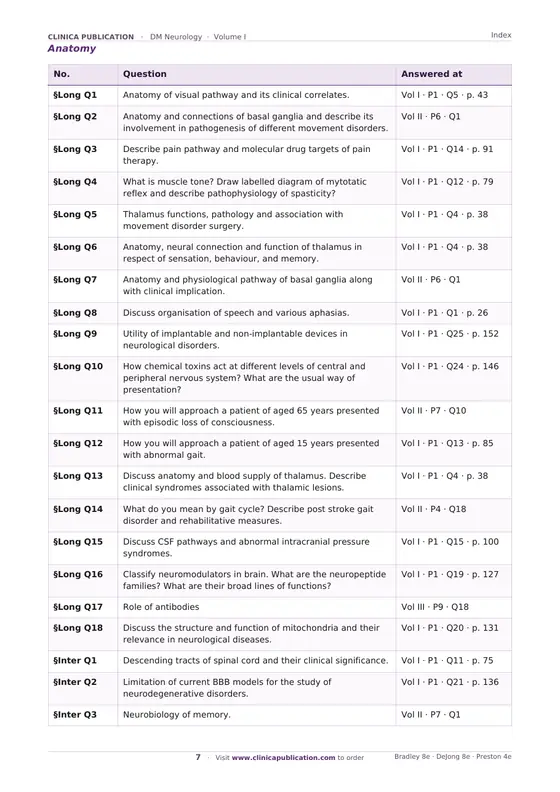
  • The opening pages and the full index of all 436 questions, each mapped to its volume, part and answer
  • Volume I answers: aphasia, the frontal lobe, the corpus callosum, functional imaging and arterial spin labelling
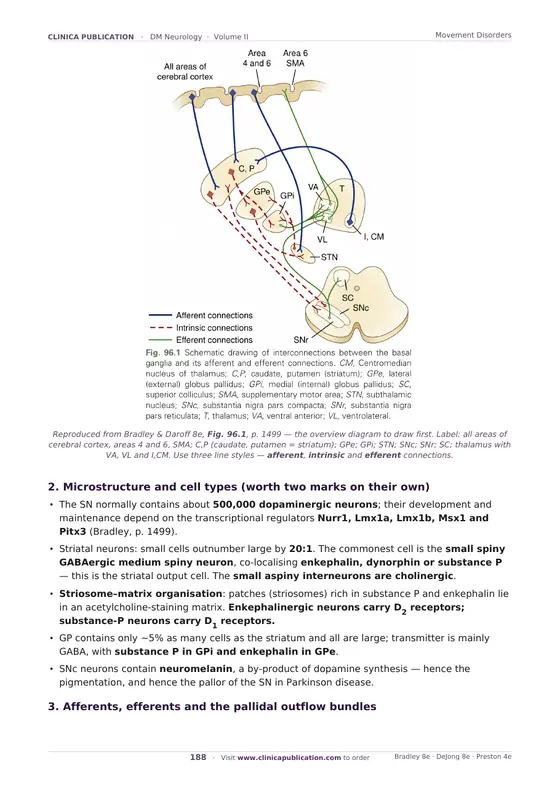
  • Volume II answers: basal ganglia, substantia nigra and dopaminergic pathways
  • Volume III answers: multiple sclerosis criteria and management, neuropathy and GBS, and AIDP electrophysiology
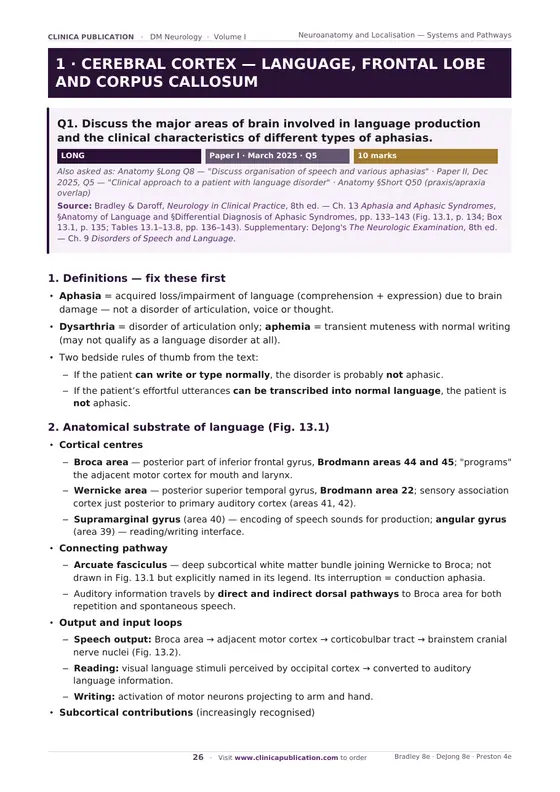
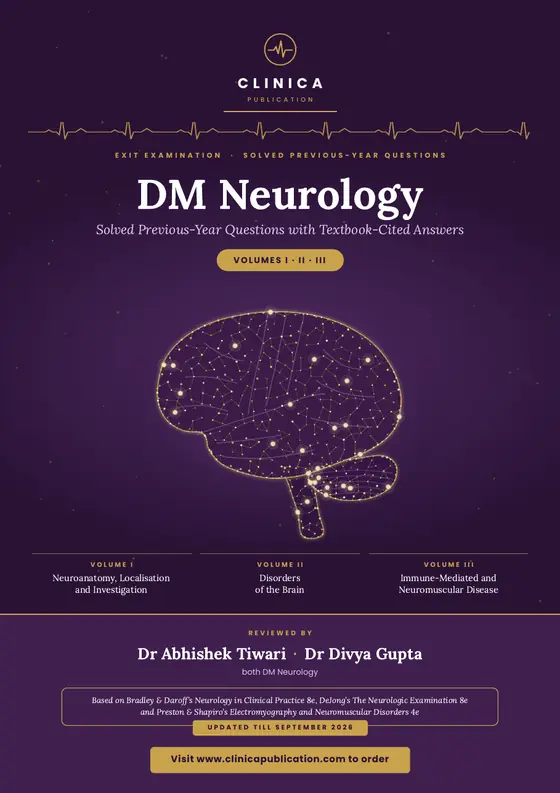
DM Neurology free sample, page 1DM Neurology free sample, page 9DM Neurology free sample, page 29DM Neurology free sample, page 57

Solved answers in the free sample

  1. Major areas of the brain in language production; types of aphasiaVolume I · Part 1 · Neuroanatomy and Localisation — Systems and Pathways
  2. The frontal lobe and its connectionsVolume I · Part 1 · Neuroanatomy and Localisation — Systems and Pathways
  3. Corpus callosum and the clinical features of callosal lesionsVolume I · Part 1 · Neuroanatomy and Localisation — Systems and Pathways
  4. Role of functional imaging in neurological disordersVolume I · Part 3 · Neuroimaging and Clinical Neurophysiology
  5. Arterial spin labelling MRI: applications in neurologyVolume I · Part 3 · Neuroimaging and Clinical Neurophysiology
  6. Basal ganglia — anatomy, connections and movement disordersVolume II · Part 6 · Movement Disorders
  7. Substantia nigraVolume II · Part 6 · Movement Disorders
  8. Dopaminergic pathways in the CNSVolume II · Part 6 · Movement Disorders
  9. Diagnostic criteria of multiple sclerosis and the role of MRIVolume III · Part 9 · Demyelinating, Autoimmune and Cerebellar Disorders
  10. Management of multiple sclerosis — a critical evaluationVolume III · Part 9 · Demyelinating, Autoimmune and Cerebellar Disorders
  11. Causes of neuropathy; GBS in India versus the rest of the worldVolume III · Part 10 · Peripheral Nerve, NMJ, Muscle and Anterior Horn Cell
  12. Electrophysiological evaluation of AIDPVolume III · Part 10 · Peripheral Nerve, NMJ, Muscle and Anterior Horn Cell

Frequently asked questions

How many DM Neurology previous-year questions are there?

This page lists all 436 questions in our DM Neurology bank: 356 from the topic-wise compilation and 80 from the eight DM Neurology papers of 2025 (March and December, Papers I to IV). Repeated and near-identical questions share one answer, so the book answers them in 286 answers.

Which DM Neurology topics are asked most often?

NMDAR encephalitis (7 questions); Thalamus (5 questions); Papez circuit (5 questions); Neurogenic bladder (5 questions); Brain death (5 questions).

Where can I find solved answers to these DM Neurology questions?

Every question here is answered in our printed DM Neurology solved previous-year questions, three volumes written from Bradley & Daroff's Neurology in Clinical Practice 8e, DeJong's The Neurologic Examination 8e and Preston & Shapiro's Electromyography and Neuromuscular Disorders 4e.

Is there a free sample of the answers?

Yes. The free 100-page sample has the full 436-question index and 12 complete answers: read the free sample (PDF).

What were the DM Neurology 2025 papers?

DM Neurology had four theory papers in each 2025 session: Paper I Basic Sciences (Neuroanatomy and Physiology), Paper II Clinical Neurology and Methodology, Paper III Diagnostic and Investigative Neurology, and Paper IV Recent Advances in Neurology. All 80 questions from March and December 2025 are listed above.
Get every answer in print

DM Neurology: 436 questions in 286 answers, printed, bound and delivered anywhere in India.

See the book